Water Purification Machines

Where Can I Buy an Undersink Purifier (Domestic Reverse Osmosis Machine) in Kenya?

Where Can I Buy an Undersink Purifier (Domestic Reverse Osmosis Machine) in Kenya? If you are tired of boiling water, buying bottled water or tasting salt and chlorine in your tap water, an undersink reverse osmosis (RO) purifier may be the fix. The next question is the practical one: where can you buy an undersink water purifier in Kenya, and how do you avoid paying for the wrong one? This guide answers both. You will see the main places to buy a domestic reverse osmosis machine in Kenya, what units typically cost, what to check before you pay, and the mistakes that leave people with a machine that doesn't suit their water. Quick Answer: Where to Buy You can buy an undersink RO purifier in Kenya from: Water treatment specialists that design, supply, install and service systems (best for borehole water and after-sales support) Large water and pump equipment suppliers with showrooms Online marketplaces such as Jumia and Jiji Hardware and plumbing shops Direct fabricators and assemblers who can build to your water analysis Importing directly (usually not recommended) The right choice depends on your water source, your budget, and how much installation and after-sales support you need. What Is an Undersink Purifier (Domestic RO Machine)? An undersink purifier is a compact reverse osmosis system that fits in the cabinet under your kitchen sink and delivers purified drinking water through a dedicated tap. Water passes through several stages, typically: Sediment filter (removes dust, rust and larger particles) Activated carbon filter (removes chlorine, odour and bad taste) Carbon block filter (further taste and odour reduction) RO membrane (removes most dissolved salts, hardness, fluoride, nitrates and heavy metals) Post carbon filter (final polish) Many systems add a storage tank, a booster pump for low-pressure homes, UV disinfection for bacteria, and a remineralisation stage that adds back some minerals for taste. Check the label: some "five-stage" filters sold online are not reverse osmosis at all. A true RO system has an RO membrane, usually rated in GPD (gallons per day). Do You Actually Need One? An undersink RO machine is worth considering if your water has: Salty or brackish taste, common with coastal and some borehole supplies High hardness, shown by scale on kettles and taps Fluoride or nitrate above guideline levels A strong chlorine taste or smell A tank or borehole you don't fully trust It is not a substitute for testing. Get your water tested first, because the right system depends on what is in the water. Water with high iron, high hardness or bacteria also needs the right pre-treatment, or the RO membrane will clog and fail early. See our guide to the best water treatment methods for how problems map to treatment. Where to Buy: 6 Options Compared 1. Water Treatment Specialists Companies that design, fabricate, supply, install and service water treatment systems. Pros: they can recommend a system based on your water analysis, install it correctly, and support you with filters and servicing Cons: the price may be higher than the cheapest marketplace listing Best for: borehole water, hard or salty water, and anyone who wants installation and ongoing support 2. Large Water and Pump Equipment Suppliers Established suppliers with showrooms and branded RO ranges. Pros: recognised brands, showroom visits and spare parts Cons: the standard range may not suit unusual borehole water Best for: municipal water and standard home use 3. Online Marketplaces (Jumia, Jiji and similar) Sellers list undersink RO systems with delivery across Kenya. Pros: wide choice, price comparison and fast delivery in towns Cons: product quality and claims vary, warranty and spare parts can be unclear, and some listings are not true RO Best for: buyers who know exactly what they need and can verify the seller 4. Hardware and Plumbing Shops Some stock basic five-stage RO systems. Pros: you can see the unit and take it home the same day Cons: limited advice, installation may not be included, and replacement filters may be hard to find Best for: simple municipal-water installs where you can arrange a plumber 5. Direct Fabricators and Assemblers Firms that build systems to suit your water analysis. Pros: the system is designed around your water, with sensible pre-treatment Cons: it may take longer and needs a lab report Best for: borehole water with hardness, fluoride, iron or salinity problems 6. Importing Directly Ordering from overseas suppliers. Pros: the headline price can look low Cons: shipping, duty, spare parts, membrane compatibility and the lack of local support make it risky Best for: very few buyers; usually not recommended for home use Typical Prices in Kenya Advertised prices for undersink RO purifiers on marketplaces currently run from roughly KSh 22,500 to KSh 49,000. Examples seen include a five-stage undersink RO system at around KSh 42,000, a domestic RO purifier at about KSh 45,500, a borehole and defluoridation-rated unit at about KSh 49,000, and a basic five-stage RO set at around KSh 22,500 from a hardware shop. What you are buying Advertised range (KSh) Basic five-stage undersink RO About 22,500 – 30,000 Standard five-stage undersink RO with tank and tap About 40,000 – 46,000 Borehole-ready or defluoridation-rated unit About 45,000 – 50,000 and above These are examples of advertised prices and change often. Larger domestic RO machines rated in litres per hour, and systems designed for borehole water, are quoted individually. What drives the price RO membrane capacity and brand Number of stages and pre-filtration Booster pump and storage tank UV disinfection and remineralisation Installation, warranty and after-sales support Don't forget running costs Pre-filters usually need replacing every 6 to 18 months, and the RO membrane and post carbon every 2 to 4 years, depending on your water quality. Ask for the price of replacement cartridges before you buy. 10 Things to Check Before You Pay Your water test. Know your TDS, hardness, fluoride, iron and bacteria levels. A real RO membrane. Confirm the membrane's GPD rating, for example 50, 75 or 100 GPD. Pre-treatment. Borehole water often needs extra sediment, softening or iron removal before RO. Water pressure. Most systems need decent mains pressure, so low-pressure homes need a booster pump. Storage tank size. Check that the tank suits your household's drinking and cooking use. Disinfection. If your source has bacteria, choose a system with UV. Installation. Is it included? Who does it, and is a drain connection part of the price? Warranty and spare parts. Can you get replacement filters and membranes in Kenya, and for how long? Honest claims. Be wary of exaggerated claims, such as removing "everything," with no data. Support and reviews. Check feedback, the seller's address and how to reach them after the sale. Sizing: GPD vs Litres per Hour Undersink systems are usually rated in gallons per day (GPD). As a rough guide: Rating Approx. litres per day 50 GPD About 190 L 75 GPD About 285 L 100 GPD About 380 L Larger domestic RO machines, used for whole-home drinking water, small offices or small shops, are rated in litres per hour (LPH). Choose by daily drinking and cooking use, not by the biggest number on the box. Installation Requirements A cold water supply line and a drain connection under the sink Enough space under the sink for the filters and tank Adequate mains pressure, or a booster pump A power point nearby if the system has a booster pump or UV lamp A hole for the dedicated drinking tap on the sink or counter RO vs UF vs a Basic Filter Reverse osmosis Ultrafiltration (UF) Basic carbon filter Removes dissolved salts, fluoride, nitrates Yes No No Removes bacteria and particles Yes Yes Partly Keeps minerals in the water Reduced (remineralisation optional) Yes Yes Best for Salty, hard or contaminated borehole water Microbially unsafe water with acceptable chemistry Improving taste and odour Red Flags When Buying A price far below the rest with no brand, spec or warranty No stated membrane rating or no mention of an RO membrane Asking for payment in advance with no way to inspect the unit No information on replacement filters Claims that it removes everything, with no mention of your water's test results Buy Your Domestic RO Machine From Trivon Trading Trivon Trading designs, fabricates, supplies, installs and services water treatment equipment across Kenya, including domestic systems for homes, offices and small businesses: Domestic reverse osmosis (RO) systems of 250 LPH and below, with sediment filtration, activated carbon, an RO membrane and UV disinfection, for removing heavy metals, fluoride, nitrates and dissolved solids Domestic ultrafiltration (UF) systems of 250 LPH and below, for chemical-free purification that retains essential minerals 3-in-1 water purifiers combining sediment filtration, carbon filtration and RO or UF, in a compact design Larger RO systems and water vending machines if your needs grow Send us your water test, or tell us whether your water comes from a borehole or the mains, and we will recommend the right system and arrange delivery and installation. Our workshop is in Ruiru, along Thika Superhighway, and we deliver nationwide. Trivon Trading Company Limited šŸ“ž Call/WhatsApp: 0790145145 | 0713644544 šŸ“§ info@trivontrading.co.ke | trivontrading@gmail.com 🌐 www.trivontrading.co.ke Trivon Trading Co. Ltd – Delivering Reliable Water & Dairy Solutions You Can Trust Frequently Asked Questions Where can I buy an undersink water purifier in Kenya? From water treatment specialists, water equipment suppliers, online marketplaces such as Jumia and Jiji, hardware shops and fabricators. For borehole water, a specialist who can design around your water test is the safest choice. How much does an undersink RO purifier cost in Kenya? Advertised prices on marketplaces range from roughly KSh 22,500 to KSh 49,000 for common five-stage units. Systems built for borehole water, and larger domestic RO machines, are quoted individually. Is a domestic reverse osmosis machine good for borehole water? Yes, if it is designed for your water. Borehole water often needs extra pre-treatment for hardness, iron or sediment so the RO membrane lasts. Test your water first. Do I need a booster pump? If your mains or tank pressure is low, yes. Most RO systems need reasonable water pressure to work properly. Does RO remove fluoride and salt? Reverse osmosis removes most dissolved salts, and it is one of the main methods used to reduce fluoride, nitrates and hardness. The exact results depend on the system and your water. How often do I change the filters? Pre-filters are typically replaced every 6 to 18 months, and the RO membrane and post carbon every 2 to 4 years, depending on your water quality and usage. Can I install it myself? Some people do, but proper installation, with a safe drain connection and leak-free fittings, matters. A supplier who installs it for you also makes warranty claims easier. What is the difference between a 50 GPD and a 100 GPD system? It is the capacity of the RO membrane, about 190 litres per day for 50 GPD and about 380 litres per day for 100 GPD. Choose based on your household's drinking and cooking needs. Is RO water healthy? RO water is very pure. Some people prefer a remineralisation stage to restore taste and some minerals, which many systems offer.

If you are tired of boiling water, buying bottled water or tasting salt and chlorine in your tap water, an undersink reverse osmosis (RO) purifier may be the fix. The next question is the practical one: where can you buy an undersink water purifier in Kenya, and how do you avoid paying for the wrong one?

This guide answers both. You will see the main places to buy a domestic reverse osmosis machine in Kenya, what units typically cost, what to check before you pay, and the mistakes that leave people with a machine that doesn’t suit their water.


Quick Answer: Where to Buy

You can buy an undersink RO purifier in Kenya from:

  1. Water treatment specialists that design, supply, install, and service systems (best for borehole water and after-sales support)
  2. Large water and pump equipment suppliers with showrooms
  3. Online marketplaces such as Jumia and Jiji
  4. Hardware and plumbing shops
  5. Direct fabricators and assemblers who can build to your water analysis
  6. Importing directly (usually not recommended)

The right choice depends on your water source, your budget, and how much installation and after-sales support you need.


What Is an Undersink Purifier (Domestic RO Machine)?

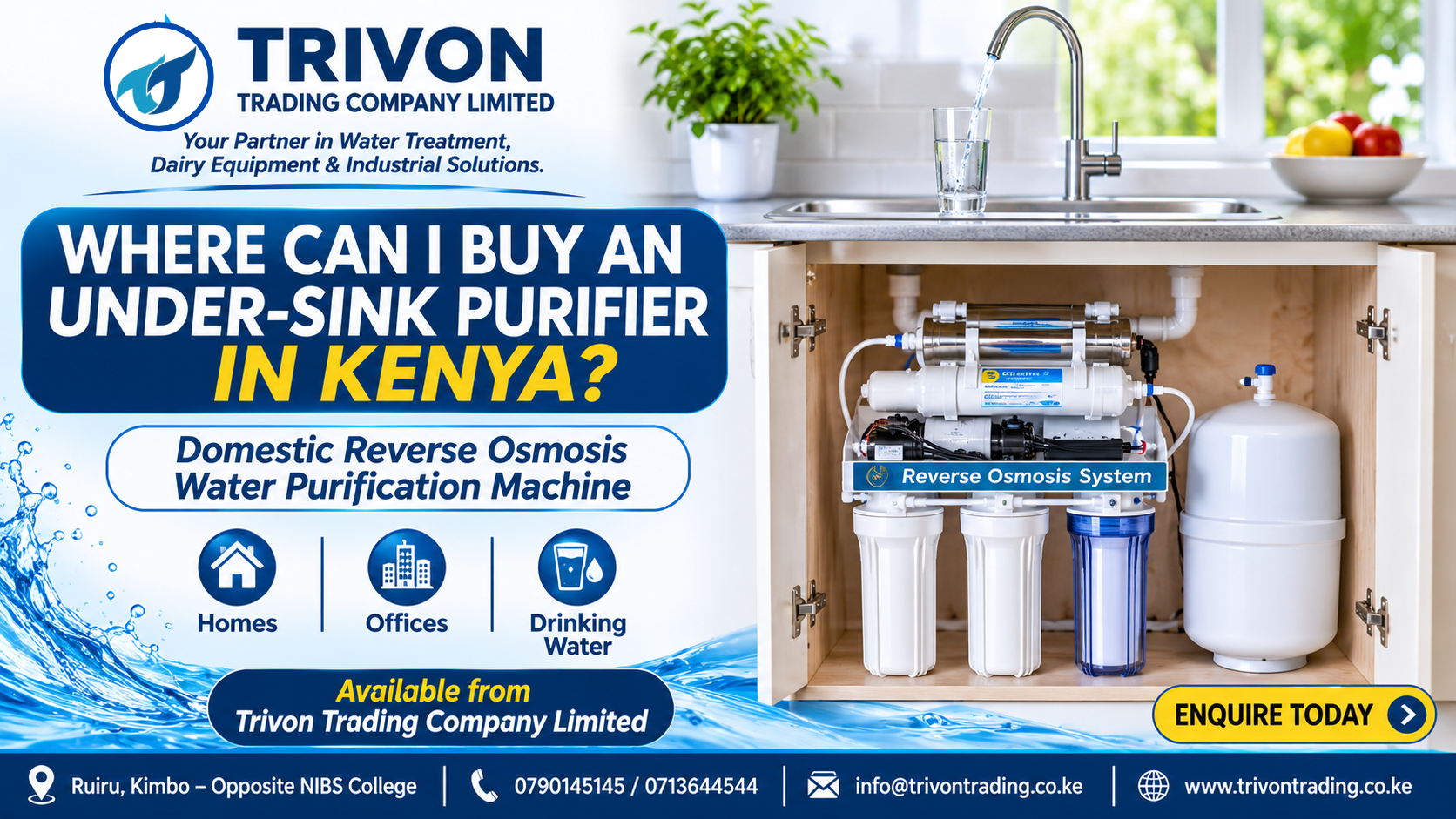
An undersink purifier is a compact reverse osmosis system that fits in the cabinet under your kitchen sink and delivers purified drinking water through a dedicated tap. Water passes through several stages, typically:

  1. Sediment filter (removes dust, rust and larger particles)
  2. Activated carbon filter (removes chlorine, odour and bad taste)
  3. Carbon block filter (further taste and odour reduction)
  4. RO membrane (removes most dissolved salts, hardness, fluoride, nitrates and heavy metals)
  5. Post carbon filter (final polish)

Many systems add a storage tank, a booster pump for low-pressure homes, UV disinfection for bacteria, and a remineralisation stage that adds back some minerals for taste.

Check the label: some ā€œfive-stageā€ filters sold online are not reverse osmosis at all. A true RO system has an RO membrane, usually rated in GPD (gallons per day).


Do You Actually Need One?

An undersink RO machine is worth considering if your water has:

  • Salty or brackish taste, common with coastal and some borehole supplies
  • High hardness, shown by scale on kettles and taps
  • Fluoride or nitrate above guideline levels
  • A strong chlorine taste or smell
  • A tank or borehole you don’t fully trust

It is not a substitute for testing. Get your water tested first, because the right system depends on what is in the water. Water with high iron, high hardness or bacteria also needs the right pre-treatment, or the RO membrane will clog and fail early. See our guide to the best water treatment methods for how problems map to treatment.


Where to Buy: 6 Options Compared

1. Water Treatment Specialists

Companies that design, fabricate, supply, install and service water treatment systems.

  • Pros: they can recommend a system based on your water analysis, install it correctly, and support you with filters and servicing
  • Cons: the price may be higher than the cheapest marketplace listing
  • Best for: borehole water, hard or salty water, and anyone who wants installation and ongoing support

2. Large Water and Pump Equipment Suppliers

Established suppliers with showrooms and branded RO ranges.

  • Pros: recognised brands, showroom visits and spare parts
  • Cons: the standard range may not suit unusual borehole water
  • Best for: municipal water and standard home use

3. Online Marketplaces (Jumia, Jiji and similar)

Sellers list undersink RO systems with delivery across Kenya.

  • Pros: wide choice, price comparison and fast delivery in towns
  • Cons: product quality and claims vary, warranty and spare parts can be unclear, and some listings are not true RO
  • Best for: buyers who know exactly what they need and can verify the seller

4. Hardware and Plumbing Shops

Some stock basic five-stage RO systems.

  • Pros: you can see the unit and take it home the same day
  • Cons: limited advice, installation may not be included, and replacement filters may be hard to find
  • Best for: simple municipal-water installs where you can arrange a plumber

5. Direct Fabricators and Assemblers

Firms that build systems to suit your water analysis.

  • Pros: the system is designed around your water, with sensible pre-treatment
  • Cons: it may take longer and needs a lab report
  • Best for: borehole water with hardness, fluoride, iron or salinity problems

6. Importing Directly

Ordering from overseas suppliers.

  • Pros: the headline price can look low
  • Cons: shipping, duty, spare parts, membrane compatibility and the lack of local support make it risky
  • Best for: very few buyers; usually not recommended for home use

Typical Prices in Kenya

Advertised prices for undersink RO purifiers on marketplaces currently run from roughly KSh 22,500 to KSh 49,000. Examples seen include a five-stage undersink RO system at around KSh 42,000, a domestic RO purifier at about KSh 45,500, a borehole and defluoridation-rated unit at about KSh 49,000, and a basic five-stage RO set at around KSh 22,500 from a hardware shop.

What you are buying Advertised range (KSh)
Basic five-stage undersink RO About 22,500 – 30,000
Standard five-stage undersink RO with tank and tap About 40,000 – 46,000
Borehole-ready or defluoridation-rated unit About 45,000 – 50,000 and above

These are examples of advertised prices and change often. Larger domestic RO machines rated in litres per hour, and systems designed for borehole water, are quoted individually.

What drives the price

  • RO membrane capacity and brand
  • Number of stages and pre-filtration
  • Booster pump and storage tank
  • UV disinfection and remineralisation
  • Installation, warranty and after-sales support

Don’t forget running costs

Pre-filters usually need replacing every 6 to 18 months, and the RO membrane and post carbon every 2 to 4 years, depending on your water quality. Ask for the price of replacement cartridges before you buy.


10 Things to Check Before You Pay

  1. Your water test. Know your TDS, hardness, fluoride, iron and bacteria levels.
  2. A real RO membrane. Confirm the membrane’s GPD rating, for example 50, 75 or 100 GPD.
  3. Pre-treatment. Borehole water often needs extra sediment, softening or iron removal before RO.
  4. Water pressure. Most systems need decent mains pressure, so low-pressure homes need a booster pump.
  5. Storage tank size. Check that the tank suits your household’s drinking and cooking use.
  6. Disinfection. If your source has bacteria, choose a system with UV.
  7. Installation. Is it included? Who does it, and is a drain connection part of the price?
  8. Warranty and spare parts. Can you get replacement filters and membranes in Kenya, and for how long?
  9. Honest claims. Be wary of exaggerated claims, such as removing ā€œeverything,ā€ with no data.
  10. Support and reviews. Check feedback, the seller’s address and how to reach them after the sale.

Sizing: GPD vs Litres per Hour

Undersink systems are usually rated in gallons per day (GPD). As a rough guide:

Rating Approx. litres per day
50 GPD About 190 L
75 GPD About 285 L
100 GPD About 380 L

Larger domestic RO machines, used for whole-home drinking water, small offices or small shops, are rated in litres per hour (LPH). Choose by daily drinking and cooking use, not by the biggest number on the box.


Installation Requirements

  • A cold water supply line and a drain connection under the sink
  • Enough space under the sink for the filters and tank
  • Adequate mains pressure, or a booster pump
  • A power point nearby if the system has a booster pump or UV lamp
  • A hole for the dedicated drinking tap on the sink or counter

RO vs UF vs a Basic Filter

Reverse osmosis Ultrafiltration (UF) Basic carbon filter
Removes dissolved salts, fluoride, nitrates Yes No No
Removes bacteria and particles Yes Yes Partly
Keeps minerals in the water Reduced (remineralisation optional) Yes Yes
Best for Salty, hard or contaminated borehole water Microbially unsafe water with acceptable chemistry Improving taste and odour

Red Flags When Buying

  • A price far below the rest with no brand, spec or warranty
  • No stated membrane rating or no mention of an RO membrane
  • Asking for payment in advance with no way to inspect the unit
  • No information on replacement filters
  • Claims that it removes everything, with no mention of your water’s test results

Buy Your Domestic RO Machine From Trivon Trading

Trivon Trading designs, fabricates, supplies, installs and services water treatment equipment across Kenya, including domestic systems for homes, offices and small businesses:

  • Domestic reverse osmosis (RO) systems of 250 LPH and below, with sediment filtration, activated carbon, an RO membrane and UV disinfection, for removing heavy metals, fluoride, nitrates and dissolved solids
  • Domestic ultrafiltration (UF) systems of 250 LPH and below, for chemical-free purification that retains essential minerals
  • 3-in-1 water purifiers combining sediment filtration, carbon filtration and RO or UF, in a compact design
  • Larger RO systems and water vending machines if your needs grow

Send us your water test, or tell us whether your water comes from a borehole or the mains, and we will recommend the right system and arrange delivery and installation. Our workshop is in Ruiru, along Thika Superhighway, and we deliver nationwide.

Trivon Trading Company Limited šŸ“ž Call/WhatsApp: 0790145145 | 0713644544 šŸ“§ info@trivontrading.co.ke | trivontrading@gmail.com 🌐 www.trivontrading.co.ke

Trivon Trading Co. Ltd – Delivering Reliable Water & Dairy Solutions You Can Trust


Frequently Asked Questions

Where can I buy an undersink water purifier in Kenya?

From water treatment specialists, water equipment suppliers, online marketplaces such as Jumia and Jiji, hardware shops and fabricators. For borehole water, a specialist who can design around your water test is the safest choice.

How much does an undersink RO purifier cost in Kenya?

Advertised prices on marketplaces range from roughly KSh 22,500 to KSh 49,000 for common five-stage units. Systems built for borehole water, and larger domestic RO machines, are quoted individually.

Is a domestic reverse osmosis machine good for borehole water?

Yes, if it is designed for your water. Borehole water often needs extra pre-treatment for hardness, iron or sediment so the RO membrane lasts. Test your water first.

Do I need a booster pump?

If your mains or tank pressure is low, yes. Most RO systems need reasonable water pressure to work properly.

Does RO remove fluoride and salt?

Reverse osmosis removes most dissolved salts, and it is one of the main methods used to reduce fluoride, nitrates and hardness. The exact results depend on the system and your water.

How often do I change the filters?

Pre-filters are typically replaced every 6 to 18 months, and the RO membrane and post carbon every 2 to 4 years, depending on your water quality and usage.

Can I install it myself?

Some people do, but proper installation, with a safe drain connection and leak-free fittings, matters. A supplier who installs it for you also makes warranty claims easier.

What is the difference between a 50 GPD and a 100 GPD system?

It is the capacity of the RO membrane, about 190 litres per day for 50 GPD and about 380 litres per day for 100 GPD. Choose based on your household’s drinking and cooking needs.

Is RO water healthy?

RO water is very pure. Some people prefer a remineralisation stage to restore taste and some minerals, which many systems offer.