Dairy Business, Milk Cooling Tanks, Milk Pasteurizer, Milk Vending Machines

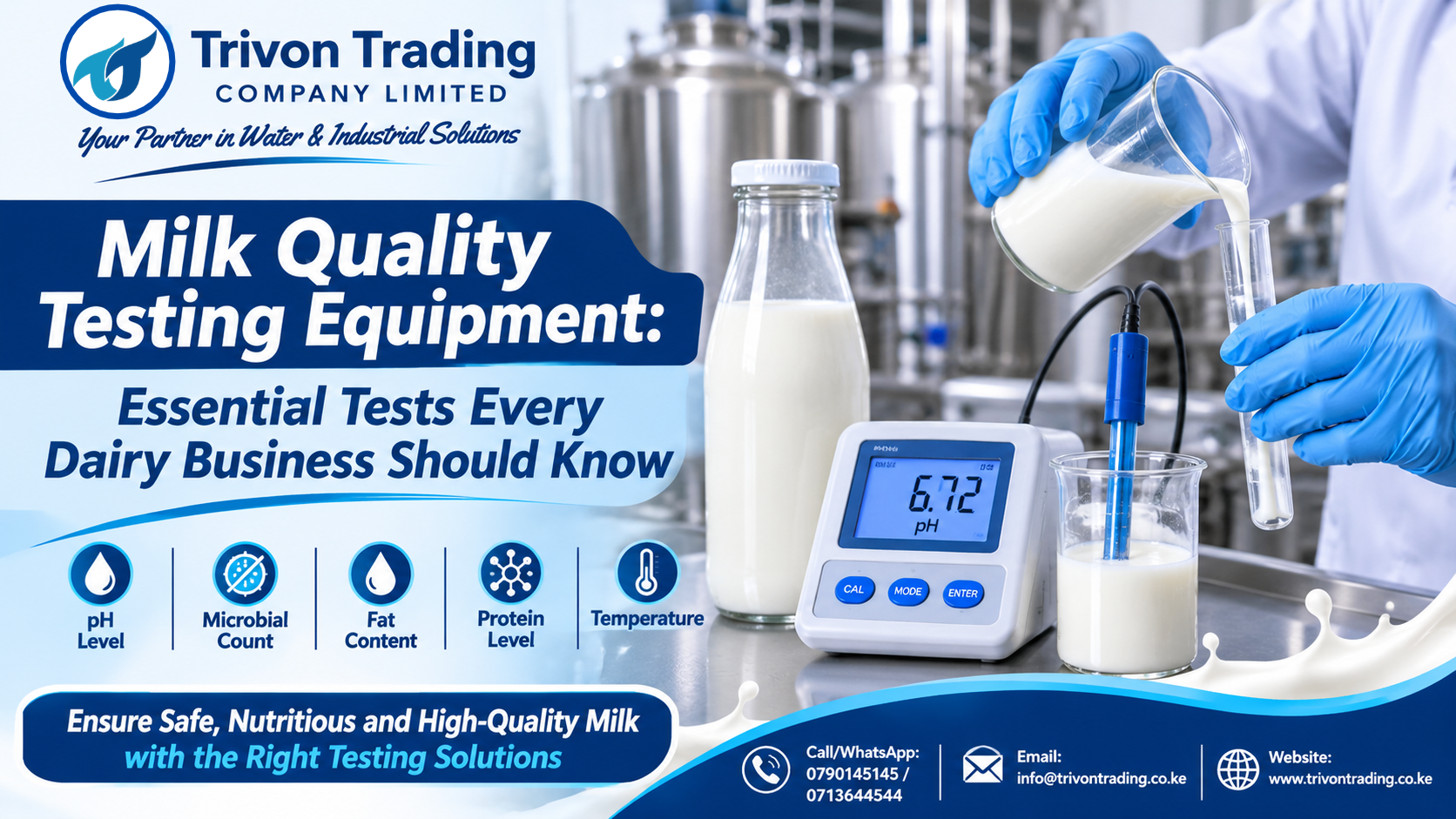
Milk Quality Testing Equipment: Essential Tests Every Dairy Business Should Know

# Milk Quality Testing Equipment: Essential Tests Every Dairy Business Should Know Every litre of milk that passes through your business carries your reputation with it. A farmer's payment, a processor's yield, a customer's health and a regulator's approval all depend on one thing: whether the milk is good. The only way to know is to test it. This guide explains the milk quality testing equipment and the essential tests every dairy business should know, whether you run a farm, a milk collection centre, a packed milk business, a yoghurt kitchen or a Milk ATM. For each test you will see what it detects, what equipment you need, and how it fits into a simple testing routine. --- ## Why Milk Quality Testing Matters - **Fair payment.** Fat, solids and quality decide what milk is worth, so honest testing protects farmers and buyers alike. - **Safe milk.** Testing catches spoilage, adulteration, antibiotic residues and ineffective pasteurisation before milk reaches customers. - **Better processing.** Milk that is too acidic or contaminated can curdle in the pasteurizer, spoil yoghurt batches and shorten shelf life. - **Fewer rejections and losses.** Catching poor milk at the gate stops it from ruining a whole tank. - **Compliance and trust.** Regulators and buyers expect records that show you test and act on the results. --- ## Milk Quality Testing Equipment at a Glance | Test | What it tells you | Equipment needed | Typical use | |---|---|---|---| | Sampling and sensory check | Appearance, smell, visible dirt | Stainless sampling dipper, clean sample bottles | Everyone | | Temperature | Whether milk has been kept cool | Digital probe thermometer | Everyone | | Alcohol test | Developed acidity and heat stability | Test tubes, ethanol, dropper or measure | Farms, collection centres | | Clot-on-boiling (COB) | Acidity and suitability for heating | Test tubes, heat source or water bath | Farms, collection centres | | Density (lactometer) | Possible added water | Lactometer, measuring cylinder, thermometer | Collection centres, processors | | Titratable acidity and pH | How sour the milk is | Burette or pipette, NaOH, indicator, pH meter | Collection centres, processors | | Fat (Gerber) | Fat content, which affects price | Butyrometers, centrifuge, reagents | Collection centres, processors | | Solids-not-fat and composition | Fat, SNF, protein, added water | Milk analyzer | Collection centres, processors | | Freezing point | Added water | Cryoscope | Processors, laboratories | | Adulterant tests | Starch, neutralisers, peroxide, formalin and more | Test kits and reagents | Collection centres, processors | | Antibiotic residue test | Drug residues | Rapid test kits, incubator or reader if required | Processors, collection centres | | Mastitis test (CMT) | Udder infection | CMT paddle and reagent | Farms | | Microbiological tests | Bacterial load, coliforms | Laboratory, incubator, culture media | Processors, accredited labs | | Phosphatase test | Whether pasteurisation worked | Test kit | Pasteurizing businesses | --- ## Platform Tests: Quick Checks at the Milk Reception Platform tests are fast checks done on the spot, where milk is received. They are the first line of defence and need little equipment. ### 1. Sampling and Sensory Check **What it detects:** visible dirt, abnormal colour, unusual smell, clots. **Equipment:** a clean stainless steel dipper or sampler, and clean sample bottles. **How it works:** mix the milk well, take a sample and check its appearance and smell. Never taste raw milk of unknown quality. > **Sampling tip:** a result is only as good as the sample. Milk that is not mixed can give misleading fat and acidity results. This is one reason cooling tanks have an agitator. ### 2. Temperature **What it detects:** milk that has been left warm, where bacteria multiply quickly. **Equipment:** a digital probe thermometer, calibrated regularly. **Why it matters:** milk should be cooled promptly and held cold, around 4°C, until collection or processing. ### 3. Alcohol Test **What it detects:** milk with developed acidity or poor heat stability. **Equipment:** test tubes, ethanol of the strength specified in the standard, and a measure. **How it works:** mix equal volumes of milk and alcohol. Flakes or clots show a positive result, meaning the milk should not be accepted for heat processing. **Kenyan standard:** the result must be negative. ### 4. Clot-on-Boiling (COB) Test **What it detects:** acidity high enough that the milk will curdle when heated. **Equipment:** test tubes and a heat source or water bath. **How it works:** heat a small sample to boiling. Milk that clots is positive. **Kenyan standard:** the result must be negative. ### 5. Density (Lactometer) **What it detects:** possible added water, since water lowers milk's density. **Equipment:** a lactometer, a measuring cylinder and a thermometer, because readings must be corrected for temperature. **Kenyan standard:** about 1.028 to 1.034 g/mL at 20°C, according to recent editions of the standard. ### 6. Titratable Acidity and pH **What it detects:** how much lactic acid has developed, meaning how sour the milk is. **Equipment:** titration kit (burette or pipette, sodium hydroxide solution and indicator) or a calibrated pH meter. **Kenyan standard:** titratable acidity should be no more than 0.17% lactic acid, and pH should be about 6.6 to 6.8. --- ## Composition Tests: What the Milk Contains ### 7. Fat Test (Gerber Method) **What it detects:** milk fat percentage, which usually affects price and yield. **Equipment:** Gerber butyrometers, a Gerber centrifuge, pipettes and the required reagents. **Kenyan standard:** milk fat of at least 3.25%. **Safety:** the method uses strong acid, so only trained staff should do it, with protective equipment. ### 8. Solids-Not-Fat (SNF) and the Milk Analyzer **What it detects:** the non-fat solids (protein, lactose and minerals) and, with an analyzer, fat, protein, density and added water in one test. **Equipment:** a milk analyzer, or a lactometer and calculation. **Kenyan standard:** SNF of at least 8.5%. **Why consider an analyzer:** it gives fast, repeatable results for busy collection centres that test many suppliers each day. ### 9. Freezing Point **What it detects:** added water, which raises the freezing point of milk. **Equipment:** a cryoscope. **Kenyan standard:** about −0.550 to −0.525°C. **Best for:** processors and laboratories that need a precise added-water check. --- ## Adulteration and Safety Tests ### 10. Adulterant Tests **What they detect:** substances added to disguise poor milk or extend shelf life, such as starch, neutralisers like soda, hydrogen peroxide and formalin. **Equipment:** test kits and reagents for each adulterant. **Why it matters:** these substances are unsafe, and they are also signs that milk has been mishandled. ### 11. Antibiotic Residue Test **What it detects:** drug residues from treated cows, which are a health risk and interfere with yoghurt and cheese cultures. **Equipment:** rapid test kits, and an incubator or reader where the kit requires one. **Who needs it:** processors and collection centres, especially those making yoghurt or other fermented products. ### 12. Mastitis Test (CMT) **What it detects:** udder infection, shown by a high cell count in the milk. **Equipment:** a California Mastitis Test paddle and reagent. **Best for:** farms, where it can be done at milking to protect both the cow and the milk. --- ## Microbiological and Pasteurisation Tests ### 13. Microbiological Tests **What they detect:** total bacterial count, coliforms and other organisms that indicate hygiene and safety. **Equipment:** an accredited laboratory, or an in-house lab with an incubator and culture media. Simpler platform methods such as the resazurin test give a quick indication of bacterial quality. **Best for:** processors and any business that needs formal quality records. ### 14. Phosphatase Test (Checking Pasteurisation) **What it detects:** whether pasteurisation was effective. Properly pasteurised milk should test negative. **Equipment:** a phosphatase test kit. **Best for:** anyone who pasteurizes milk, including packed milk, yoghurt and Milk ATM suppliers. --- ## Kenyan Raw Milk Limits at a Glance The East African Standard for raw cow milk (EAS 67), used in Kenya, sets these key limits. | Parameter | Requirement | |---|---| | Milk fat | At least 3.25% | | Milk solids-not-fat | At least 8.5% | | Freezing point | −0.550 to −0.525°C | | Alcohol test | Negative | | Clot-on-boiling test | Negative | | pH | 6.6 to 6.8 | | Density at 20°C | About 1.028 to 1.034 g/mL | | Titratable acidity | Not more than 0.17% (as lactic acid) | *Always confirm the current edition and any additional requirements with KEBS and the Kenya Dairy Board.* --- ## What Testing Equipment Does Your Business Need? | Business | Core testing equipment | |---|---| | **Dairy farm** | Thermometer, alcohol test, COB test, CMT paddle, lactometer | | **Milk collection centre** | Thermometer, alcohol and COB tests, lactometer, acidity test or pH meter, Gerber kit or milk analyzer, adulterant tests, antibiotic test kits | | **Packed milk processor** | All of the above, plus freezing point or analyzer, phosphatase test, microbiological testing through a laboratory | | **Milk ATM operator** | Thermometer, alcohol and COB tests on incoming milk, phosphatase test or proof of pasteurisation from your supplier | | **Yoghurt maker** | Acidity or pH meter, antibiotic test kits, thermometer, microbiological testing through a laboratory | --- ## How to Set Up a Basic Milk Testing Station 1. **Pick a clean, well-lit bench** away from the milk-handling area, with a washable surface. 2. **Provide clean water and drainage** for washing glassware and equipment. 3. **Stock the essential equipment:** thermometer, test tubes, sampling dipper, lactometer and cylinder, plus the reagents for your core tests. 4. **Store reagents safely**, labelled and away from food, and train staff in safe handling. 5. **Calibrate and check equipment** regularly, including thermometers, pH meters and analyzers. 6. **Keep records** of every result, with the supplier, date, time and action taken. 7. **Set clear accept and reject rules**, so everyone knows what happens when milk fails a test. 8. **Dispose of waste safely**, particularly acids and used reagents. --- ## Get a Representative Sample Every test depends on the sample. Always: - **Mix the milk thoroughly** before sampling - Use a **clean, dry sampler** each time - Sample **each supplier's milk** separately - Test **promptly**, and keep samples cool until tested A cooling tank with an agitator keeps milk evenly mixed, so a sample taken from it reflects the whole tank. --- ## Common Testing Mistakes - **Unmixed or dirty samples,** which give misleading results - **Uncalibrated equipment,** such as thermometers and pH meters that have drifted - **Expired or poorly stored reagents** - **Testing only some of the milk,** instead of every supplier and every delivery - **No records,** so problems cannot be traced - **Not acting on results,** where failed milk is accepted anyway - **Relying on one test.** Platform tests are quick, but they do not replace laboratory testing for safety and compliance. --- ## Testing Finds Problems. The Right Equipment Prevents Them. Testing tells you when milk is already poor. The equipment you use to cool, handle and process milk decides whether it stays good. Trivon Trading supplies the dairy equipment that protects the quality you test for: - **Milk cooling tanks (chillers)** with an agitator and temperature monitoring, to cool milk quickly and keep it evenly mixed for accurate sampling - **Stainless steel milk cans** (20L to 80L) that are easy to clean and do not hold odours - **Batch pasteurizers** with temperature monitoring, so your pasteurisation can pass the phosphatase test - **Milk ATMs** in food-grade stainless steel, with a self-cleaning tube and password-protected sales records - **Fermentation and mixer tanks** for yoghurt and other value-added products - **Stainless steel tables, sinks and storage tanks** that are easy to sanitise If you are setting up a collection centre, a packed milk business or a yoghurt kitchen, talk to us. We will help you choose equipment that makes quality easier to protect. **Trivon Trading Company Limited** 📞 Call/WhatsApp: 0790145145 | 0713644544 📧 info@trivontrading.co.ke | trivontrading@gmail.com 🌐 www.trivontrading.co.ke *Trivon Trading Co. Ltd – Delivering Reliable Water & Dairy Solutions You Can Trust* --- ## Frequently Asked Questions ### What equipment do I need to test milk quality? At minimum: a thermometer, test tubes, sampling dipper, lactometer and measuring cylinder, plus reagents for the alcohol and clot-on-boiling tests. Collection centres and processors add acidity testing, a Gerber kit or milk analyzer, adulterant tests and antibiotic test kits. ### What are platform tests for milk? Platform tests are quick checks done at milk reception, including the sensory check, temperature, alcohol test, clot-on-boiling test, lactometer reading and acidity or pH. ### What does a positive alcohol test mean? Flakes or clots after mixing milk with alcohol mean the milk has developed acidity or poor heat stability and should not be heat-processed. ### How do I test milk for added water? Use a lactometer to check density, a milk analyzer, or a cryoscope to measure freezing point, which is the most precise method. ### What is the minimum fat content for raw cow milk in Kenya? The East African Standard requires milk fat of at least 3.25%, and solids-not-fat of at least 8.5%. ### How do I know if milk has been pasteurised properly? Pasteurised milk should test negative on the phosphatase test. Pasteurizer temperature and time records support the result. ### Should I buy a milk analyzer? If you test many suppliers every day, an analyzer saves time and gives consistent results for fat, SNF, density and added water. Small farms can usually manage with platform tests and a lactometer. ### Do I still need laboratory testing? Yes. Platform tests are fast screening tools. Microbiological and residue testing, and formal compliance records, need an accredited laboratory. ### How often should I calibrate testing equipment? Follow the manufacturer's instructions, and check thermometers, pH meters and analyzers regularly. Record each calibration. --- ## Yoast SEO Plugin Fields (Copy-Paste Ready) **Focus Keyphrase:** milk quality testing equipment **SEO Title:** Milk Quality Testing Equipment: Essential Tests (Kenya) **Slug:** milk-quality-testing-equipment-essential-tests **Meta Description (about 149 characters):** Milk quality testing equipment explained: the essential tests every dairy business needs, what each one detects, and how to set up a testing station. **Related Keyphrases (Yoast Premium, up to 4):** - milk testing equipment Kenya - platform tests for milk - milk adulteration tests - alcohol test for milk **Keyphrase Synonyms (Yoast Premium):** milk testing kit, milk quality tests, dairy testing equipment **Suggested Image Alt Text:** - "Milk quality testing equipment: lactometer, test tubes and thermometer on a dairy testing bench" - "Platform tests for milk at a Kenyan dairy collection centre" - "Milk analyzer testing fat and solids-not-fat in a milk sample" - "Stainless steel milk cooling tank with agitator for representative milk sampling" **Yoast Schema Settings:** - Page type: Web Page - Article type: Blog Post - Use the **Yoast FAQ block** for the FAQ section above to generate FAQ rich results - Consider marking as **Cornerstone content**, as a pillar page for your dairy quality cluster **Internal Linking Suggestions:** - "milk cooling tanks" → your milk cooling tank product page and your post "Milk Cooling Tank Prices in Kenya" - "stop losing milk to spoilage" → your post "How to Stop Losing Milk to Spoilage: A Dairy Farmer's Guide to Cooling Equipment" - "batch pasteurizers" → your post "Where Can I Buy a Batch Pasteurizer Tank in Kenya" and your pasteurizer product page - "Milk ATMs" and "milk cans" → their product pages - "yoghurt" and "packed milk" → your post "5 Business Ideas to Venture Into in Kenya" (business ideas post) - Link back to this post from those pages using the anchor "milk quality testing equipment" **Category:** Dairy Equipment **Tags:** milk quality testing equipment, milk testing, platform tests, milk adulteration, dairy quality, milk collection centre, pasteurisation, dairy business Kenya **Social / Open Graph (Yoast Social tab):** - Title: Milk Quality Testing Equipment: The Essential Tests Every Dairy Business Needs - Description: From platform tests to pasteurisation checks, see what each test detects and the equipment you need. - Image: 1200×630px featured image **Featured Image Brief (for design team):** A clean bench scene with a lactometer, test tubes, a thermometer and a milk sample, beside a stainless steel milk can, under the headline "Essential Milk Quality Tests." Use the Trivon palette: navy #0a2540, emerald #1f8f75 / #43c6ac, gold #c9a227, with Lora for the headline and Poppins for supporting text. Size: 1200×630px. **On-page SEO Checklist:** - Focus keyphrase appears in the SEO title, slug, meta description, first paragraph and image alt text - Keep both tables (at a glance and Kenyan limits) as real HTML tables to help win featured snippets - Add the FAQ as a Yoast FAQ block, not plain text - Review the standard's values whenever KEBS publishes a new edition

Every litre of milk that passes through your business carries your reputation with it. A farmer’s payment, a processor’s yield, a customer’s health and a regulator’s approval all depend on one thing: whether the milk is good. The only way to know is to test it.

This guide explains the milk quality testing equipment and the essential tests every dairy business should know, whether you run a farm, a milk collection centre, a packed milk business, a yoghurt kitchen or a Milk ATM. For each test you will see what it detects, what equipment you need, and how it fits into a simple testing routine.


Why Milk Quality Testing Matters

  • Fair payment. Fat, solids and quality decide what milk is worth, so honest testing protects farmers and buyers alike.
  • Safe milk. Testing catches spoilage, adulteration, antibiotic residues and ineffective pasteurisation before milk reaches customers.
  • Better processing. Milk that is too acidic or contaminated can curdle in the pasteurizer, spoil yoghurt batches and shorten shelf life.
  • Fewer rejections and losses. Catching poor milk at the gate stops it from ruining a whole tank.
  • Compliance and trust. Regulators and buyers expect records that show you test and act on the results.

Milk Quality Testing Equipment at a Glance

Test What it tells you Equipment needed Typical use
Sampling and sensory check Appearance, smell, visible dirt Stainless sampling dipper, clean sample bottles Everyone
Temperature Whether milk has been kept cool Digital probe thermometer Everyone
Alcohol test Developed acidity and heat stability Test tubes, ethanol, dropper or measure Farms, collection centres
Clot-on-boiling (COB) Acidity and suitability for heating Test tubes, heat source or water bath Farms, collection centres
Density (lactometer) Possible added water Lactometer, measuring cylinder, thermometer Collection centres, processors
Titratable acidity and pH How sour the milk is Burette or pipette, NaOH, indicator, pH meter Collection centres, processors
Fat (Gerber) Fat content, which affects price Butyrometers, centrifuge, reagents Collection centres, processors
Solids-not-fat and composition Fat, SNF, protein, added water Milk analyzer Collection centres, processors
Freezing point Added water Cryoscope Processors, laboratories
Adulterant tests Starch, neutralisers, peroxide, formalin and more Test kits and reagents Collection centres, processors
Antibiotic residue test Drug residues Rapid test kits, incubator or reader if required Processors, collection centres
Mastitis test (CMT) Udder infection CMT paddle and reagent Farms
Microbiological tests Bacterial load, coliforms Laboratory, incubator, culture media Processors, accredited labs
Phosphatase test Whether pasteurisation worked Test kit Pasteurizing businesses

Platform Tests: Quick Checks at the Milk Reception

Platform tests are fast checks done on the spot, where milk is received. They are the first line of defence and need little equipment.

1. Sampling and Sensory Check

What it detects: visible dirt, abnormal colour, unusual smell, clots. Equipment: a clean stainless steel dipper or sampler, and clean sample bottles. How it works: mix the milk well, take a sample and check its appearance and smell. Never taste raw milk of unknown quality.

Sampling tip: a result is only as good as the sample. Milk that is not mixed can give misleading fat and acidity results. This is one reason cooling tanks have an agitator.

2. Temperature

What it detects: milk that has been left warm, where bacteria multiply quickly. Equipment: a digital probe thermometer, calibrated regularly. Why it matters: milk should be cooled promptly and held cold, around 4°C, until collection or processing.

3. Alcohol Test

What it detects: milk with developed acidity or poor heat stability. Equipment: test tubes, ethanol of the strength specified in the standard, and a measure. How it works: mix equal volumes of milk and alcohol. Flakes or clots show a positive result, meaning the milk should not be accepted for heat processing. Kenyan standard: the result must be negative.

4. Clot-on-Boiling (COB) Test

What it detects: acidity high enough that the milk will curdle when heated. Equipment: test tubes and a heat source or water bath. How it works: heat a small sample to boiling. Milk that clots is positive. Kenyan standard: the result must be negative.

5. Density (Lactometer)

What it detects: possible added water, since water lowers milk’s density. Equipment: a lactometer, a measuring cylinder and a thermometer, because readings must be corrected for temperature. Kenyan standard: about 1.028 to 1.034 g/mL at 20°C, according to recent editions of the standard.

6. Titratable Acidity and pH

What it detects: how much lactic acid has developed, meaning how sour the milk is. Equipment: titration kit (burette or pipette, sodium hydroxide solution and indicator) or a calibrated pH meter. Kenyan standard: titratable acidity should be no more than 0.17% lactic acid, and pH should be about 6.6 to 6.8.


Composition Tests: What the Milk Contains

7. Fat Test (Gerber Method)

What it detects: milk fat percentage, which usually affects price and yield. Equipment: Gerber butyrometers, a Gerber centrifuge, pipettes and the required reagents. Kenyan standard: milk fat of at least 3.25%. Safety: the method uses strong acid, so only trained staff should do it, with protective equipment.

8. Solids-Not-Fat (SNF) and the Milk Analyzer

What it detects: the non-fat solids (protein, lactose and minerals) and, with an analyzer, fat, protein, density and added water in one test. Equipment: a milk analyzer, or a lactometer and calculation. Kenyan standard: SNF of at least 8.5%. Why consider an analyzer: it gives fast, repeatable results for busy collection centres that test many suppliers each day.

9. Freezing Point

What it detects: added water, which raises the freezing point of milk. Equipment: a cryoscope. Kenyan standard: about −0.550 to −0.525°C. Best for: processors and laboratories that need a precise added-water check.


Adulteration and Safety Tests

10. Adulterant Tests

What they detect: substances added to disguise poor milk or extend shelf life, such as starch, neutralisers like soda, hydrogen peroxide and formalin. Equipment: test kits and reagents for each adulterant. Why it matters: these substances are unsafe, and they are also signs that milk has been mishandled.

11. Antibiotic Residue Test

What it detects: drug residues from treated cows, which are a health risk and interfere with yoghurt and cheese cultures. Equipment: rapid test kits, and an incubator or reader where the kit requires one. Who needs it: processors and collection centres, especially those making yoghurt or other fermented products.

12. Mastitis Test (CMT)

What it detects: udder infection, shown by a high cell count in the milk. Equipment: a California Mastitis Test paddle and reagent. Best for: farms, where it can be done at milking to protect both the cow and the milk.


Microbiological and Pasteurisation Tests

13. Microbiological Tests

What they detect: total bacterial count, coliforms and other organisms that indicate hygiene and safety. Equipment: an accredited laboratory, or an in-house lab with an incubator and culture media. Simpler platform methods such as the resazurin test give a quick indication of bacterial quality. Best for: processors and any business that needs formal quality records.

14. Phosphatase Test (Checking Pasteurisation)

What it detects: whether pasteurisation was effective. Properly pasteurised milk should test negative. Equipment: a phosphatase test kit. Best for: anyone who pasteurizes milk, including packed milk, yoghurt and Milk ATM suppliers.


Kenyan Raw Milk Limits at a Glance

The East African Standard for raw cow milk (EAS 67), used in Kenya, sets these key limits.

Parameter Requirement
Milk fat At least 3.25%
Milk solids-not-fat At least 8.5%
Freezing point −0.550 to −0.525°C
Alcohol test Negative
Clot-on-boiling test Negative
pH 6.6 to 6.8
Density at 20°C About 1.028 to 1.034 g/mL
Titratable acidity Not more than 0.17% (as lactic acid)

Always confirm the current edition and any additional requirements with KEBS and the Kenya Dairy Board.


What Testing Equipment Does Your Business Need?

Business Core testing equipment
Dairy farm Thermometer, alcohol test, COB test, CMT paddle, lactometer
Milk collection centre Thermometer, alcohol and COB tests, lactometer, acidity test or pH meter, Gerber kit or milk analyzer, adulterant tests, antibiotic test kits
Packed milk processor All of the above, plus freezing point or analyzer, phosphatase test, microbiological testing through a laboratory
Milk ATM operator Thermometer, alcohol and COB tests on incoming milk, phosphatase test or proof of pasteurisation from your supplier
Yoghurt maker Acidity or pH meter, antibiotic test kits, thermometer, microbiological testing through a laboratory

How to Set Up a Basic Milk Testing Station

  1. Pick a clean, well-lit bench away from the milk-handling area, with a washable surface.
  2. Provide clean water and drainage for washing glassware and equipment.
  3. Stock the essential equipment: thermometer, test tubes, sampling dipper, lactometer and cylinder, plus the reagents for your core tests.
  4. Store reagents safely, labelled and away from food, and train staff in safe handling.
  5. Calibrate and check equipment regularly, including thermometers, pH meters and analyzers.
  6. Keep records of every result, with the supplier, date, time and action taken.
  7. Set clear accept and reject rules, so everyone knows what happens when milk fails a test.
  8. Dispose of waste safely, particularly acids and used reagents.

Get a Representative Sample

Every test depends on the sample. Always:

  • Mix the milk thoroughly before sampling
  • Use a clean, dry sampler each time
  • Sample each supplier’s milk separately
  • Test promptly, and keep samples cool until tested

A cooling tank with an agitator keeps milk evenly mixed, so a sample taken from it reflects the whole tank.


Common Testing Mistakes

  • Unmixed or dirty samples, which give misleading results
  • Uncalibrated equipment, such as thermometers and pH meters that have drifted
  • Expired or poorly stored reagents
  • Testing only some of the milk, instead of every supplier and every delivery
  • No records, so problems cannot be traced
  • Not acting on results, where failed milk is accepted anyway
  • Relying on one test. Platform tests are quick, but they do not replace laboratory testing for safety and compliance.

Testing Finds Problems. The Right Equipment Prevents Them.

Testing tells you when milk is already poor. The equipment you use to cool, handle and process milk decides whether it stays good. Trivon Trading supplies the dairy equipment that protects the quality you test for:

  • Milk cooling tanks (chillers) with an agitator and temperature monitoring, to cool milk quickly and keep it evenly mixed for accurate sampling
  • Stainless steel milk cans (20L to 80L) that are easy to clean and do not hold odours
  • Batch pasteurizers with temperature monitoring, so your pasteurisation can pass the phosphatase test
  • Milk ATMs in food-grade stainless steel, with a self-cleaning tube and password-protected sales records
  • Fermentation and mixer tanks for yoghurt and other value-added products
  • Stainless steel tables, sinks and storage tanks that are easy to sanitise

If you are setting up a collection centre, a packed milk business or a yoghurt kitchen, talk to us. We will help you choose equipment that makes quality easier to protect.

Trivon Trading Company Limited 📞 Call/WhatsApp: 0790145145 | 0713644544 📧 info@trivontrading.co.ke | trivontrading@gmail.com 🌐 www.trivontrading.co.ke

Trivon Trading Co. Ltd – Delivering Reliable Water & Dairy Solutions You Can Trust


Frequently Asked Questions

What equipment do I need to test milk quality?

At minimum: a thermometer, test tubes, sampling dipper, lactometer and measuring cylinder, plus reagents for the alcohol and clot-on-boiling tests. Collection centres and processors add acidity testing, a Gerber kit or milk analyzer, adulterant tests and antibiotic test kits.

What are platform tests for milk?

Platform tests are quick checks done at milk reception, including the sensory check, temperature, alcohol test, clot-on-boiling test, lactometer reading and acidity or pH.

What does a positive alcohol test mean?

Flakes or clots after mixing milk with alcohol mean the milk has developed acidity or poor heat stability and should not be heat-processed.

How do I test milk for added water?

Use a lactometer to check density, a milk analyzer, or a cryoscope to measure freezing point, which is the most precise method.

What is the minimum fat content for raw cow milk in Kenya?

The East African Standard requires milk fat of at least 3.25%, and solids-not-fat of at least 8.5%.

How do I know if milk has been pasteurised properly?

Pasteurised milk should test negative on the phosphatase test. Pasteurizer temperature and time records support the result.

Should I buy a milk analyzer?

If you test many suppliers every day, an analyzer saves time and gives consistent results for fat, SNF, density and added water. Small farms can usually manage with platform tests and a lactometer.

Do I still need laboratory testing?

Yes. Platform tests are fast screening tools. Microbiological and residue testing, and formal compliance records, need an accredited laboratory.

How often should I calibrate testing equipment?

Follow the manufacturer’s instructions, and check thermometers, pH meters and analyzers regularly. Record each calibration.