

Starting a water vending business is one of the most promising opportunities in Kenya due to the increasing demand for safe, affordable, and reliable drinking water. However, one of the biggest decisions every entrepreneur must make before investing is:
What Reverse Osmosis (RO) machine capacity should I start with?
Many new investors make the mistake of either buying a machine that is too small and quickly outgrow it, or buying a very large system that increases their initial investment without utilizing its full capacity.
The goal is to find a balance between:
✔ Affordable startup cost
✔ Enough production capacity
✔ Ability to serve customers efficiently
✔ Room for future business growth
For most new water vending businesses in Kenya, a 500 Litres Per Hour (LPH) Reverse Osmosis system is one of the best starting points.
This guide explains why a 500LPH RO machine is often recommended for beginners, what it can produce, when to upgrade, and how to build a scalable water purification business.
Understanding RO Machine Capacity (LPH Explained)
Before choosing a system, it is important to understand what RO capacity means.
LPH means Litres Per Hour.
A 500LPH RO machine means the system can produce approximately:
500 litres of purified water every hour under normal operating conditions.
However, actual production depends on:
- Water source quality
- Incoming water pressure
- Temperature
- Membrane condition
- Pre-treatment system efficiency
For a commercial water vending business, capacity determines:
- Number of customers you can serve
- Daily production volume
- Business growth potential
Why Choosing the Right RO Capacity Matters
Your RO machine is the heart of your water vending business.
Choosing the wrong capacity can create challenges.
Starting Too Small
Some entrepreneurs begin with very small systems because they want to reduce startup costs.
For example:
100LPH or 200LPH systems may appear affordable, but they can become limiting when:
- Customer numbers increase
- Delivery orders grow
- Offices and institutions start ordering
- Peak-hour demand increases
A small machine may force customers to wait longer, affecting customer satisfaction.
Starting Too Large
On the other hand, installing a very large industrial RO system at the beginning can create unnecessary expenses.
Challenges include:
- Higher purchase cost
- Higher electricity consumption
- More maintenance requirements
- Underutilized production capacity
A business should grow its equipment alongside demand.
Why a 500LPH RO Machine Is the Recommended Starting Capacity
For many new water vending businesses in Kenya, a 500LPH Reverse Osmosis machine provides the ideal balance between investment and growth.
Here is why:
1. It Provides Enough Production for a Growing Business
A 500LPH RO system can produce approximately:
- 500 litres per hour
- 4,000–6,000 litres during a normal working day depending on operating hours
This is enough to support:
✔ Walk-in refill customers
✔ 20L bottle refills
✔ Small delivery operations
✔ Offices and local businesses
2. It Allows Room for Business Growth
When starting a water vending business, your customer base grows gradually.
A 500LPH system gives you enough capacity to:
- Build your customer base
- Establish your brand
- Test your location
- Generate revenue before expanding
Instead of replacing equipment quickly, you can upgrade when demand justifies it.
3. Better Return on Investment
A good business investment should generate income before requiring major expansion.
A 500LPH system allows entrepreneurs to:
- Start professionally
- Maintain manageable operating costs
- Recover investment faster
- Expand using generated profits
4. Suitable for Borehole Water Treatment
Many Kenyan water vending businesses use borehole water as their main source.
However, borehole water often contains:
- High TDS
- Minerals
- Salts
- Iron
- Hardness
A properly designed 500LPH RO system combined with correct pre-treatment can effectively handle many borehole water challenges.
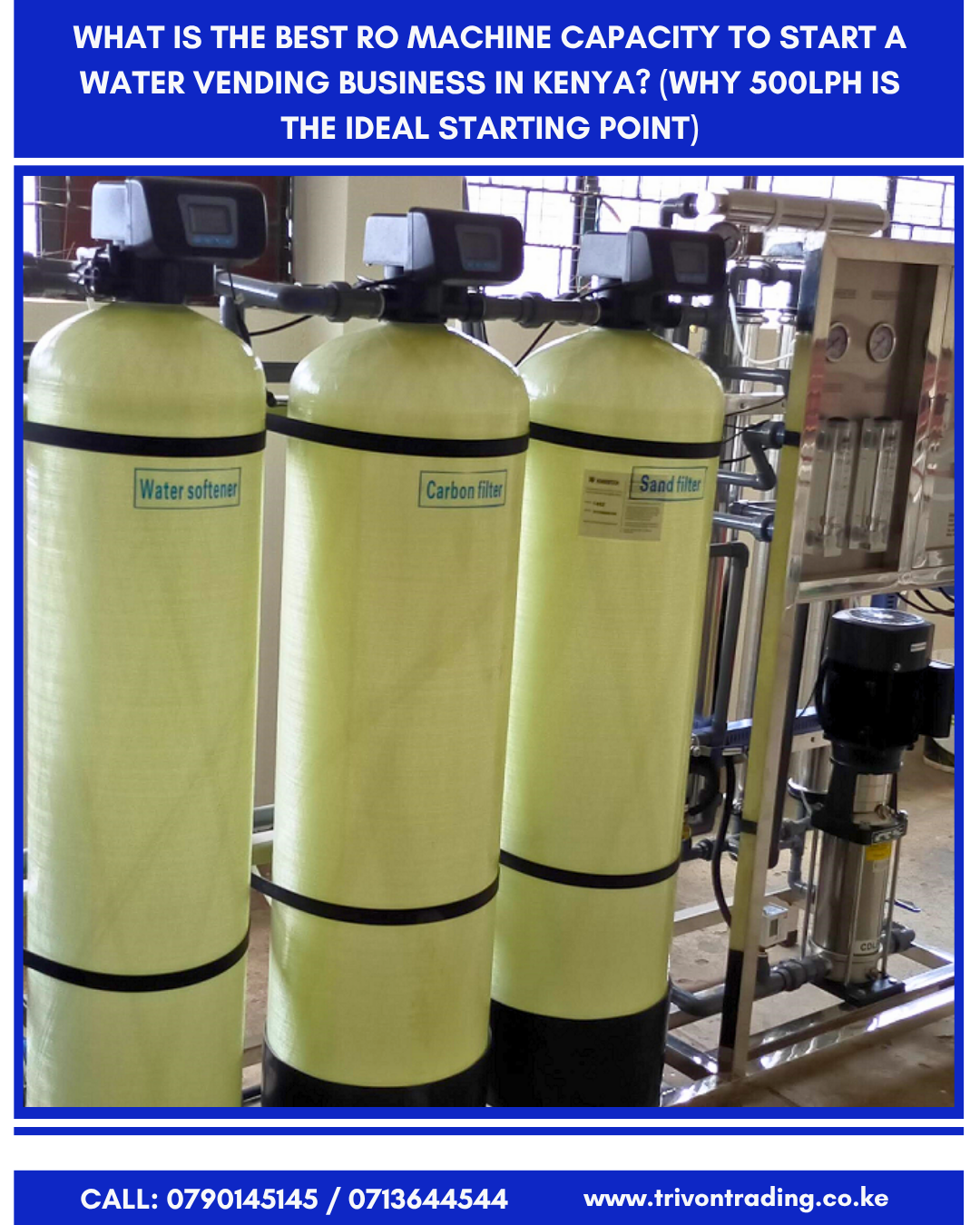
A complete system may include:
✔ Sand filter
✔ Carbon filter
✔ Water softener (where required)
✔ Cartridge filters
✔ Reverse Osmosis membrane system
✔ UV sterilization
✔ Pure water storage tanks
What Does a Complete 500LPH Water Vending Setup Include?
A professional water refill station requires more than just an RO machine.
A complete setup normally includes:
1. Water Storage Tanks
Separate tanks for:
- Raw water storage
- Purified water storage
2. Pre-Treatment System
Protects the RO membranes by removing larger contaminants.
Includes:
- Sediment filtration
- Carbon filtration
- Mineral treatment depending on water quality
3. Reverse Osmosis Machine
The main purification unit.
A commercial Reverse Osmosis Machines removes dissolved contaminants and improves water quality.
4. UV Sterilization
Provides additional microbial protection.
5. Bottle Rinsing System
A professional business should maintain proper hygiene during bottle handling.
Equipment such as a Single Bowl (Jet-Type) Bottle Rinser helps clean bottles before filling.
6. Filling Station
A filling station improves speed and customer experience.
A system such as a 6 Taps Manual Filling Line allows multiple bottles to be filled efficiently.
How Many Customers Can a 500LPH RO Machine Serve?
This depends on customer behavior and operating hours.
Example:
A 500LPH machine operating for 8 hours can theoretically produce:
500 × 8 = 4,000 litres/day
This can serve approximately:
- 200 customers buying 20 litres each
OR - A combination of household refills, deliveries, and business customers
Actual sales depend on:
- Location
- Pricing
- Competition
- Marketing
The machine provides the capacity — the business strategy creates the demand.
When Should You Upgrade Your RO Capacity?
A common mistake is upgrading too early.
Upgrade when your current system is consistently reaching its limits.
Signs you need a bigger system:
✔ Customers are waiting too long
✔ You are operating the machine continuously every day
✔ You cannot meet delivery demand
✔ Institutional orders exceed capacity
✔ Sales are consistently increasing
At this point, upgrading to:
- 1000LPH
- 2000LPH
- Higher industrial systems
may be appropriate.
Common Mistakes When Choosing an RO Machine Capacity
1. Choosing Capacity Based Only on Price
The cheapest option is not always the best investment.
Consider:
- Future growth
- Maintenance costs
- Production needs
2. Ignoring Water Testing
Capacity alone does not determine success.
Your system must match your water quality.
Borehole water should be tested for:
- TDS
- pH
- Hardness
- Iron levels
- Salinity
3. Buying Without Considering Expansion
A good setup should allow future upgrades.
Why Trivon Trading Recommends Starting With 500LPH
At Trivon Trading, we understand that most entrepreneurs want to start carefully while building a profitable business.
For many new water vending businesses, we recommend:
Start with a properly designed 500LPH RO system and upgrade as your customer base grows.
This approach allows you to:
✔ Reduce unnecessary startup costs
✔ Start with professional equipment
✔ Serve customers efficiently
✔ Expand when demand increases
Our water solutions include:
- Reverse Osmosis Systems
- Water Vending Stations
- Bottle Rinsers
- Filling Lines
- Storage Tanks
- Complete purification setups
Final Thoughts
Choosing the right RO capacity is one of the most important decisions when starting a water vending business in Kenya.
While there are many options available, a 500LPH Reverse Osmosis system provides an excellent starting point for most entrepreneurs because it offers:
✔ Enough production capacity
✔ Affordable investment
✔ Business growth flexibility
✔ Professional operation standards
The best approach is not always to start with the biggest machine — it is to start with the right machine and upgrade as your business grows.
A well-designed 500LPH water vending setup can become the foundation of a successful and scalable clean water business.


