

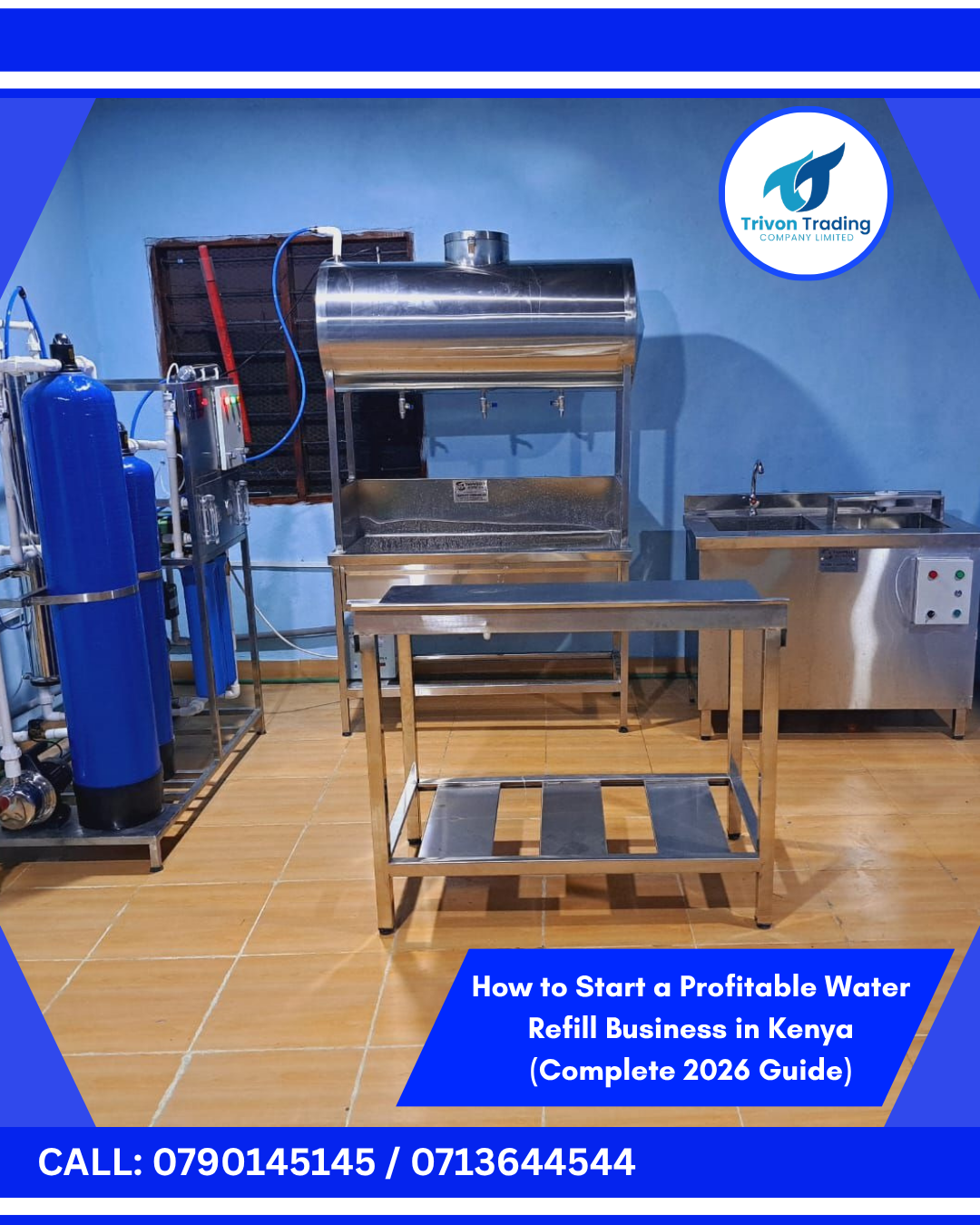
The water refill business in Kenya continues to be one of the most reliable and scalable ventures in 2026. With increasing demand for safe drinking water in urban and peri-urban areas, entrepreneurs are turning water vending into a steady source of daily income.
But here’s the truth:
:highlight
This complete guide walks you through everything you need to know to start and grow a successful water refill business in Kenya, including:
- Step-by-step setup process
- Equipment required
- Startup costs
- Profit margins
- Expert tips for long-term success
We’ll also show how working with a trusted supplier like Trivon Trading helps you build a professional and scalable operation.
Why the Water Refill Business Is Profitable in Kenya
The demand for clean, purified drinking water is driven by:
- Rapid urbanization
- Inconsistent municipal water quality
- Health awareness among consumers
- Growth of apartments and rental housing
Most households rely on:
- 20L refillable bottles
- Daily water purchases
- Trusted nearby vendors
This creates a high-frequency, repeat-customer business model.
Step 1: Conduct Market Research
Before investing, understand your local market.
What to Analyze:
- Number of existing water shops
- Price per 20L refill (typically KES 5–20 depending on area)
- Customer traffic
- Demand gaps (delivery, branding, quality issues)
Pro Tip:
Choose a location with:
✔ High population density
✔ Limited competition
✔ Easy accessibility
Step 2: Choose Your Water Source
Your water source determines your purification system.
Common Sources:
- Borehole water
- Municipal (tap) water
- Well water
Each source has different:
- TDS levels
- Contaminants
- Treatment requirements
Before buying equipment, test your water.
Step 3: Select the Right Purification System
This is the heart of your business.
Main Options:
1. Reverse Osmosis Systems
- Reverse Osmosis Machines
Best for: - Borehole water
- High TDS
- Salty or mineral-heavy water
2. Ultra Filtration Systems
- Ultra Filtration (UF) Machines
Best for: - Municipal water
- Low TDS areas
Choosing the wrong system leads to:
❌ Poor water quality
❌ Customer complaints
❌ Equipment damage
That’s why many successful entrepreneurs consult Trivon Trading for proper system sizing and recommendations.
Step 4: Invest in Essential Equipment
To run a professional water refill station, you need more than just a purifier.
Core Equipment Includes:
1. Bottle Rinsing System
- Single Bowl (Jet-Type) Bottle Rinser
Ensures bottles are clean before filling.
2. Filling Station
- 6 Taps Manual Filling Line
Improves efficiency and hygiene.
3. Flow Meter
- High Quality and Accurate Flow Meter
Ensures accurate water measurement.
4. Storage Tanks
- Stainless steel or food-grade tanks for storing purified water.
5. UV Sterilization System
Kills bacteria and ensures water safety.
A complete setup from Trivon Trading ensures all components work together efficiently.
Step 5: Set Up Your Shop Properly
Your shop layout affects hygiene and efficiency.
Ideal Setup Includes:
- Separate rinsing and filling areas
- Good drainage system
- Clean tiled floors
- Proper ventilation
- Organized equipment layout
A clean shop builds customer trust instantly.
Step 6: Register and Get Licensed
To operate legally in Kenya, you need:
- Business registration
- County trade license
- Public health approval
- Water quality testing certification
For bottled water expansion, compliance with Kenya Bureau of Standards (KEBS) is required.
Step 7: Understand Startup Costs (2026 Estimate)
Basic Setup Costs:
| Item | Estimated Cost (KES) |
|---|---|
| RO/UF Machine | 150,000 – 500,000 |
| Bottle Rinser | 20,000 – 60,000 |
| Filling Line | 50,000 – 150,000 |
| Storage Tanks | 30,000 – 100,000 |
| Shop Setup | 50,000 – 150,000 |
| Licenses | 10,000 – 30,000 |
Total Estimated Cost:
👉 KES 300,000 – 900,000
Costs vary depending on capacity and equipment quality.
Step 8: Pricing and Profit Margins
Typical Pricing:
- 20L refill: KES 5 – 20
Daily Sales Example:
- 100 customers × KES 10 = KES 1,000/day
- Monthly revenue ≈ KES 30,000
Scaling Scenario:
- 300 customers/day = KES 90,000/month
Profit Drivers:
✔ Location
✔ Water quality
✔ Customer trust
✔ Efficiency
✔ Branding
With proper setup, ROI can be achieved in 6–12 months.
Step 9: Add Value to Increase Profit
To grow beyond basic refills:
- Offer home delivery
- Sell branded bottles (5L, 10L)
- Partner with offices and schools
- Introduce subscription models
Expanding services increases revenue streams.
Step 10: Maintain Equipment and Water Quality
Consistency is key.
Maintenance Includes:
- Replacing filters regularly
- Cleaning tanks
- Checking pumps
- Servicing UV systems
Poor maintenance leads to:
❌ Bad taste
❌ Customer loss
❌ Equipment failure
Reliable suppliers like Trivon Trading provide support and spare parts.
Common Mistakes to Avoid
Avoid these beginner errors:
❌ Buying undersized machines
❌ Ignoring water testing
❌ Poor hygiene practices
❌ Weak branding
❌ Choosing the wrong location
Each mistake reduces profitability.
How to Scale Your Water Business
Once stable, expand into:
- Bottled water production
- Bulk supply contracts
- Multiple branches
- Distribution networks
Investing in high-capacity systems early makes scaling easier.
Why Choose Trivon Trading?
Your supplier determines your success.
Trivon Trading offers:
✔ Reverse Osmosis Machines
✔ Ultra Filtration Systems
✔ Bottle Rinsers
✔ Filling Lines
✔ Flow Meters
✔ Complete Water Vending Solutions
They provide:
- Expert consultation
- Installation support
- Durable equipment
- After-sales service
This reduces risk and ensures long-term profitability.
Final Thoughts
The water refill business in Kenya is one of the most accessible and scalable ventures in 2026. With proper planning, the right equipment, and a focus on quality, you can build a consistent and high-income business.
Success comes from:
- Choosing the right system
- Maintaining hygiene
- Building customer trust
- Planning for growth
If you’re serious about starting, partner with professionals like Trivon Trading to build a strong foundation from day one.


