

Introduction
If you’ve ever seen a water tanker pull up to a construction site, an estate experiencing rationing, or an event needing a bulk water supply, you’ve seen a business model that’s quietly become one of Kenya’s most consistently in-demand services: bulk water delivery.
Unlike a water refilling station, which waits for customers to walk in with jerry cans, a water delivery or trucking business brings water directly to where it’s needed — at scale, by the tanker-load. It’s a different business entirely, with its own equipment, licensing considerations, and customer base, and it’s worth understanding on its own terms before deciding if it’s the right venture for you.
This guide walks through what the business actually involves, what equipment you need, realistic costs, and the mistakes that trip up new entrants.
How a Water Delivery Business Differs from a Refilling Station
It’s worth being clear about this distinction upfront, since the two are often confused:
- A water refilling station is a fixed location where customers bring containers (jerry cans, bottles) to be filled — a walk-in retail model.
- A water delivery/trucking business sources or purifies water, loads it into a tanker or bowser, and transports it in bulk directly to a customer’s location — a logistics-based wholesale model.
The customer base, equipment, startup costs, and day-to-day operations are quite different, even though both businesses sell the same basic product: water.
Who Buys Bulk Water Delivery?
Understanding your customer base is the starting point for this business, since it shapes everything from tanker size to pricing:
- Residential estates and apartment complexes experiencing water rationing or supply interruptions
- Construction sites needing water for mixing concrete, dust suppression, and general site use
- Hotels, schools, and institutions supplementing unreliable municipal or borehole supply
- Events requiring temporary bulk water supply
- Industrial and commercial premises with high water usage needs
- Other water vendors who need bulk water delivered to their refilling station rather than producing it themselves
- Areas with no reliable water infrastructure at all, including some peri-urban and rural locations
Each of these customer types has different volume needs, different urgency levels, and different price sensitivity — worth mapping out before committing to a specific market segment.
Core Equipment You’ll Need
The Water Tanker (Bowser)
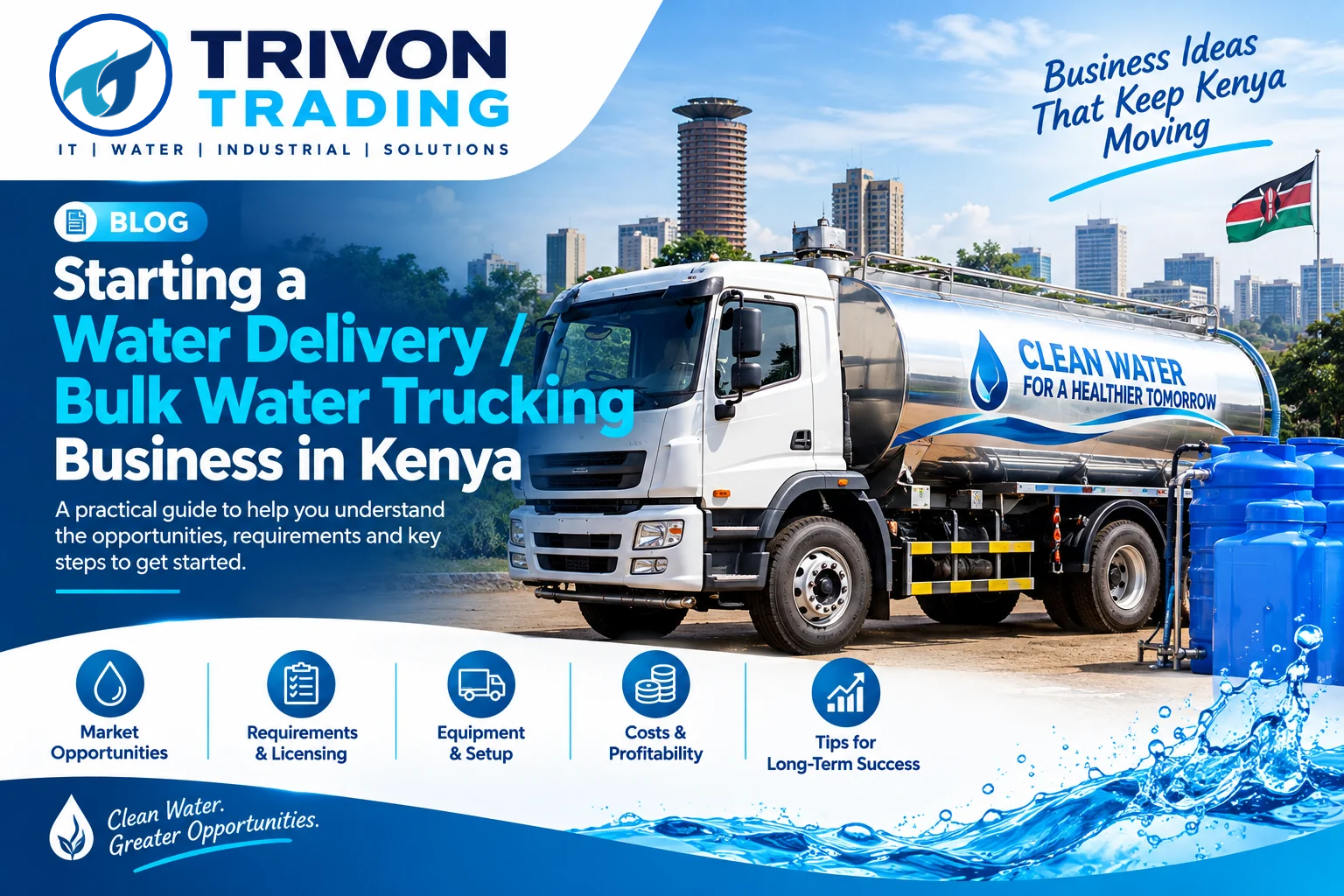
This is the central asset of the business. Water delivery tankers are typically built using stainless steel rather than mild steel, for good reason: stainless steel doesn’t rust, doesn’t contaminate the water, and lasts dramatically longer under the repeated loading and unloading cycles this business demands.
Tanker capacity is usually chosen based on your target customer base and the truck chassis available:
- Smaller tankers (1,000–3,000L) – Suited to urban delivery runs, smaller estates, and more frequent, shorter trips
- Medium tankers (3,000–8,000L) – A common choice for commercial supply, construction sites, and mixed customer bases
- Larger tankers (8,000–20,000L+) – Suited to bulk distribution, large construction projects, and high-volume institutional contracts
A Reliable Water Source
Depending on your business model, this might be:
- Your own borehole with treatment equipment
- A purchased bulk supply from an existing treatment plant or water vendor
- A municipal connection (where permitted for resale)
If you’re sourcing and treating your own water, you’ll need purification equipment — typically a Reverse Osmosis (RO) or General Purpose water treatment system sized to your delivery volume, alongside storage tanks to buffer supply between treatment and loading.
Loading and Discharge Equipment
- Filling/loading station to fill the tanker efficiently from your storage tank
- Discharge pump and hoses to offload water at the customer’s site
- Flow meters, particularly important if you’re billing by volume delivered, to ensure accurate, disputable-proof measurement
The Truck Itself
Many new entrants either purchase a truck and have a tanker fabricated onto it, or purchase an existing water bowser truck outright. Both approaches are common — the right choice depends on your budget and whether you already have a suitable truck chassis available.
Licensing and Compliance Considerations
Bulk water delivery sits at the intersection of several regulatory areas, and it’s worth planning for all of them rather than assuming one covers the rest:
- Business registration with the Business Registration Service (BRS)
- Water source licensing — if using a borehole, it must be properly licensed with the Water Resources Authority (WRA)
- Water quality compliance — water sold for drinking purposes should meet the relevant KEBS drinking water standards, particularly if marketed as safe for consumption rather than non-potable use (construction, cleaning)
- County business permit covering your operating area
- Vehicle-specific requirements, including standard commercial vehicle licensing and roadworthiness for the truck itself
- NEMA considerations, particularly if sourcing from a borehole, since groundwater abstraction can carry environmental compliance requirements
If you intend to market your water as safe for drinking (rather than purely for construction or non-potable industrial use), the same water quality compliance expectations that apply to refilling stations — testing, documentation, and KEBS alignment — apply here too.
Realistic Cost Considerations
Costs for this business vary significantly based on tanker size, whether you’re purchasing a truck or fabricating onto an existing chassis, and your water sourcing approach. Broad cost categories to budget for include:
- Tanker fabrication or purchase (the largest single cost, scaling with capacity)
- Truck acquisition (new, used, or existing chassis)
- Water treatment equipment, if sourcing and purifying your own water rather than purchasing bulk supply
- Storage and loading infrastructure at your base of operations
- Licensing and compliance costs
- Working capital for fuel, driver wages, and initial operating months before the business reaches steady demand
Because this business combines vehicle costs with water treatment/storage infrastructure, it generally requires more upfront capital than a simple refilling station — but it also accesses a wholesale customer base with larger, more consistent order volumes once established.
Pricing Your Service
Bulk water delivery is typically priced per litre or per tanker-load, factoring in:
- Distance from your base to the delivery point (fuel and time cost)
- Volume delivered
- Urgency/same-day vs. scheduled delivery
- Whether water is potable (drinking-grade) or non-potable (construction/industrial use), since these often command different price points
Many operators also establish standing contracts with regular customers — construction sites, estates, or institutions with predictable recurring needs — which provides more stable revenue than one-off deliveries alone.
Common Mistakes to Avoid
- Undersizing the tanker relative to the customer base you’re targeting, leading to excessive trips and reduced profitability per run
- Using a mild steel tank instead of stainless steel, resulting in rust, contamination risk, and a much shorter equipment lifespan
- Not confirming water source licensing before starting operations, risking issues with regulatory authorities
- Underestimating fuel and maintenance costs, which are often higher than new operators initially budget for given the weight a loaded tanker places on a vehicle
- Skipping flow meters, leading to billing disputes with customers over delivered volume
- Not distinguishing potable from non-potable water in marketing and pricing, which can create compliance and customer trust issues
Scaling the Business
Once established, water delivery businesses typically scale in one of a few directions:
- Adding more trucks/tankers to serve more routes simultaneously
- Securing standing contracts with construction companies, estates, or institutions for predictable recurring revenue
- Expanding into multi-product transport, using the same stainless steel tanker (with proper cleaning between uses) to also transport other food-grade liquids
- Vertical integration — pairing delivery with your own water treatment plant to control both production and distribution margins
Is This Business Right for You?
Bulk water delivery suits entrepreneurs who are comfortable managing logistics (routes, scheduling, vehicle maintenance) alongside the water quality side of the business, and who have access to — or are prepared to invest in — both a suitable truck and a properly fabricated tanker. It generally requires more capital and operational complexity than a fixed refilling station, but it opens a wholesale customer base that a walk-in station can’t reach.
Getting the Equipment Right From the Start
The tanker itself is the foundation of this business, and it’s not something to compromise on. A properly fabricated stainless steel tanker — built to the right capacity for your target market, with proper discharge systems and accurate measurement — determines both your operating costs and your ability to win larger contracts down the line.
At Trivon Trading, we design and fabricate stainless steel lorry tanks and water storage/treatment equipment for businesses entering the water delivery and bulk transport space, working with clients to size equipment correctly for their target market and budget.
Trivon Trading Company Limited 📞 Call/WhatsApp: 0790145145 | 0713644544 📧 info@trivontrading.co.ke | trivontrading@gmail.com 🌐 www.trivontrading.co.ke
Trivon Trading Co. Ltd – Delivering Reliable Water & Dairy Solutions You Can Trust