

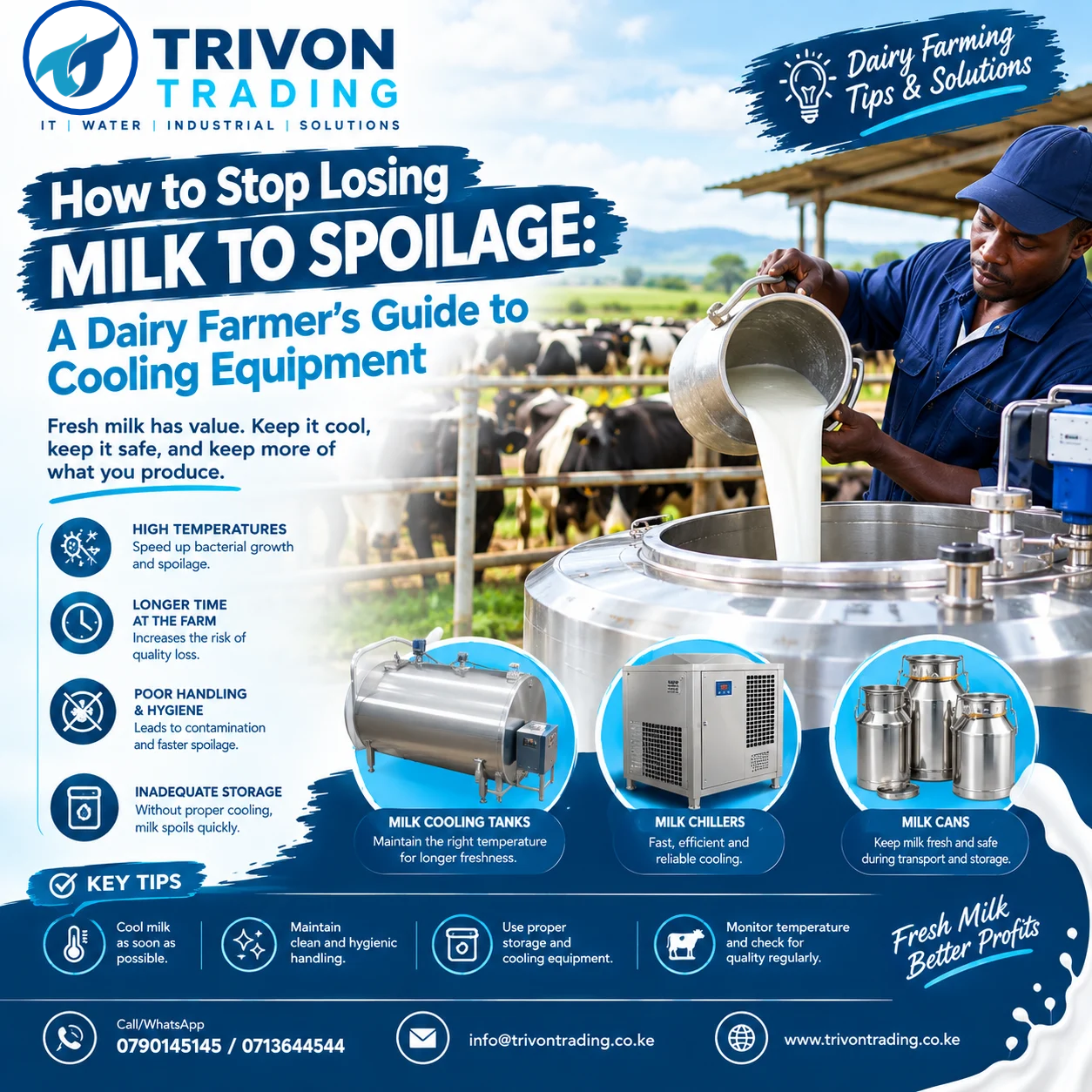
Introduction
If you’re a dairy farmer in Kenya, you’ve probably experienced this scenario more times than you’d like: milk that was fresh in the morning has soured by evening, a buyer rejects a delivery for being too warm, or milk collected over a weekend simply has to be poured away.
It’s a frustrating, expensive problem — and one that’s almost entirely preventable. This guide walks through exactly why milk spoils, what it’s actually costing you, and which cooling solutions fit different farm sizes and budgets.
Why Milk Spoils So Quickly
Raw milk is one of the most perishable foods there is, and for good reason: it’s rich in nutrients that bacteria thrive on. The moment milk leaves the cow, bacteria present on the udder, in the air, or on unclean equipment begin multiplying — and they multiply fastest in warm conditions.
At typical outdoor temperatures in many parts of Kenya, bacteria in uncooled milk can double in number roughly every 20–30 minutes. Within just a few hours, bacterial counts can rise high enough to cause souring, off-flavors, and in some cases, spoilage severe enough that the milk becomes unsellable and unsafe.
This is why the window between milking and cooling matters so much. Milk that’s cooled quickly to around 4°C dramatically slows bacterial growth, extending safe storage from a few hours to 48–72 hours or more.
The Real Cost of Milk Spoilage
Many farmers underestimate how much spoilage is actually costing them because the losses feel “normal” — a bit here, a bit there. But the numbers add up quickly.
Consider a farm producing 150 litres daily with a 10% spoilage rate (a fairly typical figure without cooling):
- Daily loss: 15 litres
- Monthly loss: roughly 450 litres
- Value lost monthly (at an average farm-gate price): a significant, recurring drain on income that never shows up as a single dramatic loss — just a steady leak
Beyond the milk itself, spoilage often comes with secondary costs: buyer rejections that damage business relationships, inconsistent income that makes planning difficult, and the stress of never being fully certain your milk will make it to sale.
What Actually Stops Spoilage: Rapid Cooling
The single most effective intervention against milk spoilage is rapid, consistent cooling immediately after milking. This is where cooling equipment — commonly called milk chillers or cooling tanks — comes in.
A proper cooling system does three things a bucket or uninsulated container cannot:
- Cools milk quickly — typically bringing milk down to around 4°C within 2–3 hours, well before bacteria have time to multiply significantly
- Maintains that temperature consistently — insulated construction and refrigeration keep milk cold for extended storage, not just a brief cooling period
- Keeps milk evenly mixed — agitation systems in proper cooling tanks prevent cream separation and maintain consistent quality throughout storage
Types of Cooling Systems
There are two main cooling technologies used in milk chillers, and the right choice depends on your scale and budget:
Glycol Chillers
These use a refrigerant and glycol solution circulating around the tank to achieve precise, rapid temperature control. Glycol systems tend to cool milk faster and hold temperature more tightly, making them well-suited to larger operations or collection centers handling significant volumes.
Air-Cooled Chillers
These rely on air circulation for cooling. They’re generally simpler in design, often with lower maintenance requirements, and can be a cost-effective option for small to medium farms where ultra-rapid cooling speed is less critical.
Choosing the Right Capacity for Your Farm
Cooling tanks are sized by litre capacity, and choosing correctly matters — an undersized tank leaves milk waiting to be cooled, while an oversized tank means paying for capacity you don’t use.
- Small farms (100–500L capacity): Suited to farms with roughly 5–20 cows, or those looking to combine morning and evening milkings safely
- Medium farms (500–2,000L capacity): Appropriate for 20–80 cow operations, or small collection points serving a handful of neighboring farmers
- Large farms and collection centers (2,000–10,000L+): Designed for large-scale operations, cooperatives, or centers aggregating milk from multiple suppliers before bulk sale or processing
Milk Cans: The Often-Overlooked Piece of the Puzzle
Cooling tanks solve storage, but how milk gets from the cow to the cooling system — and often onward to a buyer — matters too. This is where the choice between plastic, aluminum, and stainless steel milk cans becomes relevant.
Plastic cans absorb odors and flavors over time and crack under regular use. Aluminum cans corrode and can impart a metallic taste. Stainless steel cans, by contrast, don’t rust, don’t transfer taste or odor, and typically last 20+ years compared to the 1–5 year lifespan of plastic or aluminum alternatives — meaning the true long-term cost is often lower despite a higher upfront price.
For farmers serious about milk quality from the moment of milking through to sale, pairing proper cooling with proper transport containers closes the loop on preventable quality loss.
Calculating Your Own Payback Period
A simple way to think about whether a chiller investment makes sense for your farm:
- Estimate your current daily spoilage (litres lost or sold at distress prices)
- Multiply by your typical milk price to get a daily loss figure
- Multiply by 30 for a monthly loss estimate
- Compare that monthly loss against the equipment cost
Most farms that install proper cooling equipment recover their investment within 6–12 months purely from eliminated spoilage — before even accounting for the better prices that cooled, higher-quality milk often commands from buyers.
Beyond Spoilage Prevention: Better Prices, Better Negotiating Position
Cooling doesn’t just stop losses — it changes your position with buyers entirely. Processors and cooperatives typically pay a premium for properly cooled milk because it meets their quality and safety standards more reliably. Farmers with cooling capacity can also afford to be more selective about when and to whom they sell, rather than needing to offload milk immediately before it spoils.
This shift — from “I need to sell this milk right now before it goes bad” to “I can choose the best buyer and timing” — is often as financially significant as the spoilage prevention itself.
Maintenance Matters
Cooling equipment, like any mechanical system, needs basic upkeep to keep performing:
- Regular cleaning of the tank interior to prevent bacterial buildup
- Checking agitator function to ensure even cooling
- Monitoring the refrigeration/condensing unit for efficient operation
- Periodic professional servicing to catch issues before they cause breakdowns
Skipping maintenance is one of the most common ways farmers end up with reduced cooling performance or unexpected equipment failure — undermining the very investment meant to protect their milk.
Getting Started
If you’re currently losing milk to spoilage, the path forward usually comes down to three questions: how much milk are you producing, how much are you currently losing, and what capacity of cooling equipment fits both your farm size and your budget. A proper assessment of these factors — rather than guessing at equipment size — makes the difference between an investment that pays for itself quickly and one that’s mismatched to your actual needs.
At Trivon Trading, we help dairy farmers, collection centers, and cooperatives across Kenya select and install the right cooling equipment for their specific operation — from small farm-scale chillers to large collection center systems — along with stainless steel milk cans and related dairy equipment.
Trivon Trading Company Limited 📞 Call/WhatsApp: 0790145145 | 0713644544 📧 info@trivontrading.co.ke | trivontrading@gmail.com 🌐 www.trivontrading.co.ke
Trivon Trading Co. Ltd – Delivering Reliable Water & Dairy Solutions You Can Trust