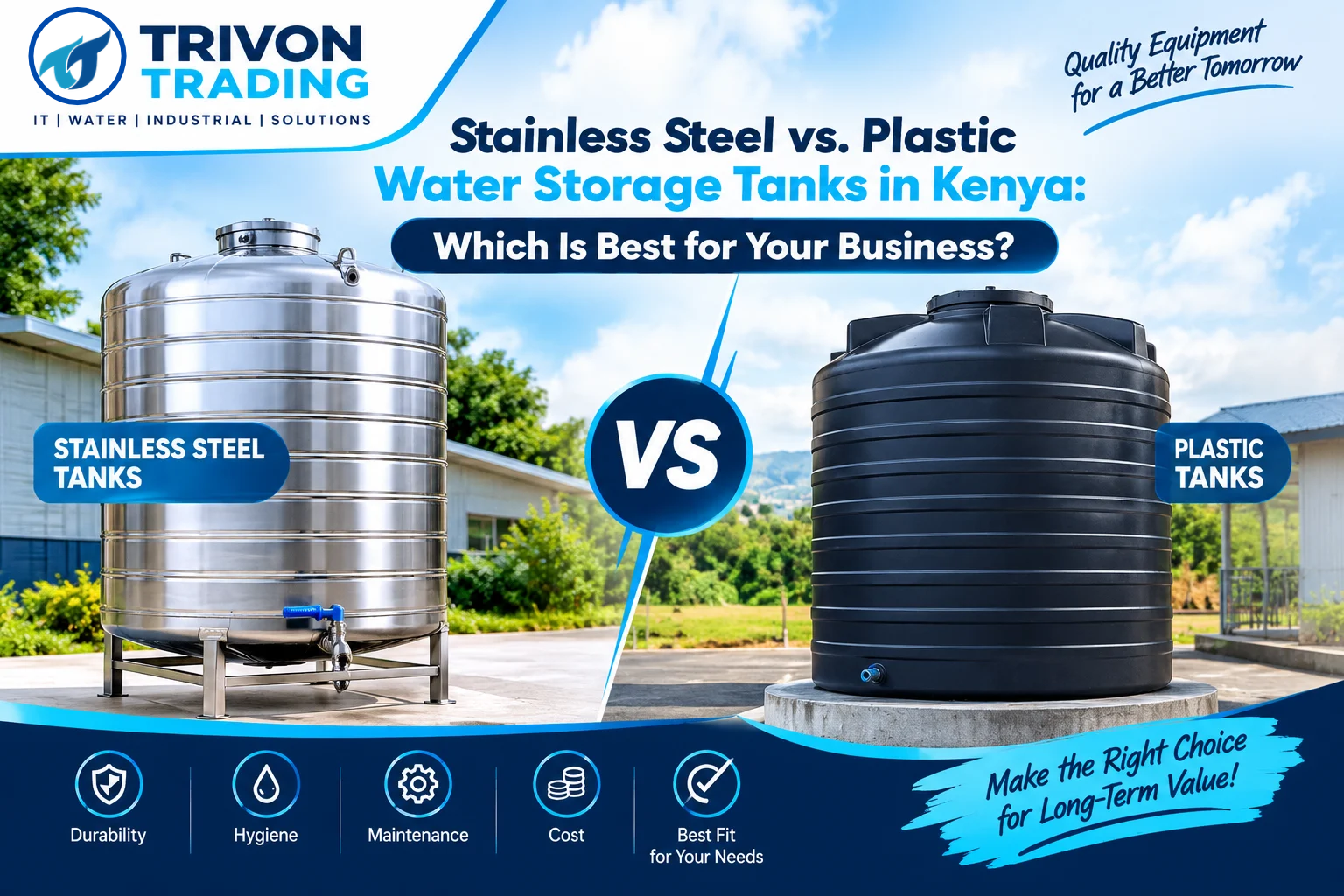
Stainless-steel Tanks, Water Vending

Stainless Steel vs. Plastic Water Storage Tanks in Kenya: Which Is Best for Your Business?

# Stainless Steel vs. Plastic Water Storage Tanks in Kenya: Which Is Best for Your Business? Choosing between stainless steel water tanks in Kenya and plastic tanks is one of the first decisions any business makes when it plans water storage, whether for a restaurant, a dairy, a water vending station, a school or a factory. The two materials look similar on a quote, but they behave very differently on durability, hygiene, cleaning, installation and cost. This guide gives you an honest comparison. Plastic is the right answer for plenty of jobs, and stainless steel is the right answer for others. By the end you will know which one fits your business, what each realistically costs in Kenya, and what to check before you buy. --- ## Quick Answer: Stainless Steel or Plastic? - **Choose plastic** for general-purpose storage where budget matters most: domestic supply, rainwater harvesting, irrigation, construction sites and non-critical raw water. - **Choose stainless steel** where hygiene, regulation, heat, fire risk or product quality are at stake: food and dairy processing, water vending and bottling, hospitals, hotels and kitchens, and industrial sites. - **Use both** in many businesses: plastic for raw water buffering, and stainless steel for treated or product water. Stainless steel tanks cost far more upfront, so they only make sense when the application needs what they offer. --- ## Stainless Steel vs Plastic Water Tanks at a Glance | Factor | Stainless steel | Plastic (HDPE/LLDPE) | |---|---|---| | Upfront cost | High | Low | | Typical lifespan | 20–30 years or more with basic care | Commonly 10–20 years, depending on quality and placement | | Hygiene | Smooth, non-porous, easy to sanitise | Good when food-grade and well maintained; scratches can hold biofilm | | Algae control | Opaque, blocks light | Multi-layer black tanks block light; thin or translucent tanks do not | | Hot water | Suitable (insulated if needed) | Generally not suitable | | Fire resistance | Non-combustible | Can deform or burn | | Weight (empty) | Heavier | Light | | Custom shapes and sizes | Easy (fabricated to order) | Limited to moulded sizes | | Resale/scrap value | High | Low | | Theft risk on remote sites | Higher (scrap value) | Lower | | Best for | Food, dairy, vending, hospitals, industry | General storage on a budget | --- ## Durability and Lifespan ### Stainless steel Food-grade stainless steel does not rust like mild steel, does not degrade in sunlight and tolerates knocks, heat and temperature swings. A well-fabricated tank, with properly finished welds, commonly serves 20–30 years or more. **Grade matters.** Grade **304** suits most drinking-water and food applications. Grade **316**, which has added molybdenum, resists chlorides far better, so it is the safer choice for coastal sites, for borehole water with high salinity, and for tanks that are sanitised with chlorine frequently. ### Plastic Good plastic tanks are UV-stabilised and multi-layer, which is why they last well in Kenyan sun. Quality varies widely, though. Thin-walled or poorly stabilised tanks can become brittle, crack or sag, and a tank that fails after two or three years costs more than a better one bought once. Wall thickness, UV stabilisation and warranty terms are the things to compare. --- ## Hygiene and Water Quality Stainless steel has a smooth, non-porous surface that does not absorb odours or flavours and does not give bacteria much to cling to. It also tolerates the hot water and sanitising chemicals used in food and dairy plants. For anything that touches a product you sell, such as treated water, milk or beverages, that surface matters. Food-grade plastic tanks are widely and safely used for drinking water. The weaknesses are practical rather than absolute: - Scratches from cleaning can create places for biofilm to build up - Translucent or thin tanks let light in, which encourages algae - Plastic is not designed for hot water - Plastic can retain taste or odour if previously used for other liquids If your business sells water, milk, juice or food, regulators and customers expect surfaces that are easy to sanitise and clearly food-grade. If you operate a water vending, bottling or dairy business, confirm the requirements that apply to you with KEBS, the Kenya Dairy Board where relevant, and your county public health office. --- ## Installation **Weight and foundations.** Water is heavy: 1,000 litres weighs about one tonne. This applies to both materials, so any tank needs a level, firm base designed for the full load. Never place a large tank on a residential roof without checking with a structural engineer. **Plastic tanks** are light when empty, easy to carry and quick to place on a prepared base. They suit sites with tight access. **Stainless steel tanks** are heavier empty, but they can be fabricated to fit the space: tall and narrow, low and wide, with a dished or sloped base for full draining, or built in sections for tight access. They can also be elevated on steel stands. Custom connections, manholes, vents, overflow and drain points are specified at fabrication, not retrofitted. --- ## Cleaning and Maintenance | Task | Stainless steel | Plastic | |---|---|---| | Routine cleaning | Smooth wall wipes and rinses easily | Scrub gently; avoid abrasives that scratch | | Sanitising | Tolerates hot water and standard sanitisers; rinse well after chlorine | Use dilute sanitiser; avoid hot water | | Full draining | Sloped base and bottom drain make it easy | Flat or slightly domed bases often leave sediment | | Inspection | Check welds, fittings and seals | Check for cracks, UV damage and fitting leaks | | Typical interval | Clean at least every 6 months, or more often for food use | Clean at least every 6–12 months | For both, keep the lid closed, protect vents and overflows with insect mesh, and keep the tank out of direct contamination such as runoff. --- ## Cost: What You Will Really Pay This is where the two materials differ most. | Capacity | Plastic tank (typical Kenyan retail, tank only) | Stainless steel tank | |---|---|---| | 500 L | KSh 4,500 – 9,500 | KSh 80,000 (Trivon Trading listed price) | | 1,000 L | KSh 9,000 – 14,000 | Quoted on request | | 2,000 L | KSh 12,700 – 24,600 | KSh 200,000 (Trivon Trading listed price) | | 5,000 L | KSh 45,000 – 62,000 | Custom quote | | 10,000 L | KSh 78,000 – 126,000 | Custom quote | *Plastic ranges reflect advertised prices from major Kenyan brands and retailers, which vary by brand, wall thickness and date. Stainless steel prices vary with grade, sheet thickness and finish. Across Kenyan suppliers, stainless tanks in the 500–3,000 L range are advertised from roughly KSh 40,000 to KSh 250,000. All prices are indicative, so request a written quotation.* **The honest picture.** At small and medium sizes, stainless steel typically costs eight to fifteen times more than plastic upfront. For plain water storage, plastic usually remains cheaper over the tank's whole life, even after allowing for a replacement. Stainless steel earns its price in other ways: - **Compliance:** meeting hygiene requirements for food, dairy and beverage operations - **Protecting your product:** no taste transfer, easy sanitising, no algae - **Heat and fire:** suitable for hot water and fire-risk sites - **Premium positioning:** vending and bottling customers notice and trust stainless steel - **Residual value:** stainless steel keeps scrap and resale value - **Custom fit:** built exactly to your space and connection needs Also budget for delivery, the base or stand, plumbing and installation, because these are usually quoted separately. --- ## Commercial Water Storage Tanks: Which Material for Which Business | Business or use | Recommended | Why | |---|---|---| | Water vending and refilling stations | Stainless steel (treated water) | Product-contact hygiene, customer trust | | Bottling plants | Stainless steel | Hygiene, cleaning, product quality | | Dairy and milk collection | Stainless steel | Sanitary design and cleaning | | Restaurants, hotels, catering | Stainless steel for potable and hot water; plastic for general supply | Hygiene where it matters | | Hospitals and clinics | Stainless steel | Hygiene and durability | | Schools and institutions | Either, based on budget and supervision | Plastic for general supply; stainless for kitchens | | Farms and irrigation | Plastic | Low cost, large volumes | | Rainwater harvesting | Plastic | Cost and easy installation | | Construction sites | Plastic | Cost and portability | | Raw or borehole water buffer | Plastic (or 316 stainless if saline) | Cost and corrosion safety | --- ## Industrial Storage Tanks: When Stainless Steel Is the Sensible Choice For industrial storage tanks, stainless steel becomes the default when: - The tank holds **food, dairy, beverage or pharmaceutical products** - Liquids are **hot**, or the process needs **temperature control or insulation** - The site faces **fire risk** - Tanks are **cleaned in place frequently** with strong sanitisers - The tank must be **built to an exact specification**, such as multiple outlets, agitators, sloped bases or integrated instruments - Long service life matters more than purchase price --- ## What About Galvanised and Pressed Steel Tanks? For very large volumes, such as 20,000 litres and above, galvanised or pressed steel tanks and elevated steel water towers are common. They are well suited to farms, estates, institutions and municipal supply. We also fabricate galvanised and stainless steel water towers from 10,000 litres to 500,000 litres and above. --- ## The Hybrid Approach for Water Businesses If you run a water vending, refilling or bottling business, you don't have to choose one material for everything. A practical setup is: - **Plastic tank** for raw or borehole water before treatment, where cost matters and the water is not yet a product - **Stainless steel tank** after treatment (reverse osmosis or UF), where the water becomes the product you sell This protects your product quality without paying stainless prices for the whole system. --- ## 10 Factors to Consider Before Buying 1. **Use:** is the water for drinking, food contact, cleaning, irrigation or industry? 2. **Regulation:** do KEBS, dairy or public health rules apply to your business? 3. **Water quality:** is your water saline, chlorinated or acidic? If so, consider 316 stainless steel. 4. **Temperature:** will it ever hold hot water? 5. **Capacity:** size for your daily use plus reserve for supply interruptions. 6. **Site:** check access, space, ground strength and whether the tank must be elevated. 7. **Security:** will the site be unattended? Stainless steel's scrap value can attract theft. 8. **Budget:** compare total cost over the tank's life, not just the price tag. 9. **Cleaning:** can you drain and reach the whole interior easily? 10. **Supplier support:** ask about warranty, delivery, installation and local after-sales service. --- ## Common Buying Mistakes - **Buying on price alone.** The cheapest tank is expensive if it cracks or fails an inspection. - **Using the wrong stainless grade.** 304 can show pitting in high-chloride conditions, so ask which grade you are getting. - **Ignoring the foundation.** A full tank is very heavy, so the base must be designed for the load. - **Forgetting drainage and access.** A tank you can't drain and clean completely will accumulate sediment. - **Skipping the cover and vent protection.** Insects and debris are a common source of contamination. - **Not specifying fittings upfront.** For stainless tanks, outlets, overflows and manholes are cheaper to include at fabrication. --- ## Stainless Steel Water Tanks from Trivon Trading Trivon Trading fabricates stainless steel storage tanks from food-grade 304 stainless steel, built in Kenya and made to suit water vending, purification, dairy and food-processing businesses. We build to your capacity, shape and connection requirements, and deliver across Kenya. Our workshop is in Ruiru, along Thika Superhighway. We also supply the equipment that goes with your storage: - **Reverse osmosis and water purification systems** for treated water - **Water vending machines and filling stations** with stainless steel storage - **Milk cooling tanks, pasteurizers and fermentation tanks** for dairy - **Lorry and transport tanks** and **steel water towers** for bulk supply - **Stainless steel fabrication** for kitchens and processing areas **Trivon Trading Company Limited** 📞 Call/WhatsApp: 0790145145 | 0713644544 📧 info@trivontrading.co.ke | trivontrading@gmail.com 🌐 www.trivontrading.co.ke --- ## Frequently Asked Questions ### Which is better, a stainless steel or plastic water tank? Neither is better for every job. Plastic is cheaper and ideal for general storage. Stainless steel is better where hygiene, regulation, heat, fire resistance or product quality matter, such as food, dairy, water vending and industrial uses. ### Are stainless steel water tanks safe for drinking water? Yes, when made from food-grade stainless steel (304 or 316) with properly finished welds. It does not corrode in normal drinking-water conditions and does not affect taste. ### How much does a stainless steel water tank cost in Kenya? Prices depend on capacity, grade, thickness and finish. Trivon Trading lists a 500-litre tank at KSh 80,000 and a 2,000-litre tank at KSh 200,000. Larger and custom tanks are quoted individually. ### How much does a plastic water tank cost in Kenya? Typically around KSh 9,000–14,000 for 1,000 litres, KSh 45,000–62,000 for 5,000 litres and KSh 78,000–126,000 for 10,000 litres, depending on brand and wall thickness. ### How long do plastic water tanks last? Good UV-stabilised tanks commonly last 10–20 years if installed on a proper base. Thin or poorly stabilised tanks can fail much sooner. ### Can plastic tanks be used for hot water? Standard plastic water tanks are not designed for hot water. Use stainless steel, insulated if needed. ### Does stainless steel rust? Food-grade stainless steel resists rust, but the grade matters. In high-chloride conditions, such as coastal sites or saline borehole water, grade 316 is safer than 304. ### Which tank is best for a water vending business? Use plastic for raw water buffering if you wish, and stainless steel for treated water that you sell, because it protects product quality and customer trust. ### How often should a water tank be cleaned? At least every 6 months, and more often for food or dairy use. --- ## Yoast SEO Plugin Fields (Copy-Paste Ready) **Focus Keyphrase:** stainless steel water tanks Kenya **SEO Title:** Stainless Steel Water Tanks in Kenya vs Plastic: 2026 Guide **Slug:** stainless-steel-vs-plastic-water-tanks-kenya **Meta Description (150 characters):** Stainless steel water tanks Kenya vs plastic: compare durability, hygiene, cleaning, installation and cost to choose the right tank for your business. **Related Keyphrases (Yoast Premium, up to 4):** - commercial water storage tanks - industrial storage tanks - stainless steel vs plastic water tank - stainless steel storage tank price Kenya **Keyphrase Synonyms (Yoast Premium):** stainless steel storage tanks Kenya, SS water tank Kenya, commercial water tanks Kenya **Suggested Image Alt Text:** - "Stainless steel water tanks Kenya: food-grade 304 storage tank for water vending" - "Stainless steel vs plastic water storage tank comparison Kenya" - "Commercial water storage tanks at a water vending station in Kenya" - "Industrial stainless steel storage tank fabricated by Trivon Trading" **Yoast Schema Settings:** - Page type: Web Page - Article type: Blog Post - Use the **Yoast FAQ block** for the FAQ section above (paste each question and answer) to generate FAQ rich-result markup - Consider marking as **Cornerstone content**, as the pillar page for your storage tank cluster **Internal Linking Suggestions:** - "stainless steel storage tanks" → https://trivontrading.co.ke/product-tag/stainless-steel-storage-tank-prices-in-kenya/ - "filling stations with storage" → https://trivontrading.co.ke/product/stainless-steel-storage-tank-with-filling-station-3-taps/ - "reverse osmosis and water purification systems" → your RO systems product pages - "water vending machines and filling stations" → your water vending product pages - "milk cooling tanks" → your new post "Milk Cooling Tank Prices in Kenya" and the milk cooling tank product page - "steel water towers" → your steel water tower product page - "KEBS" → your existing KEBS posts ("Water Quality Standards in Kenya: KEBS Requirements Explained Simply" and "KEBS Requirements for Water Vending Businesses: A Compliance Checklist") - "commercial kitchen" references → your post "Commercial Kitchen Equipment in Kenya: A Buyer's Guide to Stainless Steel Fabrication" - Link back to this post from those pages using the anchor "stainless steel water tanks Kenya" **Category:** Stainless Steel Fabrication **Tags:** stainless steel water tanks Kenya, commercial water storage tanks, industrial storage tanks, stainless steel vs plastic tank, water storage Kenya, stainless steel storage tank, water vending storage **Social / Open Graph (Yoast Social tab):** - Title: Stainless Steel vs Plastic Water Tanks in Kenya: Which Is Best? - Description: Durability, hygiene, cost and cleaning compared. Find out which water tank material suits your business. - Image: 1200×630px featured image **Featured Image Brief (for design team):** A split visual with a polished stainless steel tank on one side and a black plastic tank on the other, on a clean background, with a subtle "vs" divider. Use the Trivon palette: navy #0a2540, emerald #1f8f75 / #43c6ac, gold #c9a227. Size: 1200×630px. **On-page SEO Checklist:** - Focus keyphrase appears in the SEO title, slug, meta description, first paragraph, an H2 and image alt text - Keep both comparison tables as real HTML tables to help win featured snippets - Add the FAQ as a Yoast FAQ block, not plain text - Review prices every six months, and update the year in the title each January

Choosing between stainless steel water tanks in Kenya and plastic tanks is one of the first decisions any business makes when it plans water storage, whether for a restaurant, a dairy, a water vending station, a school or a factory. The two materials look similar on a quote, but they behave very differently on durability, hygiene, cleaning, installation and cost.

This guide gives you an honest comparison. Plastic is the right answer for plenty of jobs, and stainless steel is the right answer for others. By the end you will know which one fits your business, what each realistically costs in Kenya, and what to check before you buy.


Quick Answer: Stainless Steel or Plastic?

  • Choose plastic for general-purpose storage where budget matters most: domestic supply, rainwater harvesting, irrigation, construction sites and non-critical raw water.
  • Choose stainless steel where hygiene, regulation, heat, fire risk or product quality are at stake: food and dairy processing, water vending and bottling, hospitals, hotels and kitchens, and industrial sites.
  • Use both in many businesses: plastic for raw water buffering, and stainless steel for treated or product water.

Stainless steel tanks cost far more upfront, so they only make sense when the application needs what they offer.


Stainless Steel vs Plastic Water Tanks at a Glance

Factor Stainless steel Plastic (HDPE/LLDPE)
Upfront cost High Low
Typical lifespan 20–30 years or more with basic care Commonly 10–20 years, depending on quality and placement
Hygiene Smooth, non-porous, easy to sanitise Good when food-grade and well maintained; scratches can hold biofilm
Algae control Opaque, blocks light Multi-layer black tanks block light; thin or translucent tanks do not
Hot water Suitable (insulated if needed) Generally not suitable
Fire resistance Non-combustible Can deform or burn
Weight (empty) Heavier Light
Custom shapes and sizes Easy (fabricated to order) Limited to moulded sizes
Resale/scrap value High Low
Theft risk on remote sites Higher (scrap value) Lower
Best for Food, dairy, vending, hospitals, industry General storage on a budget

Durability and Lifespan

Stainless steel

Food-grade stainless steel does not rust like mild steel, does not degrade in sunlight and tolerates knocks, heat and temperature swings. A well-fabricated tank, with properly finished welds, commonly serves 20–30 years or more.

Grade matters. Grade 304 suits most drinking-water and food applications. Grade 316, which has added molybdenum, resists chlorides far better, so it is the safer choice for coastal sites, for borehole water with high salinity, and for tanks that are sanitised with chlorine frequently.

Plastic

Good plastic tanks are UV-stabilised and multi-layer, which is why they last well in Kenyan sun. Quality varies widely, though. Thin-walled or poorly stabilised tanks can become brittle, crack or sag, and a tank that fails after two or three years costs more than a better one bought once. Wall thickness, UV stabilisation and warranty terms are the things to compare.


Hygiene and Water Quality

Stainless steel has a smooth, non-porous surface that does not absorb odours or flavours and does not give bacteria much to cling to. It also tolerates the hot water and sanitising chemicals used in food and dairy plants. For anything that touches a product you sell, such as treated water, milk or beverages, that surface matters.

Food-grade plastic tanks are widely and safely used for drinking water. The weaknesses are practical rather than absolute:

  • Scratches from cleaning can create places for biofilm to build up
  • Translucent or thin tanks let light in, which encourages algae
  • Plastic is not designed for hot water
  • Plastic can retain taste or odour if previously used for other liquids

If your business sells water, milk, juice or food, regulators and customers expect surfaces that are easy to sanitise and clearly food-grade. If you operate a water vending, bottling or dairy business, confirm the requirements that apply to you with KEBS, the Kenya Dairy Board where relevant, and your county public health office.


Installation

Weight and foundations. Water is heavy: 1,000 litres weighs about one tonne. This applies to both materials, so any tank needs a level, firm base designed for the full load. Never place a large tank on a residential roof without checking with a structural engineer.

Plastic tanks are light when empty, easy to carry and quick to place on a prepared base. They suit sites with tight access.

Stainless steel tanks are heavier empty, but they can be fabricated to fit the space: tall and narrow, low and wide, with a dished or sloped base for full draining, or built in sections for tight access. They can also be elevated on steel stands. Custom connections, manholes, vents, overflow and drain points are specified at fabrication, not retrofitted.


Cleaning and Maintenance

Task Stainless steel Plastic
Routine cleaning Smooth wall wipes and rinses easily Scrub gently; avoid abrasives that scratch
Sanitising Tolerates hot water and standard sanitisers; rinse well after chlorine Use dilute sanitiser; avoid hot water
Full draining Sloped base and bottom drain make it easy Flat or slightly domed bases often leave sediment
Inspection Check welds, fittings and seals Check for cracks, UV damage and fitting leaks
Typical interval Clean at least every 6 months, or more often for food use Clean at least every 6–12 months

For both, keep the lid closed, protect vents and overflows with insect mesh, and keep the tank out of direct contamination such as runoff.


Cost: What You Will Really Pay

This is where the two materials differ most.

Capacity Plastic tank (typical Kenyan retail, tank only) Stainless steel tank
500 L KSh 4,500 – 9,500 KSh 80,000 (Trivon Trading listed price)
1,000 L KSh 9,000 – 14,000 Quoted on request
2,000 L KSh 12,700 – 24,600 KSh 200,000 (Trivon Trading listed price)
5,000 L KSh 45,000 – 62,000 Custom quote
10,000 L KSh 78,000 – 126,000 Custom quote

Plastic ranges reflect advertised prices from major Kenyan brands and retailers, which vary by brand, wall thickness and date. Stainless steel prices vary with grade, sheet thickness and finish. Across Kenyan suppliers, stainless tanks in the 500–3,000 L range are advertised from roughly KSh 40,000 to KSh 250,000. All prices are indicative, so request a written quotation.

The honest picture. At small and medium sizes, stainless steel typically costs eight to fifteen times more than plastic upfront. For plain water storage, plastic usually remains cheaper over the tank’s whole life, even after allowing for a replacement.

Stainless steel earns its price in other ways:

  • Compliance: meeting hygiene requirements for food, dairy and beverage operations
  • Protecting your product: no taste transfer, easy sanitising, no algae
  • Heat and fire: suitable for hot water and fire-risk sites
  • Premium positioning: vending and bottling customers notice and trust stainless steel
  • Residual value: stainless steel keeps scrap and resale value
  • Custom fit: built exactly to your space and connection needs

Also budget for delivery, the base or stand, plumbing and installation, because these are usually quoted separately.


Commercial Water Storage Tanks: Which Material for Which Business

Business or use Recommended Why
Water vending and refilling stations Stainless steel (treated water) Product-contact hygiene, customer trust
Bottling plants Stainless steel Hygiene, cleaning, product quality
Dairy and milk collection Stainless steel Sanitary design and cleaning
Restaurants, hotels, catering Stainless steel for potable and hot water; plastic for general supply Hygiene where it matters
Hospitals and clinics Stainless steel Hygiene and durability
Schools and institutions Either, based on budget and supervision Plastic for general supply; stainless for kitchens
Farms and irrigation Plastic Low cost, large volumes
Rainwater harvesting Plastic Cost and easy installation
Construction sites Plastic Cost and portability
Raw or borehole water buffer Plastic (or 316 stainless if saline) Cost and corrosion safety

Industrial Storage Tanks: When Stainless Steel Is the Sensible Choice

For industrial storage tanks, stainless steel becomes the default when:

  • The tank holds food, dairy, beverage or pharmaceutical products
  • Liquids are hot, or the process needs temperature control or insulation
  • The site faces fire risk
  • Tanks are cleaned in place frequently with strong sanitisers
  • The tank must be built to an exact specification, such as multiple outlets, agitators, sloped bases or integrated instruments
  • Long service life matters more than purchase price

What About Galvanised and Pressed Steel Tanks?

For very large volumes, such as 20,000 litres and above, galvanised or pressed steel tanks and elevated steel water towers are common. They are well suited to farms, estates, institutions and municipal supply. We also fabricate galvanised and stainless steel water towers from 10,000 litres to 500,000 litres and above.


The Hybrid Approach for Water Businesses

If you run a water vending, refilling or bottling business, you don’t have to choose one material for everything. A practical setup is:

  • Plastic tank for raw or borehole water before treatment, where cost matters and the water is not yet a product
  • Stainless steel tank after treatment (reverse osmosis or UF), where the water becomes the product you sell

This protects your product quality without paying stainless prices for the whole system.


10 Factors to Consider Before Buying

  1. Use: is the water for drinking, food contact, cleaning, irrigation or industry?
  2. Regulation: do KEBS, dairy or public health rules apply to your business?
  3. Water quality: is your water saline, chlorinated or acidic? If so, consider 316 stainless steel.
  4. Temperature: will it ever hold hot water?
  5. Capacity: size for your daily use plus reserve for supply interruptions.
  6. Site: check access, space, ground strength and whether the tank must be elevated.
  7. Security: will the site be unattended? Stainless steel’s scrap value can attract theft.
  8. Budget: compare total cost over the tank’s life, not just the price tag.
  9. Cleaning: can you drain and reach the whole interior easily?
  10. Supplier support: ask about warranty, delivery, installation and local after-sales service.

Common Buying Mistakes

  • Buying on price alone. The cheapest tank is expensive if it cracks or fails an inspection.
  • Using the wrong stainless grade. 304 can show pitting in high-chloride conditions, so ask which grade you are getting.
  • Ignoring the foundation. A full tank is very heavy, so the base must be designed for the load.
  • Forgetting drainage and access. A tank you can’t drain and clean completely will accumulate sediment.
  • Skipping the cover and vent protection. Insects and debris are a common source of contamination.
  • Not specifying fittings upfront. For stainless tanks, outlets, overflows and manholes are cheaper to include at fabrication.

Stainless Steel Water Tanks from Trivon Trading

Trivon Trading fabricates stainless steel storage tanks from food-grade 304 stainless steel, built in Kenya and made to suit water vending, purification, dairy and food-processing businesses. We build to your capacity, shape and connection requirements, and deliver across Kenya. Our workshop is in Ruiru, along Thika Superhighway.

We also supply the equipment that goes with your storage:

  • Reverse osmosis and water purification systems for treated water
  • Water vending machines and filling stations with stainless steel storage
  • Milk cooling tanks, pasteurizers and fermentation tanks for dairy
  • Lorry and transport tanks and steel water towers for bulk supply
  • Stainless steel fabrication for kitchens and processing areas

Trivon Trading Company Limited 📞 Call/WhatsApp: 0790145145 | 0713644544 📧 info@trivontrading.co.ke | trivontrading@gmail.com 🌐 www.trivontrading.co.ke


Frequently Asked Questions

Which is better, a stainless steel or plastic water tank?

Neither is better for every job. Plastic is cheaper and ideal for general storage. Stainless steel is better where hygiene, regulation, heat, fire resistance or product quality matter, such as food, dairy, water vending and industrial uses.

Are stainless steel water tanks safe for drinking water?

Yes, when made from food-grade stainless steel (304 or 316) with properly finished welds. It does not corrode in normal drinking-water conditions and does not affect taste.

How much does a stainless steel water tank cost in Kenya?

Prices depend on capacity, grade, thickness and finish. Trivon Trading lists a 500-litre tank at KSh 80,000 and a 2,000-litre tank at KSh 200,000. Larger and custom tanks are quoted individually.

How much does a plastic water tank cost in Kenya?

Typically around KSh 9,000–14,000 for 1,000 litres, KSh 45,000–62,000 for 5,000 litres and KSh 78,000–126,000 for 10,000 litres, depending on brand and wall thickness.

How long do plastic water tanks last?

Good UV-stabilised tanks commonly last 10–20 years if installed on a proper base. Thin or poorly stabilised tanks can fail much sooner.

Can plastic tanks be used for hot water?

Standard plastic water tanks are not designed for hot water. Use stainless steel, insulated if needed.

Does stainless steel rust?

Food-grade stainless steel resists rust, but the grade matters. In high-chloride conditions, such as coastal sites or saline borehole water, grade 316 is safer than 304.

Which tank is best for a water vending business?

Use plastic for raw water buffering if you wish, and stainless steel for treated water that you sell, because it protects product quality and customer trust.

How often should a water tank be cleaned?

At least every 6 months, and more often for food or dairy use.