

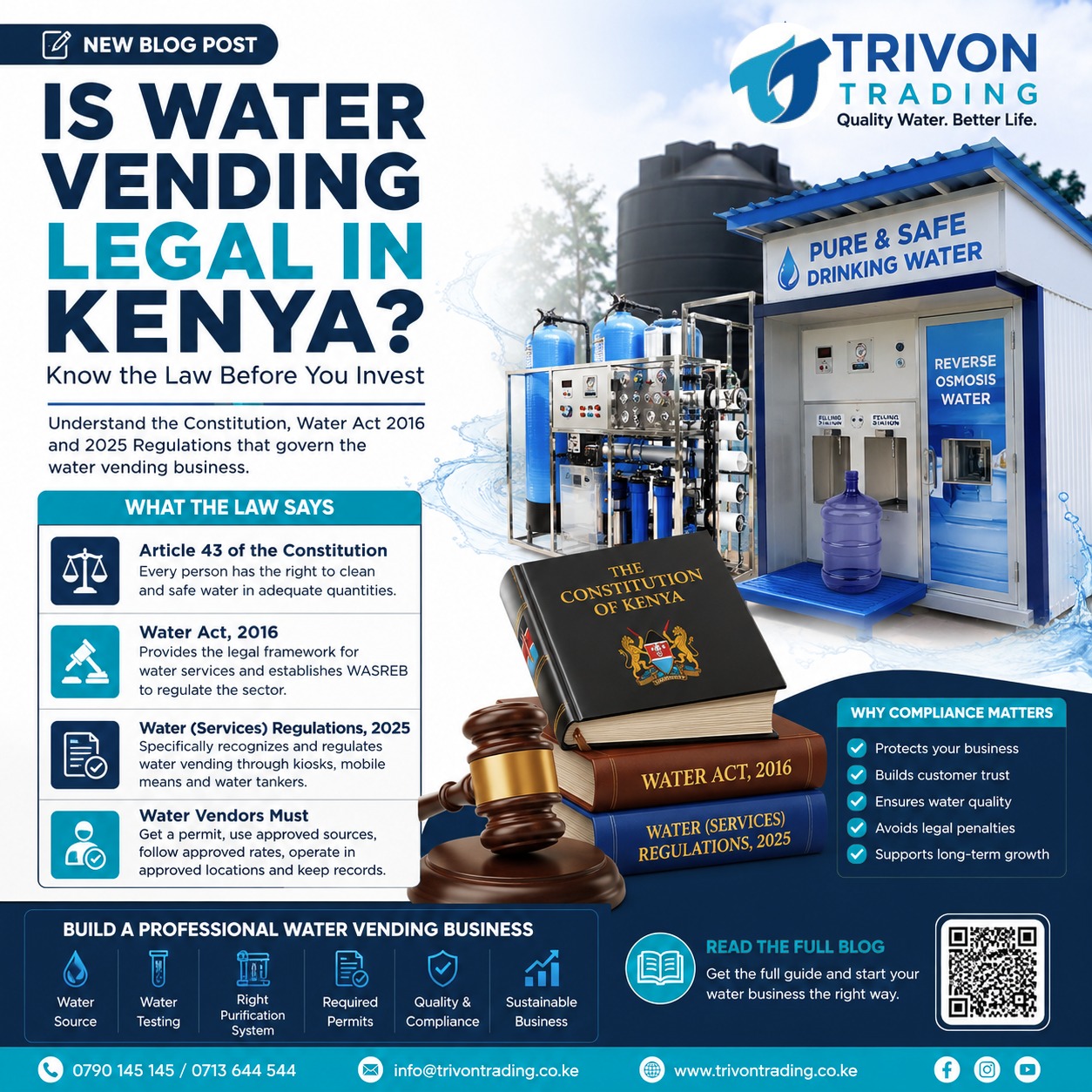
Water vending is a growing business opportunity in Kenya. From small water refill kiosks and purified water shops to commercial water delivery businesses and larger water treatment plants, entrepreneurs across the country are investing in ways to make clean and safe water more accessible to communities.
But before buying a Reverse Osmosis (RO) machine, leasing a shop, drilling a borehole, or setting up a water vending station, there is one important question every entrepreneur should ask:
Is water vending legal in Kenya?
The short answer is yes, water vending is a recognized and regulated activity in Kenya. However, being a legal business opportunity does not mean that anyone can simply obtain water, install a purification machine and start selling it without approvals.
Kenya’s legal framework establishes a right to clean and safe water, regulates the provision of water services, protects consumers and specifically provides for the regulation of water vending through kiosks, mobile means and water tankers.
The Constitution of Kenya recognizes access to clean and safe water in adequate quantities as an economic and social right. The Water Act, 2016 gives effect to this right, while the Water (Services) Regulations, 2025 specifically address water vending and set out requirements for vendors.
For entrepreneurs, this means there is a real opportunity in the water business—but it is an opportunity that should be approached professionally and in compliance with the applicable laws.
In this guide, we explain the Kenyan Constitution, Water Act 2016 and Water (Services) Regulations 2025 in simple language and show what they mean for anyone planning to start a water vending business.
Is Water Vending Legal in Kenya?
Yes. Water vending is expressly addressed in Kenya’s water-services regulations.
The Water (Services) Regulations, 2025 provide for the regulation of water vending through:
- Water kiosks
- Mobile means
- Water tankers
Regulation 74 requires water services providers to establish operational procedures for regulating water vending within their areas of supply. These procedures require vendors to obtain the appropriate permit, source water from approved sources, follow approved rates, operate from approved locations and submit required annual reports.
This is an important distinction.
The law does not say that water vending is an illegal informal activity. Instead, it creates a framework through which water vending can be regulated and operated legally.
Therefore, the better question is not:
“Can I sell water in Kenya?”
It is:
“How do I establish and operate a compliant water vending business in Kenya?”
That is where proper planning becomes important.
What Does the Constitution of Kenya Say About Water?
The foundation of Kenya’s water sector is found in the Constitution of Kenya, 2010.
Article 43(1)(d) provides that every person has the right to clean and safe water in adequate quantities.
This is significant because water is not treated merely as an ordinary commercial product. Access to clean and safe water is recognized as part of Kenya’s economic and social rights.
For a water business entrepreneur, this creates an important market context.
Communities need access to reliable water.
Businesses need water.
Schools need water.
Hotels need water.
Hospitals and institutions need water.
Households need water.
As populations grow and urban areas expand, the demand for reliable access to safe water also creates opportunities for businesses that can provide water responsibly and within the regulatory framework.
Does Article 43 Give You a License to Sell Water?
No.
This is an important clarification.
Article 43 establishes the right of people to clean and safe water. It does not automatically give an individual the right to abstract, treat or commercially sell water without complying with the relevant laws and approvals.
The Constitution establishes the broader right; legislation and regulations provide the framework for how water services are managed and provided.
That distinction should be understood by every water vending entrepreneur.
What Does the Water Act 2016 Say About Water?
The Water Act, 2016 provides the legal framework for the regulation, management and development of water resources and water services in Kenya.
Section 63 of the Act reinforces the constitutional right by stating that every person in Kenya has the right to clean and safe water in adequate quantities and to reasonable standards of sanitation, as provided under Article 43 of the Constitution.
The Act also establishes the Water Services Regulatory Board (WASREB) and gives it regulatory responsibilities relating to water services.
Among other functions, WASREB is responsible for setting national standards for water services, regulating and monitoring licensees, setting licensing conditions, approving tariffs and monitoring compliance with applicable standards.
This means the water vending industry operates within a wider regulatory ecosystem rather than existing outside government oversight.
The 2025 Water Services Regulations Are Particularly Important for Water Vendors
For anyone researching the legal requirements for a water vending business in Kenya, the Water (Services) Regulations, 2025 deserve special attention.
The regulations were published as Legal Notice No. 54 of 2025 and commenced on 28 February 2025. They provide a framework for the regulation, management, operation and financing of water services in line with the Water Act.
Most importantly for entrepreneurs, Regulation 74 specifically deals with water vending.
This means a person searching for information about whether water vending is recognized under Kenyan water law does not have to rely solely on general constitutional provisions.
There is an actual regulation dealing specifically with the activity.
What Does Regulation 74 Say About Water Vending?
Regulation 74 provides for water vending through:
1. Water kiosks
2. Mobile means
3. Water tankers
The regulation requires water services providers to develop operational procedures for regulating water vending within their areas of supply.
Those procedures must require water vendors to meet several conditions.
Let’s explain them simply.
1. Water Vendors Need the Appropriate Permit
One of the requirements under Regulation 74 is that water vendors acquire a permit from the relevant water services provider.
This is one of the most important points for a new entrepreneur.
Buying a water vending machine does not automatically make a business compliant.
Before opening your doors to customers, you should determine which water-service approvals and permits apply to your proposed operation and location.
The exact requirements can depend on:
- Your county
- Your water source
- Your water services provider
- The nature of your operation
- Whether you operate a kiosk, treatment plant, tanker or other model
2. Water Must Come From an Approved Source
Regulation 74 requires vendors to source water for vending only from approved sources.
This is especially important for entrepreneurs planning to use:
- Borehole water
- Municipal water
- Spring water
- Other natural water sources
You should not assume that having access to a water source automatically makes it suitable for commercial vending.
The source must be legally usable and the water must meet the applicable requirements.
Can I Use Borehole Water for a Water Vending Business?
Yes, borehole water can be an important source for commercial water treatment and vending, but a borehole does not automatically give you unrestricted permission to sell water commercially.
The 2025 regulations contain provisions concerning boreholes, including requirements relating to borehole permits and information about how the borehole water is being used.
The regulations also address situations involving water services providers obtaining water from privately owned boreholes.
Therefore, if your business plan is:
Borehole → Water Treatment → Storage → Water Vending
you should confirm the relevant borehole authorization, water-resource requirements and water-service requirements before investing heavily in the equipment.
This is one reason why professional consultation before purchasing an RO system can save an entrepreneur significant money.
3. Water Vendors Must Operate at Approved Locations
The 2025 regulations require water vending kiosks and water tankers to operate at approved locations.
This means that finding a cheap shop is not the only consideration when choosing a water vending location.
Before signing a long-term lease, consider:
- Whether the location is suitable for water vending
- Whether the relevant approvals can be obtained
- Availability of water and electricity
- Drainage
- Accessibility for customers
- Space for storage tanks
- Space for purification equipment
- Hygiene
- Wastewater management
- Delivery access
A good location should be both commercially attractive and operationally appropriate.
4. Water Vendors Must Follow Approved Rates Where Applicable
Regulation 74 also addresses the rates charged for water vending and requires vendors to comply with the applicable approved rates established within the regulatory framework.
This is important for entrepreneurs preparing their business plan.
Do not simply choose a selling price based on what another water kiosk is charging.
Your pricing strategy should consider:
- Cost of raw water
- Electricity
- Filter replacement
- RO membrane replacement
- Labour
- Rent
- Packaging
- Transportation
- Maintenance
- Permits and licenses
- Other operating costs
A water vending business should be profitable while remaining compliant with applicable pricing requirements.
5. Water Vendors Have Reporting Responsibilities
Regulation 74 also requires water vendors to file annual reports with the relevant water services provider.
This reinforces an important principle:
Water vending is a regulated business—not simply a cash-and-carry retail activity.
Keeping proper records is therefore good business practice.
Maintain records such as:
- Daily water production
- Water sales
- Water source
- Treatment activities
- Maintenance
- Filter replacement
- Water-quality testing
- Customer complaints
- Equipment servicing
Good records can also help you understand your actual business performance.
What About Consumer Protection?
Water vendors are dealing with a product that directly affects public health.
Article 46 of the Constitution provides consumer rights including the right to goods and services of reasonable quality, necessary information, protection of health, safety and economic interests, and compensation for loss or injury arising from defects in goods or services.
For a water vending business, this is extremely important.
You are not simply selling litres of water.
You are selling something people may drink.
Therefore:
Water quality must be treated as a core business responsibility.
Why Water Treatment Equipment Matters
A water vending business should never select purification equipment simply because it is cheap.
The correct treatment technology depends on the water source and water-quality test results.
Depending on the source, a treatment plant may require:
- Sediment filtration
- Sand filtration
- Activated carbon filtration
- Water softening
- Iron removal
- Ultra Filtration (UF)
- Reverse Osmosis (RO)
- UV sterilization
- Ozone treatment
- Final polishing
- Hygienic storage
For many borehole-water businesses, RO is an important part of the treatment process because borehole water can contain dissolved minerals and high TDS. However, water testing should determine the final system design.
What Does This Mean for Someone Starting a Water Vending Business?
The legal framework actually gives entrepreneurs something valuable:
Clarity that water vending is a regulated activity.
Instead of treating the business as an informal operation, entrepreneurs can build it as a proper commercial venture.
A professional water vending business can have:
- A registered business
- A suitable premises
- Approved water source
- Appropriate permits
- Water treatment equipment
- Storage facilities
- Hygiene procedures
- Water-quality monitoring
- Proper financial records
- Customer service procedures
- Equipment maintenance schedules
This approach creates a business that can grow beyond a small neighbourhood kiosk.
Why Water Vending Can Be a Strong Business Opportunity in Kenya
The constitutional recognition of access to clean and safe water highlights the importance of water access throughout Kenya.
At the same time, the regulatory framework provides mechanisms for water services and water vending to be organized and monitored.
This creates opportunities for entrepreneurs who can combine:
Water + Technology + Compliance + Good Business Management.
A modern water business can serve:
Households
Customers can refill 10L, 20L and other household containers.
Offices
Businesses can purchase regular drinking-water supplies.
Schools and Institutions
Institutions can require reliable treated water supplies.
Restaurants and Hotels
Hospitality businesses require consistent access to quality water.
Water Delivery Customers
Businesses can expand from walk-in refills into delivery.
Residential Developments
Apartments and gated communities can create additional demand for treated water.
What Equipment Do You Need to Start?
The exact equipment depends on the water source and business model.
A typical commercial water vending setup may include:
Raw Water Storage Tank
Stores untreated water before purification.
Pre-Treatment System
Protects downstream equipment by removing sediments and other contaminants.
Reverse Osmosis System
Used where water analysis indicates RO is required.
UV Sterilizer
Provides additional microbial treatment.
Pure Water Storage Tank
Stores treated water hygienically.
Bottle Rinser
Helps improve hygiene before filling customers’ containers.
Filling Station
Allows faster and more organized water dispensing.
Water Vending Machine or ATM
Can provide automated dispensing depending on the business model.
Why Trivon Trading Can Help You Build the Setup
Starting a water vending business involves more than purchasing a machine.
You need to choose equipment based on:
- Water source
- Water quality
- Production target
- Available space
- Budget
- Expected customer volume
- Future expansion
Trivon Trading Company Limited specializes in the design, fabrication, supply, installation, servicing and repair of water-treatment and vending systems. Its product range includes Reverse Osmosis machines, pure-water treatment systems, water vending machines, bottle rinsers, manual filling machines and automatic filling equipment.
For example, Trivon’s current product listings include a 500 LPH Reverse Osmosis system, as well as larger systems including 750 LPH, 1,000 LPH and 2,000 LPH options.
For entrepreneurs starting on a moderate scale, a properly designed 500 LPH RO system can be a practical starting point, with expansion as customer demand grows. The appropriate capacity, however, should be determined by water quality, expected production and business requirements.
Water Vending Is More Than Buying an RO Machine
One of the biggest mistakes new entrepreneurs make is thinking:
“I have an RO machine, therefore I have a water business.”
Not necessarily.
An RO machine is only one component of a complete water treatment operation.
You also need to think about:
Water source
↓
Water testing
↓
Pre-treatment
↓
RO/UF or other appropriate treatment
↓
Disinfection
↓
Clean-water storage
↓
Hygienic dispensing
↓
Quality monitoring
↓
Customer service
↓
Business compliance
This is the difference between simply owning a machine and operating a professional water business.
What About County Government Requirements?
Water services are implemented within a system that involves both national and county institutions.
The 2025 regulations assign responsibilities to county governments and county water directorates, including registration of water services providers operating within the county and enforcement of applicable rules, guidelines and standards through the relevant framework.
Therefore, entrepreneurs should not assume that one national approval automatically replaces all county-level requirements.
Depending on the nature and location of your business, you may need to consider matters such as:
- County business permits
- Premises requirements
- Public-health requirements
- Planning or zoning requirements
- Water-source authorization
- Water-service permits
- Environmental requirements where applicable
- Water-quality requirements
The exact requirements should be confirmed with the relevant authorities before opening.
What If I Want to Operate a Large Water Service?
There is an important distinction between operating a small water vending operation and becoming a water services provider.
Section 85 of the Water Act provides that a person should not provide water services except under a licence issued by the Regulatory Board, subject to the exceptions provided in the Act and regulations. WASREB also states that providing water services without the required licence can be an offence.
Therefore, entrepreneurs planning a larger water-supply operation should establish exactly which regulatory category their business falls under rather than assuming that a normal water-vending permit covers every possible activity.
The Biggest Legal Mistakes Water Entrepreneurs Should Avoid
1. Assuming Water Is Free to Commercialize
Having access to a water source does not automatically give you unlimited commercial rights.
2. Starting Without Checking the Water Source
Your source must meet the applicable requirements.
3. Opening Before Getting Required Approvals
Do not wait until after investing in equipment and renovations to investigate permits.
4. Ignoring Water Quality
A beautiful water kiosk with poor-quality water is still a failed water business.
5. Buying Equipment Before Testing the Water
Water treatment equipment should be selected based on the actual characteristics of your water.
6. Ignoring Maintenance
Filters, membranes, pumps, UV systems and other components require regular inspection and servicing.
7. Treating Compliance as a One-Time Activity
Compliance should become part of your normal business operations.
A Practical Roadmap for Starting a Compliant Water Vending Business
If you’re serious about starting a water vending business in Kenya, consider the following sequence:
Step 1: Identify Your Market
Determine who will buy your water.
Step 2: Identify Your Water Source
Will you use:
- Municipal water?
- Borehole water?
- Another approved source?
Step 3: Test the Water
Obtain a proper water-quality analysis before selecting equipment.
Step 4: Determine the Required Treatment
Choose between RO, UF or a combination of treatment technologies based on the test results.
Step 5: Select Your Production Capacity
For many new businesses, a properly designed 500 LPH system can provide a reasonable starting point, with expansion as demand grows.
Step 6: Confirm Regulatory Requirements
Check with the relevant water services provider, county government and other applicable authorities.
Step 7: Set Up the Premises
Ensure proper drainage, hygiene, electrical installation, storage and workflow.
Step 8: Install the Treatment System
Use competent technicians and follow the equipment manufacturer’s requirements.
Step 9: Establish Quality-Control Procedures
Monitor water quality and maintain equipment records.
Step 10: Launch and Grow
Start selling, monitor demand and reinvest into capacity as the business grows.
Is the Kenyan Constitution “In Favour” of Water Vending?
This question deserves a precise answer.
The Constitution supports the importance of the water sector, but it does not specifically declare water vending a constitutional right or give individuals an automatic commercial license to sell water.
What it does is recognize access to clean and safe water as a fundamental economic and social right.
The Water Act then provides the statutory framework for water services, while the Water (Services) Regulations, 2025 specifically provide for the regulation of water vending.
Therefore, the strongest conclusion is:
Kenya’s legal framework recognizes the importance of access to clean and safe water and expressly provides for regulated water vending. Entrepreneurs can therefore participate in the water vending sector, provided they comply with the applicable regulatory, water-source, quality, public-health and county requirements.
That is a much more accurate interpretation than simply saying that the Constitution “allows water vending.”
Final Thoughts: Water Vending Is a Regulated Opportunity
Kenya’s water sector presents a significant opportunity for entrepreneurs.
The Constitution recognizes access to clean and safe water as a right. The Water Act provides the legal foundation for water services, while the Water (Services) Regulations, 2025 specifically recognize and regulate water vending through kiosks, mobile means and water tankers.
For entrepreneurs, the message is clear:
There is an opportunity—but build the business correctly.
Don’t start by asking:
“What is the cheapest RO machine I can buy?”
Start by asking:
“What is my water source, what is in my water, what does the law require, and what treatment system will produce safe and consistent water?”
That approach protects your investment and your customers.
At Trivon Trading, entrepreneurs can access water purification and vending equipment ranging from RO systems and pure-water plants to vending machines, bottle rinsers and filling equipment. The company also provides design, fabrication, installation, servicing and repair services for water-treatment systems.
If you are planning to start a water vending business in Kenya, get the legal and technical side right from the beginning.
Start with the source. Test the water. Understand the requirements. Choose the right treatment system. Build for compliance—and then build for growth.
Important Legal Disclaimer
This article is intended for general educational and business-planning purposes. It is not a substitute for legal advice, regulatory advice or professional water-resource advice.
Water vending requirements can depend on the type of operation, water source, location and applicable county and water-service-provider procedures. Before investing or commencing operations, confirm the current requirements with the relevant Water Services Regulatory Board (WASREB), water services provider, Water Resources Authority (WRA), county government, public-health authorities and other applicable regulators.
Laws and regulations can also be amended, so entrepreneurs should verify the current legal requirements before starting operations.