

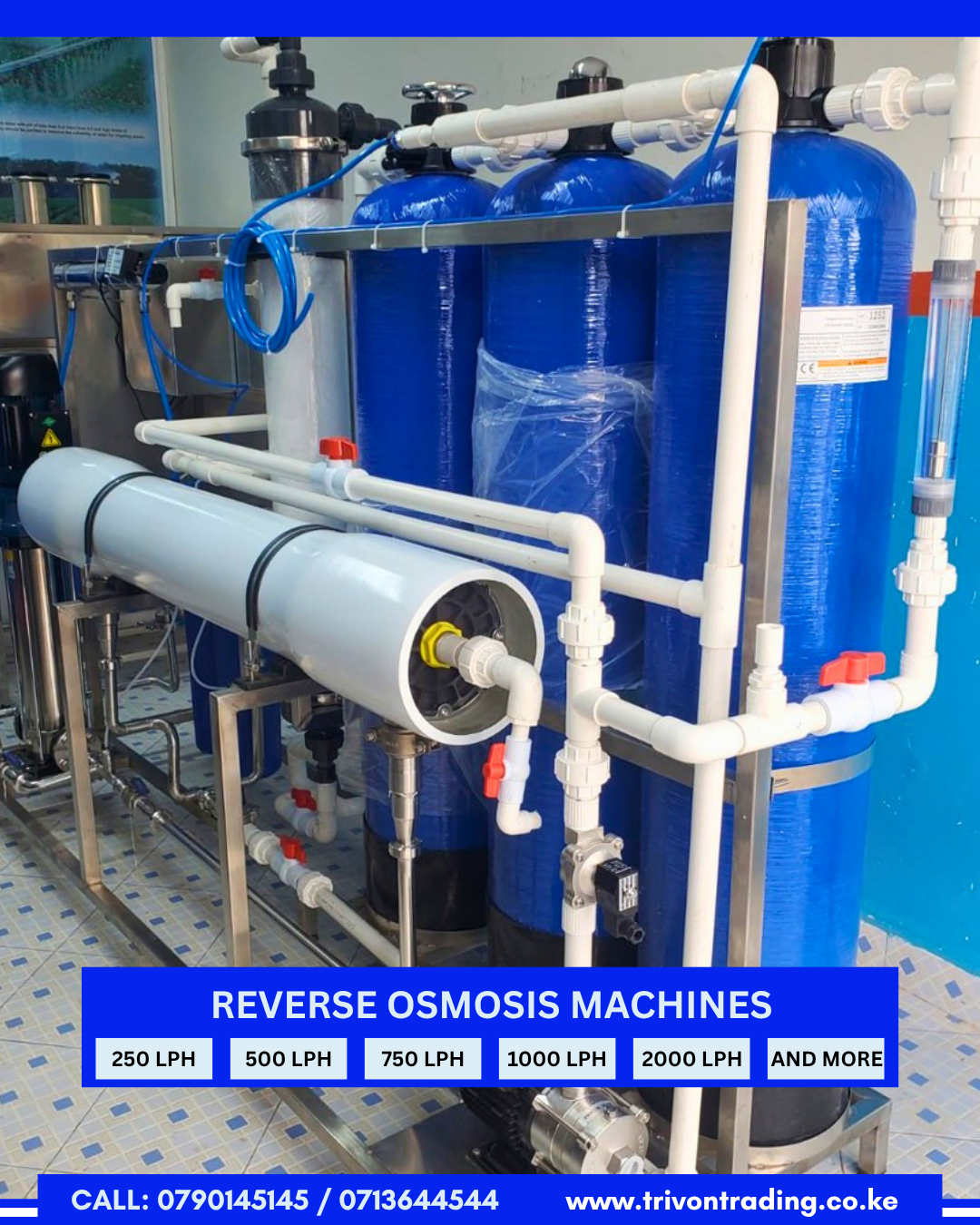
Choosing the right water purification system is one of the most important decisions when setting up a water refill business, installing a commercial water treatment plant, or even improving your home’s drinking water. Yet many people ask the same question:
Should I buy an Ultra Filtration (UF) machine or a Reverse Osmosis (RO) machine?
The answer isn’t simply “RO is better” or “UF is cheaper.” The truth is that the best water purification system depends entirely on your water source and the quality of the water you’re treating.
: highlight
This comprehensive guide explains the differences between UF and RO systems, when each one should be used, and how to determine the right solution for your home, business, or water vending station.
Why Choosing the Right Water Treatment System Matters
Water quality varies significantly across Kenya.
Depending on your location, your water may come from:
- Boreholes
- Municipal (county) water supply
- Wells
- Rivers
- Springs
- Rainwater harvesting systems
Each source contains different levels of:
- Total Dissolved Solids (TDS)
- Salts
- Minerals
- Bacteria
- Viruses
- Sediments
- Heavy metals
- Chemicals
Because every water source is different, one purification system cannot solve every water quality problem.
What Is an Ultra Filtration (UF) Machine?
An Ultra Filtration (UF) Machine uses a membrane with microscopic pores to remove:
✔ Sediments
✔ Dirt
✔ Rust
✔ Bacteria
✔ Suspended particles
Unlike Reverse Osmosis, a UF membrane does not remove dissolved minerals or salts.
This means beneficial minerals remain in the water.
Advantages of UF Systems
Ultra Filtration offers several benefits:
✔ Lower installation cost
✔ Lower maintenance costs
✔ Higher water recovery
✔ No electricity required in some systems
✔ Retains natural minerals
UF systems are ideal when the incoming water is already relatively clean.
Limitations of UF Systems
Although UF is highly effective for many applications, it cannot remove:
❌ High TDS
❌ Salinity
❌ Dissolved salts
❌ Fluoride
❌ Heavy metals
❌ Chemical contaminants
For these issues, Reverse Osmosis is usually the better solution.
What Is a Reverse Osmosis (RO) Machine?
A Reverse Osmosis Machine uses high pressure to force water through a semi-permeable membrane.
This process removes:
✔ Dissolved salts
✔ High TDS
✔ Heavy metals
✔ Fluoride
✔ Harmful chemicals
✔ Bacteria
✔ Viruses
✔ Unpleasant taste and odor
RO systems provide a much deeper level of purification.
Advantages of RO Systems
Reverse Osmosis is recommended when water quality is poor.
Benefits include:
✔ Excellent drinking water quality
✔ Removes dissolved contaminants
✔ Improves taste
✔ Reduces salinity
✔ Produces consistent water quality
This makes RO the preferred solution for many commercial applications.
Limitations of RO Systems
RO systems also have considerations:
- Higher initial investment
- Regular filter and membrane replacement
- Produces reject water as part of the purification process
- Requires adequate water pressure
However, these trade-offs are often worthwhile when treating challenging water sources.
UF vs RO: What’s the Difference?
| Feature | UF Machine | RO Machine |
|---|---|---|
| Removes bacteria | ✅ | ✅ |
| Removes viruses | Some systems | ✅ |
| Removes dissolved salts | ❌ | ✅ |
| Removes high TDS | ❌ | ✅ |
| Removes heavy metals | ❌ | ✅ |
| Retains natural minerals | ✅ | Removes many dissolved minerals |
| Best for low-TDS water | ✅ | Can work but may be unnecessary |
| Best for borehole water | Sometimes | ✅ Often the better choice |
Which System Is Best for Borehole Water?
Many Kenyan entrepreneurs use borehole water for:
- Water vending businesses
- Bottled water production
- Commercial operations
Borehole water commonly contains:
- High TDS
- Salts
- Iron
- Hardness
- Fluoride
For these conditions, an Reverse Osmosis Machines is usually the recommended solution because it removes dissolved contaminants that UF systems cannot.
Which System Is Best for Municipal Water?
County or municipal water is generally treated before distribution.
If water has:
- Low TDS
- Good taste
- Acceptable chemical levels
A Ultra Filtration (UF) Machines may be sufficient.
However, if municipal water has high dissolved solids or unusual contamination, an RO system may still be necessary.
Why Water Testing Comes First
The biggest mistake buyers make is purchasing equipment before testing their water.
Professional water analysis should measure:
- TDS
- pH
- Hardness
- Iron
- Fluoride
- Salinity
- Turbidity
The results determine whether a UF or RO system is the right investment.
At Trivon Trading, customers are encouraged to understand their water quality before choosing a treatment system.
Can You Use UF and RO Together?
Yes.
Many commercial systems combine:
- Sand filtration
- Activated carbon filtration
- Water softening (where necessary)
- Reverse Osmosis
- UV sterilization
Some treatment plants also include UF as part of a multi-stage process to improve efficiency and protect downstream equipment.
Which System Is Better for a Water Vending Business?
If your business uses borehole water, an RO system is generally the better choice because it can handle high TDS and dissolved minerals.
If your business receives already-treated municipal water with acceptable quality, a UF system may be enough—provided water testing confirms this.
This is why there is no universal answer. The best system depends on your water analysis.
Common Mistakes to Avoid
Avoid these common errors:
1. Buying Based on Price
A cheaper UF machine may cost more in the long run if it cannot solve your water quality problems.
2. Assuming All Borehole Water Is the Same
Every borehole is different.
Two neighboring boreholes can have completely different TDS and mineral levels.
3. Ignoring Water Testing
Never buy equipment before understanding your water.
4. Choosing the Wrong Supplier
Professional guidance helps you avoid purchasing equipment that doesn’t meet your needs.
Why Many Businesses Choose Trivon Trading
Selecting the right purification system requires experience.
Trivon Trading supplies:
✔ Borehole Water Treatment Solutions
✔ Water Vending Equipment
✔ Complete Commercial Water Purification Plants
The team helps customers:
- Analyze their water source
- Recommend suitable treatment technology
- Design scalable purification systems
- Install and support commercial operations
Final Thoughts
When choosing between a UF and an RO machine, the most important factor is your water source—not the price of the equipment.
As a general guide:
- Choose a UF system if your water has low TDS and is already relatively clean, such as treated municipal water.
- Choose an RO system if your water has high TDS, salinity, fluoride, heavy metals, or comes from a borehole.
The smartest investment starts with a professional water quality test. Once you understand what’s in your water, selecting the right purification system becomes much easier.
By working with experienced suppliers like Trivon Trading, you can invest confidently in a solution that delivers clean, safe water while supporting your long-term business goals.


