

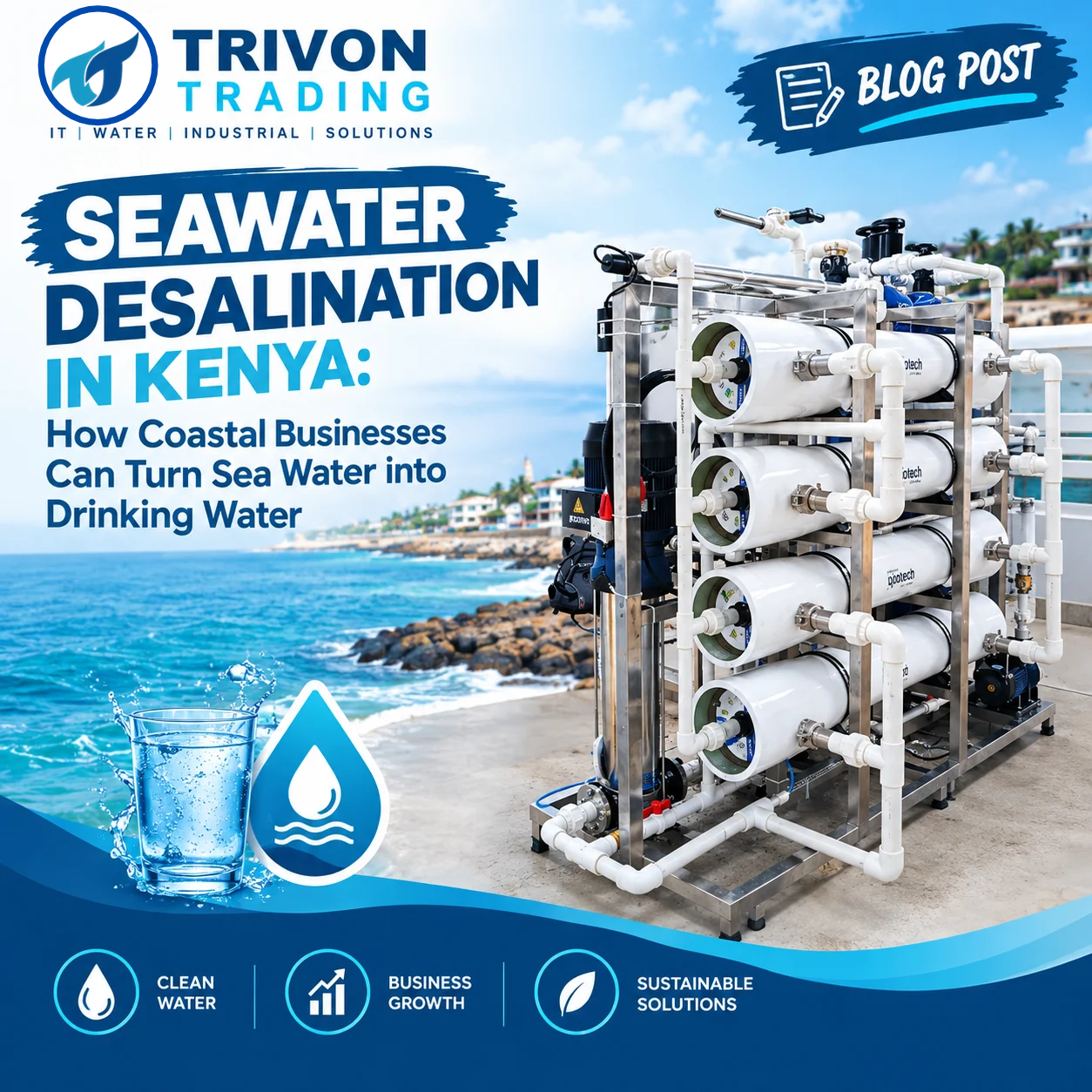
Introduction
If you run a hotel, resort, school, hospital, or industrial facility along Kenya’s coast — Mombasa, Malindi, Lamu, Kilifi, Diani, or the many islands and beachfront developments in between — you already know one thing better than most: reliable freshwater is not guaranteed.
Coastal areas face a unique water challenge. Groundwater is often brackish or salty due to seawater intrusion, municipal supply can be inconsistent, and trucking in water is expensive and unreliable during peak season when demand is highest. Meanwhile, there’s an almost unlimited resource sitting right next to these businesses — the ocean.
Seawater desalination solves exactly this problem. It’s the process of removing salt and dissolved minerals from seawater to produce clean, safe drinking water, and it’s increasingly being adopted by coastal hotels, resorts, and institutions across Kenya as a permanent, on-site water security solution.
This guide explains how seawater desalination actually works, who it’s suited for, what it costs to run, and what to look for before investing in a system.
Why Coastal Kenya Has a Unique Water Problem
Unlike inland areas where boreholes typically strike fresh or moderately mineral-rich water, coastal boreholes are prone to saline intrusion — seawater seeping into freshwater aquifers, especially in areas with heavy groundwater extraction or proximity to the shoreline. This means many coastal boreholes produce water with total dissolved solids (TDS) far too high for comfortable drinking, let alone commercial food and beverage use.
At the same time:
- Municipal supply is inconsistent in many coastal towns, with rationing common during dry seasons
- Tourism demand spikes seasonally, putting pressure on water systems exactly when hotels and resorts need reliability most
- Water trucking is expensive and unreliable, especially for island properties or remote beachfront locations
- Guest and institutional expectations are high — hotels, hospitals, and schools can’t afford inconsistent water quality
For businesses in this position, desalination isn’t a luxury upgrade. It’s often the most practical long-term fix to a structural water supply problem.
How Seawater Desalination Works
Seawater desalination uses Reverse Osmosis (RO) — the same core technology used in freshwater purification, but engineered specifically to handle the much higher salt content of seawater.
Here’s the general process:
- Sand Filtration – Removes large particles, sediment, and debris from the raw seawater intake
- Activated Carbon Filtration – Eliminates organic compounds and odors
- Cartridge/Sediment Filtration (5-micron) – Captures fine particles and protects the RO membranes from damage
- High-Pressure Pumping – Seawater is pressurized to 55–65 Bar (roughly 10 times the pressure used in standard freshwater RO) to force water molecules through the membrane while blocking salt
- Seawater RO Membrane Array – Specially rated membranes reject over 99% of dissolved salts and contaminants
- Micro-Filtration – A polishing stage for additional clarity
- UV Disinfection – Destroys any remaining bacteria, viruses, or pathogens
The result is fresh, safe drinking water with total dissolved solids typically brought down from 35,000–45,000 ppm (raw seawater) to under 1,000 ppm — well within safe drinking standards.
Why Seawater Desalination Requires Different Engineering Than Freshwater RO
It’s important to understand that seawater desalination is not simply “a bigger RO machine.” Seawater’s salinity is dramatically higher than brackish borehole water, which changes the entire engineering approach:
- Much higher operating pressure (55–65 Bar vs. 8–15 Bar for standard borehole RO)
- Specially rated seawater membranes, built to withstand higher pressure and salt concentration without degrading quickly
- Corrosion-resistant construction throughout — stainless steel 316 piping and components are standard, since standard steel grades corrode quickly in a high-salinity, high-pressure environment
- Lower recovery rates — typically 35–50% of the feed water becomes usable product water, with the remainder discharged as concentrated brine
- Higher power consumption per litre produced, due to the pressure required
This is why sourcing a purpose-built seawater desalination system — rather than adapting a standard borehole RO unit — matters enormously for reliability and equipment lifespan.
Who Should Consider a Seawater Desalination System?
Seawater desalination makes the most sense for:
- Coastal hotels and resorts needing a reliable, guest-quality water supply independent of municipal rationing
- Island properties and remote beachfront developments where water trucking is costly or logistically difficult
- Hospitals and clinics in coastal areas requiring dependable water for medical use
- Schools and institutions serving large populations in areas with poor groundwater quality
- Commercial water vending businesses in coastal towns looking to sell purified water where borehole options are limited by salinity
- Industrial and marine facilities requiring process water independent of variable public supply
What Size System Do You Need?
Desalination systems are typically sized by production capacity in Litres Per Hour (LPH). The right size depends on your daily water demand:
- 500 LPH – Suited to smaller hotels, guesthouses, or institutions with moderate daily demand (roughly 8,000–12,000 litres over a typical operating day)
- 1,000 LPH – A common mid-range choice for larger hotels, resorts, or schools (up to 24,000 litres/day)
- 2,000 LPH and above – Designed for large resorts, hospitals, industrial sites, or businesses supplying water to multiple points or third parties (up to 48,000 litres/day and beyond)
Getting the capacity right matters. Undersizing leaves you short during peak occupancy or demand; oversizing means paying for power and maintenance capacity you don’t need. A proper site assessment — factoring in guest numbers, existing usage patterns, and growth plans — should always precede a purchase decision.
What Does a Complete Desalination Setup Include?
A properly engineered seawater desalination installation typically includes:
- Seawater intake system with pre-filtration (sand, carbon, cartridge stages)
- High-pressure pump system, rated for continuous seawater duty
- Seawater-rated RO membrane array
- UV disinfection stage for final microbial safety
- Digital control panel with pressure gauges, flow meters, and TDS monitoring
- Automatic shut-off protection against low pressure or dry-run conditions
- Product water storage tank, sized to your daily demand
- Brine/reject water discharge system, compliant with local environmental discharge requirements
Maintenance: What to Expect
Seawater systems require more attentive maintenance than standard freshwater RO, simply because of the harsher operating conditions:
- Sand filter backwash – weekly
- Cartridge filter replacement – every 4–6 weeks
- Carbon filter replacement – every 3–6 months
- Membrane cleaning (CIP) – every 3–6 months
- Membrane replacement – every 3–5 years
- UV lamp replacement – annually
Businesses that skip regular maintenance typically see reduced water output, higher energy consumption, and shortened membrane life — so budgeting for ongoing upkeep, not just the initial purchase, is essential.
Managing Running Costs
Because seawater desalination requires significantly higher pressure than standard water treatment, power consumption is naturally higher — typically in the range of 4.5–6.0 kWh per cubic metre of product water. For businesses running larger systems, an energy recovery device (ERD) is worth considering, as it captures energy from the high-pressure reject stream and can meaningfully reduce overall power costs at scale.
Solar-compatible configurations are also increasingly requested by coastal properties looking to offset running costs, particularly given the strong solar resource along Kenya’s coastline.
Environmental & Regulatory Considerations
Brine (reject water) discharge needs to be handled responsibly and in line with local environmental regulations, since concentrated saline discharge can affect nearby marine or coastal ecosystems if released carelessly. A properly designed system will include a compliant discharge route as part of the installation — this is something to confirm with your supplier before installation, not after.
Systems should also be built with food-grade materials suitable for potable water contact, with reference to KEBS water treatment equipment standards, and documentation provided at handover for compliance purposes.
Common Mistakes Coastal Businesses Make
- Adapting a standard RO system for seawater instead of using purpose-built seawater-rated equipment — this leads to rapid membrane failure and poor performance
- Undersizing the system based on off-season demand, then struggling during peak tourist season
- Skipping pre-treatment stages to save on upfront cost, which shortens membrane life dramatically
- Not planning for brine discharge before installation, leading to compliance issues later
- Ignoring maintenance schedules, resulting in declining water quality and unplanned downtime
Why This Matters for Coastal Business Reliability
For a hotel or resort, water isn’t just operational infrastructure — it’s directly tied to guest experience, health compliance, and reputation. For hospitals and schools, it’s a matter of basic service reliability. Seawater desalination gives coastal businesses genuine independence from the water supply constraints that have historically limited growth and reliability in these regions — turning an abundant, previously unusable resource into a dependable operational asset.
Get a System Built for Your Location
At Trivon Trading, we design and fabricate seawater desalination systems specifically engineered for the pressures and conditions of seawater treatment — not adapted freshwater units. We work with coastal hotels, resorts, institutions, and businesses across Kenya’s coastline to assess water demand, design the right capacity, and install complete, compliant systems with ongoing technical support.
Trivon Trading Company Limited 📞 Call/WhatsApp: 0790145145 | 0713644544 📧 info@trivontrading.co.ke | trivontrading@gmail.com 🌐 www.trivontrading.co.ke
Trivon Trading Co. Ltd – Delivering Reliable Water & Dairy Solutions You Can Trust