Water Purification Machines, Water Vending

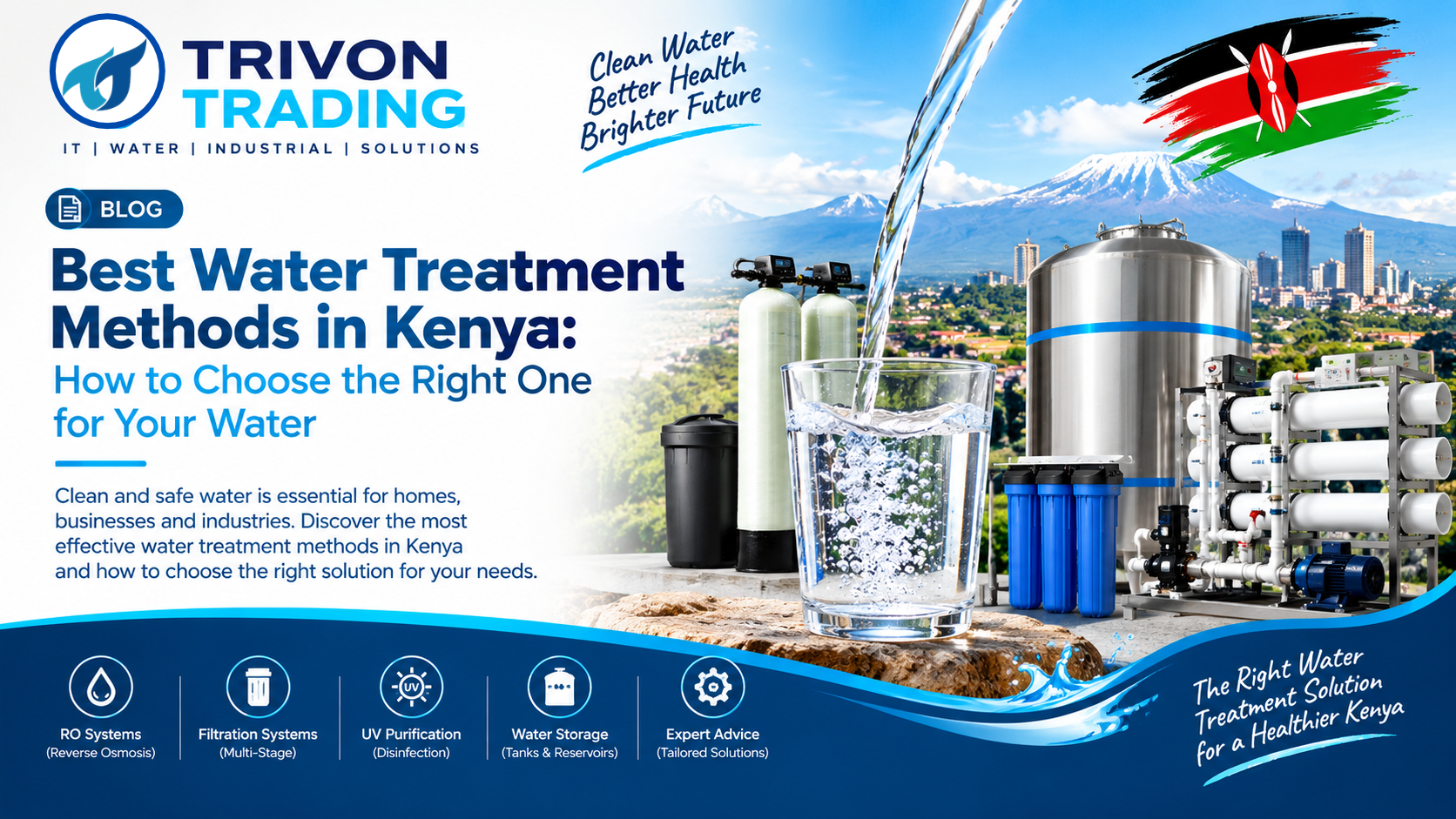
Best Water Treatment Methods in Kenya: How to Choose the Right One for Your Water

# Best Water Treatment Methods in Kenya: How to Choose the Right One for Your Water If you are searching for the **best water treatment methods**, here is the most useful answer up front: there is no single best method. The right treatment depends on what is actually in your water. A borehole in the Rift Valley may carry fluoride and salts, a coastal well may be brackish, a river source may be muddy and full of bacteria, and a town supply may simply taste of chlorine. Each problem needs a different fix. This guide explains the main water treatment methods used in Kenya, what each one removes, what it cannot remove, and how they are combined into a complete system for homes, businesses and institutions. At the end you will know how to match the method to your problem. > **Need help treating your water? Contact Trivon Trading.** We design, fabricate, supply, install and service water treatment systems across Kenya. Call or WhatsApp **0790145145**, email **info@trivontrading.co.ke**, or visit **www.trivontrading.co.ke**. --- ## Step 1: Test Your Water Before Choosing Any Method The most common mistake is buying equipment before knowing what needs treating. Many serious contaminants, including fluoride, nitrates and harmful bacteria, cannot be seen, smelled or tasted. Send a sample to an accredited laboratory and ask for at least these parameters: - pH and total dissolved solids (TDS) or conductivity - Total hardness - Iron and manganese - Fluoride and chloride - Nitrate - Turbidity - Microbiology (E. coli and total coliforms) Compare the results against the KEBS drinking water standard and the WHO guidelines. The WHO guideline value for fluoride, for example, is 1.5 mg/L. A good treatment design starts from the failed parameters, not from guesswork. ### Common water problems and what they usually mean | Problem | What you may notice | Likely treatment | |---|---|---| | Cloudy or muddy water (turbidity) | Visible particles, sediment | Coagulation, sand and cartridge filtration, ultrafiltration | | Chlorine, smell or odd taste | Chemical or earthy smell | Activated carbon | | Hard water | Scale on kettles and taps, soap that will not lather | Softening or reverse osmosis | | Iron and manganese | Red-brown or black stains, metallic taste | Aeration or oxidation plus an iron-removal filter | | High TDS or salty water | Salty taste, heavy scale | Reverse osmosis (brackish), desalination (seawater) | | Fluoride | Often no visible sign; mottled teeth over time | Reverse osmosis, activated alumina, bone char | | Bacteria and viruses | No visible sign; stomach illness | Chlorination, UV, ultrafiltration | | Acidic or alkaline pH | Corrosion, bitter or soapy taste | pH correction | | Nitrate | No visible sign | Reverse osmosis, ion exchange | --- ## The Best Water Treatment Methods Explained ### 1. Coagulation, Flocculation and Sedimentation Chemicals such as alum or ferric chloride cause fine suspended particles to clump together into heavier flocs that settle out. This is the usual first stage for muddy surface water from rivers and dams. - **Removes:** turbidity, some organic matter and some colour - **Does not remove:** dissolved salts, fluoride or most dissolved chemicals - **Best for:** surface water and large-scale treatment ### 2. Sand (Multimedia) Filtration Water passes through graded sand and gravel, which traps suspended solids. Pressure sand filters are compact and can be backwashed to clean them. - **Removes:** silt, sand, rust particles and larger suspended solids - **Does not remove:** bacteria, dissolved chemicals or odour - **Best for:** the first stage of nearly every borehole and surface-water system ### 3. Activated Carbon Filtration Granular activated carbon adsorbs chlorine, organic compounds and many substances that cause bad taste and odour. It also protects RO membranes from chlorine damage. - **Removes:** chlorine, odour, taste and colour compounds, some pesticides and organics - **Does not remove:** salts, hardness, fluoride, nitrate or most bacteria - **Note:** carbon needs regular replacement, or it stops working and can harbour bacteria ### 4. Sediment and Cartridge Filtration Cartridge filters in sizes such as 1 to 5 microns capture fine particles that pass through sand filters. They are a safety stage before membranes and UV units. - **Removes:** fine particles and carbon fines - **Best for:** protecting downstream equipment ### 5. Water Softening (Ion Exchange) A resin exchanges calcium and magnesium (the minerals behind hardness) for sodium. Resin is regenerated with salt. - **Removes:** hardness - **Does not remove:** TDS overall, fluoride or bacteria - **Best for:** hard water that causes scale in boilers, kettles, kitchens and laundry ### 6. Iron and Manganese Removal Dissolved iron and manganese turn from clear to rust-coloured when exposed to air. They are removed by aeration or chemical oxidation, followed by a filter media designed for iron and manganese, such as Birm. - **Removes:** iron and manganese, and the stains and metallic taste they cause - **Best for:** many borehole supplies ### 7. Fluoride Removal (Defluoridation) High fluoride is a well-known problem in parts of the Rift Valley and other volcanic areas. Over time it causes dental fluorosis and can affect bones. Three methods are common: - **Reverse osmosis** rejects the bulk of fluoride and also reduces TDS - **Activated alumina** adsorbs fluoride onto the media, and works best when pH is controlled - **Bone char** adsorbs fluoride onto bone-based media, and also performs best when pH is controlled Boiling does **not** remove fluoride, and it actually concentrates it. Fluoride treatment should always be designed around a lab report, because the right method and media life depend on the fluoride level, pH and alkalinity. ### 8. pH Correction Acidic water corrodes pipes and fixtures. Alkaline water can taste soapy, form scale and reduce the performance of some treatment media. pH is corrected by dosing acid or CO₂ (for high pH) or by passing water through a neutralising media or dosing an alkali (for low pH). ### 9. Chlorination Chlorine kills bacteria and many viruses, and leaves a residual that protects water in storage and pipes, typically around 0.2 to 0.5 mg/L at the point of use. - **Removes (kills):** bacteria and most viruses - **Limits:** needs adequate contact time, is less effective against some protozoa and does not remove chemicals - **Best for:** disinfection of tanks, distribution lines and large supplies ### 10. UV Disinfection Ultraviolet light inactivates bacteria, viruses and protozoa without adding chemicals or changing taste. - **Removes (inactivates):** microorganisms - **Limits:** water must be clear for UV to work, it leaves no residual, and the lamp needs annual replacement - **Best for:** the final disinfection step after filtration ### 11. Ultrafiltration (UF) UF membranes have extremely small pores that block bacteria, protozoa, many viruses and suspended solids while keeping dissolved minerals in the water. It uses no chemicals and little energy. - **Removes:** bacteria, protozoa, suspended solids and microplastics - **Does not remove:** dissolved salts, fluoride or nitrate - **Best for:** microbiologically unsafe water with acceptable chemistry, and homes that want to keep minerals ### 12. Reverse Osmosis (RO) RO forces water through a membrane that rejects dissolved salts and most dissolved contaminants. It is the most broadly effective single stage for chemical problems. - **Removes:** dissolved salts, hardness, fluoride, nitrate, heavy metals and most TDS, typically 95 to 99% - **Needs:** good pre-treatment (sand, carbon and cartridge filters) and pressure, and it produces a reject stream - **Best for:** high TDS or fluoride, brackish borehole water, water vending and bottling, and homes wanting purified drinking water ### 13. Seawater Desalination Seawater RO uses much higher pressure and specially rated membranes to turn seawater or high-salinity water into drinking water. It suits coastal hotels, resorts, islands and institutions. ### 14. Simple Household Methods For emergencies and small households: - **Boiling:** a rolling boil for at least one minute (longer at high altitude) kills microbes, but removes no chemicals - **Chlorine tablets or drops:** disinfect clear water - **Ceramic filters:** remove many bacteria and particles - **Solar disinfection:** clear water in transparent bottles in strong sun for several hours These do not fix hardness, fluoride or salinity. --- ## Which Method Fixes Which Problem? | If your water has... | Best-fit methods | |---|---| | Muddy or cloudy appearance | Sand filtration, cartridge filtration, coagulation | | Bad smell or chlorine taste | Activated carbon | | Hardness and scale | Softening, RO | | Iron or manganese | Aeration/oxidation plus iron-removal filter | | High TDS | RO | | High fluoride | RO, activated alumina, bone char | | Bacteria or viruses | Chlorination, UV, UF | | Wrong pH | pH correction | | Seawater or very high salinity | Seawater RO desalination | --- ## Combining Methods: Typical Treatment Trains Real systems rarely use one method. They combine stages so that each one protects the next. **Borehole water with iron, hardness and bacteria** Aeration/oxidation → sand and iron-removal filter → softener → activated carbon → UV or chlorination **Borehole water with high fluoride or high TDS** Sand filter → activated carbon → cartridge filter → reverse osmosis → UV (with pH correction and remineralisation if needed) **Surface water from a river or dam** Coagulation and sedimentation → sand filter → activated carbon → ultrafiltration → UV or chlorination **Water vending, refilling or bottling** Sand → carbon → cartridge → reverse osmosis → micro-filtration → UV, with stainless steel storage and dispensing --- ## Best Water Treatment Method by Situation - **Homes:** a compact RO or UF unit at the kitchen tap, with softening if hardness is severe - **Water vending and bottling:** a multi-stage RO system, because customers pay for consistently low TDS and safe water - **Hotels, schools and hospitals:** pre-treatment plus RO or UF, UV disinfection, and treated-water storage sized to demand - **Farms and dairies:** filtration and disinfection for animal and processing water, plus softening where scale affects equipment - **Coastal properties:** seawater RO, or brackish RO if the source is borehole water with high chloride - **Large community supplies:** coagulation, filtration, disinfection and, where needed, fluoride removal --- ## How to Choose: 8 Factors 1. **Lab results.** Treat what is actually wrong with your water. 2. **Purpose.** Drinking, cooking, food processing, laundry, irrigation and industry need different quality levels. 3. **Volume.** Daily demand sets the system size, measured in litres per hour. 4. **Source stability.** Borehole quality can change, so allow for variation. 5. **Power availability.** RO needs electricity, while gravity-based filters may not. 6. **Space and installation.** Check floor area, drainage and access. 7. **Running costs.** Compare filters, membranes, chemicals, electricity and servicing, not only the purchase price. 8. **Support.** Look for a supplier who installs, trains your operators and services the equipment. --- ## Why Water Treatment Systems Fail (and How to Avoid It) - **Skipping pre-treatment.** Membranes fail early when sand, carbon and cartridge stages are missing or neglected. - **Wrong method for the problem.** A carbon filter will not remove fluoride, and a softener will not make salty water drinkable. - **No maintenance.** Filters, carbon, membranes and UV lamps all have replacement intervals. - **Ignoring changes in the source.** Test again at least once a year, and whenever the taste, colour or smell changes. - **Buying on price alone.** An undersized or poorly built unit costs more in the end. --- ## Need Help Treating Your Water? Contact Trivon Trading Choosing the right water treatment method is easier with the right partner. Trivon Trading designs, fabricates, supplies, installs and services water treatment systems for homes, businesses and institutions across Kenya, including: - **Reverse osmosis systems** from domestic units to industrial capacity - **Ultrafiltration systems** for chemical-free microbial protection - **General purpose water plants** for borehole water, with flocculation, sand filtration, carbon, iron removal, pH adjustment and fluoride removal stages - **Seawater desalination machines** for coastal properties - **Water vending machines, filling stations and bottling equipment** - **Stainless steel storage tanks** for treated water Send us your lab report, or tell us what is wrong with your water, and we will recommend a treatment train that fits your needs and budget. **Trivon Trading Company Limited** 📞 Call/WhatsApp: 0790145145 | 0713644544 📧 info@trivontrading.co.ke | trivontrading@gmail.com 🌐 www.trivontrading.co.ke *Trivon Trading Co. Ltd – Delivering Reliable Water & Dairy Solutions You Can Trust* --- ## Frequently Asked Questions ### What is the best method of water treatment? It depends on your water. For most Kenyan borehole water, the best approach is a multi-stage system: filtration for particles, carbon for taste and chlorine, RO or UF depending on the chemistry, and UV or chlorine for disinfection. ### What is the most effective way to purify water? Reverse osmosis removes the widest range of dissolved contaminants, including salts, fluoride and nitrate. For microbes, UV, chlorination and ultrafiltration are highly effective. Most systems combine them. ### How do I treat borehole water in Kenya? Test the water first, then build a treatment train around the results. Typical stages include sand filtration, iron removal, softening or RO, activated carbon and disinfection. ### How can I remove fluoride from water? Reverse osmosis, activated alumina and bone char all remove fluoride. Boiling does not, because it concentrates fluoride. ### How do I remove hardness from water? Use a water softener (ion exchange) or reverse osmosis. Boiling only removes temporary hardness and leaves scale. ### Is boiling enough to make water safe? Boiling kills bacteria, viruses and protozoa, but it does not remove chemicals such as fluoride, nitrate, salts or heavy metals. ### What is the difference between RO and UF? UF removes bacteria and suspended solids but leaves dissolved minerals. RO also removes dissolved salts, fluoride and most chemicals. Choose by what your lab results show. ### How often should a water treatment system be serviced? Check it regularly and follow the replacement schedule for filters, carbon, membranes and UV lamps. Many systems need a service visit at least once or twice a year. ### How much does water treatment cost? Cost depends on your water quality, daily volume and the methods needed. Contact Trivon Trading with your lab report for a quotation. --- ## Yoast SEO Plugin Fields (Copy-Paste Ready) **Focus Keyphrase:** best water treatment methods **SEO Title:** Best Water Treatment Methods in Kenya: Complete 2026 Guide **Slug:** best-water-treatment-methods-kenya **Meta Description (153 characters):** Discover the best water treatment methods in Kenya: filtration, RO, UV, softening and more. Learn which fits your water problem and when to call experts. **Related Keyphrases (Yoast Premium, up to 4):** - water treatment methods Kenya - how to treat borehole water - water purification methods - water treatment systems Kenya **Keyphrase Synonyms (Yoast Premium):** water purification techniques, water treatment options, ways to treat water **Suggested Image Alt Text:** - "Best water treatment methods in Kenya: multi-stage borehole water treatment system" - "Reverse osmosis and UV water treatment system by Trivon Trading" - "Water treatment methods chart: matching problems to treatment" - "Sand filter and activated carbon vessels for water treatment in Kenya" **Yoast Schema Settings:** - Page type: Web Page - Article type: Blog Post - Use the **Yoast FAQ block** for the FAQ section above to generate FAQ rich results - Mark as **Cornerstone content**, since this is the pillar page for your whole water treatment cluster **Internal Linking Suggestions:** - "reverse osmosis" → your RO systems product page - "ultrafiltration" → your UF systems product page, and your post "UF or RO Machine? How to Choose" - "borehole" → your post "Borehole Water Treatment: Complete Purification Process Explained" - "KEBS drinking water standard" → your post "Water Quality Standards in Kenya: KEBS Requirements Explained Simply" - "seawater desalination" → your post "Seawater Desalination in Kenya: How Coastal Businesses Can Turn Sea Water into Drinking Water" - "general purpose water plants" → your General Purpose Water Plant product page - "water vending and bottling" → your water vending and filling station product pages - "stainless steel storage tanks" → your post "Stainless Steel Water Tanks in Kenya vs Plastic" - Link back to this post from those pages using the anchor "best water treatment methods" **Category:** Water Purification Machines **Tags:** water treatment methods, best water treatment methods, water purification Kenya, borehole water treatment, reverse osmosis, UV disinfection, fluoride removal, hard water **Social / Open Graph (Yoast Social tab):** - Title: Best Water Treatment Methods in Kenya: Which One Fits Your Water? - Description: Filtration, RO, UV, softening and more. Match the method to your water problem and know when to call the experts. - Image: 1200×630px featured image **Featured Image Brief (for design team):** A clean infographic-style header showing water moving through treatment stages (sand, carbon, RO, UV) into a glass of clear water. Use the Trivon palette: navy #0a2540, emerald #1f8f75 / #43c6ac, gold #c9a227. Size: 1200×630px. **On-page SEO Checklist:** - Focus keyphrase appears in the SEO title, slug, meta description, first paragraph, an H2-level passage and image alt text - Keep both tables as real HTML tables to help win featured snippets - Add the FAQ as a Yoast FAQ block, not plain text - Place the "Need help treating your water? Contact Trivon Trading" call-out near the top and bottom, as written - Review the post each January and update the year in the title

If you are searching for the best water treatment methods, here is the most useful answer up front: there is no single best method. The right treatment depends on what is actually in your water. A borehole in the Rift Valley may carry fluoride and salts, a coastal well may be brackish, a river source may be muddy and full of bacteria, and a town supply may simply taste of chlorine. Each problem needs a different fix.

This guide explains the main water treatment methods used in Kenya, what each one removes, what it cannot remove, and how they are combined into a complete system for homes, businesses and institutions. At the end you will know how to match the method to your problem.

Need help treating your water? Contact Trivon Trading. We design, fabricate, supply, install and service water treatment systems across Kenya. Call or WhatsApp 0790145145, email info@trivontrading.co.ke, or visit www.trivontrading.co.ke.


Step 1: Test Your Water Before Choosing Any Method

The most common mistake is buying equipment before knowing what needs treating. Many serious contaminants, including fluoride, nitrates and harmful bacteria, cannot be seen, smelled or tasted.

Send a sample to an accredited laboratory and ask for at least these parameters:

  • pH and total dissolved solids (TDS) or conductivity
  • Total hardness
  • Iron and manganese
  • Fluoride and chloride
  • Nitrate
  • Turbidity
  • Microbiology (E. coli and total coliforms)

Compare the results against the KEBS drinking water standard and the WHO guidelines. The WHO guideline value for fluoride, for example, is 1.5 mg/L. A good treatment design starts from the failed parameters, not from guesswork.

Common water problems and what they usually mean

Problem What you may notice Likely treatment
Cloudy or muddy water (turbidity) Visible particles, sediment Coagulation, sand and cartridge filtration, ultrafiltration
Chlorine, smell or odd taste Chemical or earthy smell Activated carbon
Hard water Scale on kettles and taps, soap that will not lather Softening or reverse osmosis
Iron and manganese Red-brown or black stains, metallic taste Aeration or oxidation plus an iron-removal filter
High TDS or salty water Salty taste, heavy scale Reverse osmosis (brackish), desalination (seawater)
Fluoride Often no visible sign; mottled teeth over time Reverse osmosis, activated alumina, bone char
Bacteria and viruses No visible sign; stomach illness Chlorination, UV, ultrafiltration
Acidic or alkaline pH Corrosion, bitter or soapy taste pH correction
Nitrate No visible sign Reverse osmosis, ion exchange

The Best Water Treatment Methods Explained

1. Coagulation, Flocculation and Sedimentation

Chemicals such as alum or ferric chloride cause fine suspended particles to clump together into heavier flocs that settle out. This is the usual first stage for muddy surface water from rivers and dams.

  • Removes: turbidity, some organic matter and some colour
  • Does not remove: dissolved salts, fluoride or most dissolved chemicals
  • Best for: surface water and large-scale treatment

2. Sand (Multimedia) Filtration

Water passes through graded sand and gravel, which traps suspended solids. Pressure sand filters are compact and can be backwashed to clean them.

  • Removes: silt, sand, rust particles and larger suspended solids
  • Does not remove: bacteria, dissolved chemicals or odour
  • Best for: the first stage of nearly every borehole and surface-water system

3. Activated Carbon Filtration

Granular activated carbon adsorbs chlorine, organic compounds and many substances that cause bad taste and odour. It also protects RO membranes from chlorine damage.

  • Removes: chlorine, odour, taste and colour compounds, some pesticides and organics
  • Does not remove: salts, hardness, fluoride, nitrate or most bacteria
  • Note: carbon needs regular replacement, or it stops working and can harbour bacteria

4. Sediment and Cartridge Filtration

Cartridge filters in sizes such as 1 to 5 microns capture fine particles that pass through sand filters. They are a safety stage before membranes and UV units.

  • Removes: fine particles and carbon fines
  • Best for: protecting downstream equipment

5. Water Softening (Ion Exchange)

A resin exchanges calcium and magnesium (the minerals behind hardness) for sodium. Resin is regenerated with salt.

  • Removes: hardness
  • Does not remove: TDS overall, fluoride or bacteria
  • Best for: hard water that causes scale in boilers, kettles, kitchens and laundry

6. Iron and Manganese Removal

Dissolved iron and manganese turn from clear to rust-coloured when exposed to air. They are removed by aeration or chemical oxidation, followed by a filter media designed for iron and manganese, such as Birm.

  • Removes: iron and manganese, and the stains and metallic taste they cause
  • Best for: many borehole supplies

7. Fluoride Removal (Defluoridation)

High fluoride is a well-known problem in parts of the Rift Valley and other volcanic areas. Over time it causes dental fluorosis and can affect bones. Three methods are common:

  • Reverse osmosis rejects the bulk of fluoride and also reduces TDS
  • Activated alumina adsorbs fluoride onto the media, and works best when pH is controlled
  • Bone char adsorbs fluoride onto bone-based media, and also performs best when pH is controlled

Boiling does not remove fluoride, and it actually concentrates it. Fluoride treatment should always be designed around a lab report, because the right method and media life depend on the fluoride level, pH and alkalinity.

8. pH Correction

Acidic water corrodes pipes and fixtures. Alkaline water can taste soapy, form scale and reduce the performance of some treatment media. pH is corrected by dosing acid or CO₂ (for high pH) or by passing water through a neutralising media or dosing an alkali (for low pH).

9. Chlorination

Chlorine kills bacteria and many viruses, and leaves a residual that protects water in storage and pipes, typically around 0.2 to 0.5 mg/L at the point of use.

  • Removes (kills): bacteria and most viruses
  • Limits: needs adequate contact time, is less effective against some protozoa and does not remove chemicals
  • Best for: disinfection of tanks, distribution lines and large supplies

10. UV Disinfection

Ultraviolet light inactivates bacteria, viruses and protozoa without adding chemicals or changing taste.

  • Removes (inactivates): microorganisms
  • Limits: water must be clear for UV to work, it leaves no residual, and the lamp needs annual replacement
  • Best for: the final disinfection step after filtration

11. Ultrafiltration (UF)

UF membranes have extremely small pores that block bacteria, protozoa, many viruses and suspended solids while keeping dissolved minerals in the water. It uses no chemicals and little energy.

  • Removes: bacteria, protozoa, suspended solids and microplastics
  • Does not remove: dissolved salts, fluoride or nitrate
  • Best for: microbiologically unsafe water with acceptable chemistry, and homes that want to keep minerals

12. Reverse Osmosis (RO)

RO forces water through a membrane that rejects dissolved salts and most dissolved contaminants. It is the most broadly effective single stage for chemical problems.

  • Removes: dissolved salts, hardness, fluoride, nitrate, heavy metals and most TDS, typically 95 to 99%
  • Needs: good pre-treatment (sand, carbon and cartridge filters) and pressure, and it produces a reject stream
  • Best for: high TDS or fluoride, brackish borehole water, water vending and bottling, and homes wanting purified drinking water

13. Seawater Desalination

Seawater RO uses much higher pressure and specially rated membranes to turn seawater or high-salinity water into drinking water. It suits coastal hotels, resorts, islands and institutions.

14. Simple Household Methods

For emergencies and small households:

  • Boiling: a rolling boil for at least one minute (longer at high altitude) kills microbes, but removes no chemicals
  • Chlorine tablets or drops: disinfect clear water
  • Ceramic filters: remove many bacteria and particles
  • Solar disinfection: clear water in transparent bottles in strong sun for several hours

These do not fix hardness, fluoride or salinity.


Which Method Fixes Which Problem?

If your water has… Best-fit methods
Muddy or cloudy appearance Sand filtration, cartridge filtration, coagulation
Bad smell or chlorine taste Activated carbon
Hardness and scale Softening, RO
Iron or manganese Aeration/oxidation plus iron-removal filter
High TDS RO
High fluoride RO, activated alumina, bone char
Bacteria or viruses Chlorination, UV, UF
Wrong pH pH correction
Seawater or very high salinity Seawater RO desalination

Combining Methods: Typical Treatment Trains

Real systems rarely use one method. They combine stages so that each one protects the next.

Borehole water with iron, hardness and bacteria Aeration/oxidation → sand and iron-removal filter → softener → activated carbon → UV or chlorination

Borehole water with high fluoride or high TDS Sand filter → activated carbon → cartridge filter → reverse osmosis → UV (with pH correction and remineralisation if needed)

Surface water from a river or dam Coagulation and sedimentation → sand filter → activated carbon → ultrafiltration → UV or chlorination

Water vending, refilling or bottling Sand → carbon → cartridge → reverse osmosis → micro-filtration → UV, with stainless steel storage and dispensing


Best Water Treatment Method by Situation

  • Homes: a compact RO or UF unit at the kitchen tap, with softening if hardness is severe
  • Water vending and bottling: a multi-stage RO system, because customers pay for consistently low TDS and safe water
  • Hotels, schools and hospitals: pre-treatment plus RO or UF, UV disinfection, and treated-water storage sized to demand
  • Farms and dairies: filtration and disinfection for animal and processing water, plus softening where scale affects equipment
  • Coastal properties: seawater RO, or brackish RO if the source is borehole water with high chloride
  • Large community supplies: coagulation, filtration, disinfection and, where needed, fluoride removal

How to Choose: 8 Factors

  1. Lab results. Treat what is actually wrong with your water.
  2. Purpose. Drinking, cooking, food processing, laundry, irrigation and industry need different quality levels.
  3. Volume. Daily demand sets the system size, measured in litres per hour.
  4. Source stability. Borehole quality can change, so allow for variation.
  5. Power availability. RO needs electricity, while gravity-based filters may not.
  6. Space and installation. Check floor area, drainage and access.
  7. Running costs. Compare filters, membranes, chemicals, electricity and servicing, not only the purchase price.
  8. Support. Look for a supplier who installs, trains your operators and services the equipment.

Why Water Treatment Systems Fail (and How to Avoid It)

  • Skipping pre-treatment. Membranes fail early when sand, carbon and cartridge stages are missing or neglected.
  • Wrong method for the problem. A carbon filter will not remove fluoride, and a softener will not make salty water drinkable.
  • No maintenance. Filters, carbon, membranes and UV lamps all have replacement intervals.
  • Ignoring changes in the source. Test again at least once a year, and whenever the taste, colour or smell changes.
  • Buying on price alone. An undersized or poorly built unit costs more in the end.

Need Help Treating Your Water? Contact Trivon Trading

Choosing the right water treatment method is easier with the right partner. Trivon Trading designs, fabricates, supplies, installs and services water treatment systems for homes, businesses and institutions across Kenya, including:

  • Reverse osmosis systems from domestic units to industrial capacity
  • Ultrafiltration systems for chemical-free microbial protection
  • General purpose water plants for borehole water, with flocculation, sand filtration, carbon, iron removal, pH adjustment and fluoride removal stages
  • Seawater desalination machines for coastal properties
  • Water vending machines, filling stations and bottling equipment
  • Stainless steel storage tanks for treated water

Send us your lab report, or tell us what is wrong with your water, and we will recommend a treatment train that fits your needs and budget.

Trivon Trading Company Limited 📞 Call/WhatsApp: 0790145145 | 0713644544 📧 info@trivontrading.co.ke | trivontrading@gmail.com 🌐 www.trivontrading.co.ke

Trivon Trading Co. Ltd – Delivering Reliable Water & Dairy Solutions You Can Trust


Frequently Asked Questions

What is the best method of water treatment?

It depends on your water. For most Kenyan borehole water, the best approach is a multi-stage system: filtration for particles, carbon for taste and chlorine, RO or UF depending on the chemistry, and UV or chlorine for disinfection.

What is the most effective way to purify water?

Reverse osmosis removes the widest range of dissolved contaminants, including salts, fluoride and nitrate. For microbes, UV, chlorination and ultrafiltration are highly effective. Most systems combine them.

How do I treat borehole water in Kenya?

Test the water first, then build a treatment train around the results. Typical stages include sand filtration, iron removal, softening or RO, activated carbon and disinfection.

How can I remove fluoride from water?

Reverse osmosis, activated alumina and bone char all remove fluoride. Boiling does not, because it concentrates fluoride.

How do I remove hardness from water?

Use a water softener (ion exchange) or reverse osmosis. Boiling only removes temporary hardness and leaves scale.

Is boiling enough to make water safe?

Boiling kills bacteria, viruses and protozoa, but it does not remove chemicals such as fluoride, nitrate, salts or heavy metals.

What is the difference between RO and UF?

UF removes bacteria and suspended solids but leaves dissolved minerals. RO also removes dissolved salts, fluoride and most chemicals. Choose by what your lab results show.

How often should a water treatment system be serviced?

Check it regularly and follow the replacement schedule for filters, carbon, membranes and UV lamps. Many systems need a service visit at least once or twice a year.

How much does water treatment cost?

Cost depends on your water quality, daily volume and the methods needed. Contact Trivon Trading with your lab report for a quotation.