Water Purification Machines, Water Vending, Water Vending ATM Machines

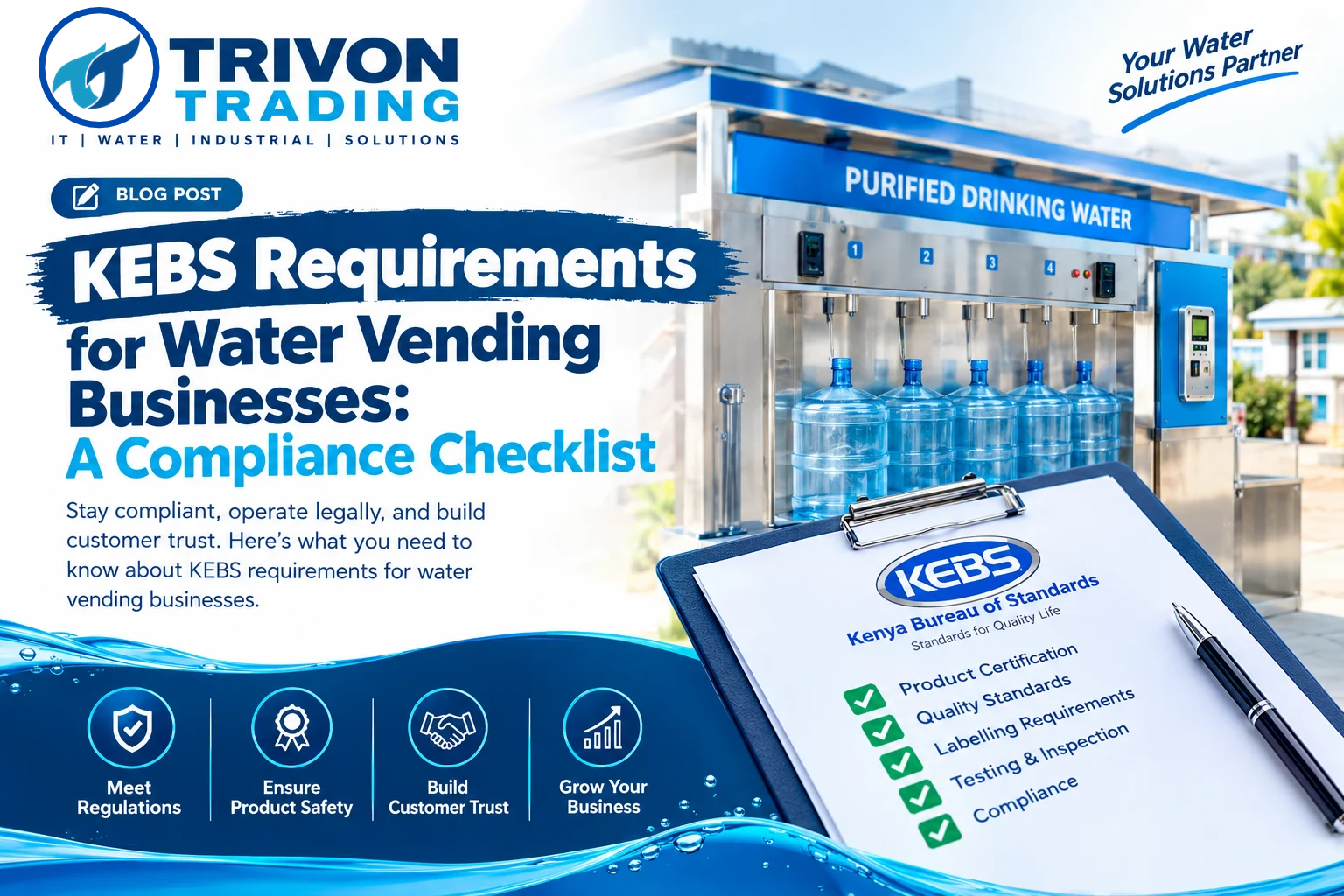
KEBS Requirements for Water Vending Businesses: A Compliance Checklist

Introduction So you've decided to start a water vending business. You've probably already thought about equipment, location, and pricing — but there's one area that trips up more new entrepreneurs than any other: compliance. Many water vendors in Kenya operate for months, sometimes years, without realizing they're missing a required certification, permit, or standard — until an inspection, a customer complaint, or a competitor's report brings it to a halt. At that point, what could have been a simple checklist item becomes a costly, stressful problem. This guide breaks down the actual compliance requirements for running a water vending business in Kenya, presented as a practical checklist rather than a wall of regulatory text — so you know exactly what to do, in what order, and why each step matters. Why Compliance Matters Beyond Avoiding Fines Before the checklist itself, it's worth understanding why this matters practically, not just legally: Customer trust — Certified, compliant water businesses attract and retain customers more easily, especially institutional buyers like schools, hotels, and offices who often ask for certification before purchasing Business continuity — Non-compliant businesses risk closure, confiscation of equipment, or fines that can far exceed the cost of doing things right from the start Access to bigger contracts — Many bulk buyers, government tenders, and corporate clients require proof of KEBS certification before they'll even consider a supplier Product liability protection — Following required standards protects you if a customer ever raises a health concern about your water With that context, here's the checklist. The Water Vending Business Compliance Checklist ✅ Step 1: Business Registration Before anything else, your business needs to be formally registered — as a sole proprietorship, partnership, or limited company — with the Business Registration Service (BRS). This is the foundation every other certification and permit builds on, since most regulatory bodies will ask for your business registration certificate. ✅ Step 2: Water Source Assessment Whether you're sourcing from a borehole, municipal connection, or other source, your water source needs to be assessed for suitability. If using a borehole, this typically involves: A hydrogeological survey (for new boreholes) Water quality testing of the raw source before treatment Confirmation the source is appropriately licensed with the relevant water authority (Water Resources Authority – WRA) ✅ Step 3: KEBS Product Certification (Permit to Use the Diamond Mark or SDA) This is the step most new vendors underestimate. KEBS requires bottled/vended water businesses to obtain product certification confirming your final water product meets the relevant Kenya Standard (KS) for drinking water quality. Depending on your business model, this may involve: Submitting water samples for laboratory testing against KEBS drinking water standards Factory/premises inspection by KEBS officers to confirm your treatment process, equipment, and hygiene standards meet requirements Obtaining a Standardization Mark (Diamond Mark) or Statement of Diamond Mark Application (SDA) — the SDA can allow you to sell while your full certification is being processed This step should not be treated as optional or something to "get around to later" — it's the core certification that legitimizes your water product for sale. ✅ Step 4: Water Quality Testing (Ongoing, Not Just Once) KEBS certification isn't a one-time event. Compliant water vendors need to conduct regular water quality testing to confirm their product continues to meet standards over time — equipment can degrade, filters need replacing, and source water quality can change. Maintaining test records also protects you if your certification is ever questioned or audited. ✅ Step 5: Public Health / County Government Licensing Alongside KEBS certification, most counties require a public health license for any business selling food or drinking water to the public. This typically involves: An inspection by public health officers of your premises and equipment Confirmation of proper hygiene practices, waste disposal, and staff health certificates where applicable Payment of the relevant county licensing fee (varies by county) ✅ Step 6: Equipment Standards Compliance Your treatment equipment itself matters for compliance, not just your final water product. This includes: Using food-grade materials (stainless steel 304/316, food-grade plastics) throughout your system — anything in contact with the water should meet food-safety material standards Proper installation of filtration stages (sediment, carbon, RO/UF membrane, UV disinfection where applicable) Documentation from your equipment supplier confirming materials and construction standards, which you may be asked to produce during inspection ✅ Step 7: Packaging and Labeling Compliance (If Bottling) If you're bottling and selling packaged water rather than only vending refills, additional requirements typically apply: Labels must include required information: product name, net volume, manufacturer/vendor details, batch/production date, and the KEBS mark once certified Packaging materials themselves must meet food-grade safety standards Bottle sourcing and sealing processes should prevent contamination between filling and sale ✅ Step 8: Weights and Measures Compliance If you're selling water by volume — whether per litre, per jerry can, or per bottle — your dispensing equipment (meters, scales, or vending mechanisms) may be subject to inspection by the Weights and Measures department to confirm customers are receiving accurate quantities for what they pay. ✅ Step 9: Business Permit (County Single Business Permit) Beyond public health licensing, your county will typically require a general single business permit, renewed annually, covering your right to operate the business within that jurisdiction. ✅ Step 10: Ongoing Record-Keeping Maintain organized records of: Water quality test results and dates Equipment maintenance and filter replacement schedules Certification renewal dates Any correspondence with KEBS or public health officers These records aren't just good practice — they're often the first thing requested during any inspection or audit, and having them organized can be the difference between a smooth inspection and a shutdown notice. Common Compliance Mistakes to Avoid Starting to sell before certification is complete — the SDA exists precisely to bridge this gap legally; operating without any documentation at all is a common and risky shortcut Assuming a one-time test is enough — water quality can change over time, especially as filters age Overlooking county-level requirements while focusing only on KEBS — both levels of compliance are typically required, not one or the other Using non-food-grade components in the treatment system to cut costs, which can fail inspection even if the final water tests well Letting certifications lapse — renewal dates matter, and letting a certification expire puts you back in "non-compliant" status even after previously passing How Long Does the Full Process Typically Take? Timelines vary based on county, your existing documentation, and how quickly water samples clear testing, but new vendors should generally expect the combined process of business registration, KEBS certification, and public health licensing to take several weeks to a few months from a standing start — which is worth factoring into your business launch timeline rather than assuming you can begin selling immediately after equipment installation. Building Compliance Into Your Setup From Day One The businesses that navigate this most smoothly are the ones that plan for compliance from the equipment-buying stage, not after. Choosing food-grade equipment, working with a supplier who understands KEBS requirements, and budgeting time for certification alongside your equipment purchase saves significant stress later. At Trivon Trading, we supply water treatment equipment built with food-grade materials and design standards aligned with KEBS requirements, and we work with clients to understand what documentation and specifications they'll need going into the certification process. While we're not a substitute for KEBS or your county's public health department, getting the equipment side right from the start makes the rest of the compliance journey considerably smoother. Trivon Trading Company Limited 📞 Call/WhatsApp: 0790145145 | 0713644544 📧 info@trivontrading.co.ke | trivontrading@gmail.com 🌐 www.trivontrading.co.ke Trivon Trading Co. Ltd – Delivering Reliable Water & Dairy Solutions You Can Trust

Introduction

So you’ve decided to start a water vending business. You’ve probably already thought about equipment, location, and pricing — but there’s one area that trips up more new entrepreneurs than any other: compliance.

Many water vendors in Kenya operate for months, sometimes years, without realizing they’re missing a required certification, permit, or standard — until an inspection, a customer complaint, or a competitor’s report brings it to a halt. At that point, what could have been a simple checklist item becomes a costly, stressful problem.

This guide breaks down the actual compliance requirements for running a water vending business in Kenya, presented as a practical checklist rather than a wall of regulatory text — so you know exactly what to do, in what order, and why each step matters.

Why Compliance Matters Beyond Avoiding Fines

Before the checklist itself, it’s worth understanding why this matters practically, not just legally:

  • Customer trust — Certified, compliant water businesses attract and retain customers more easily, especially institutional buyers like schools, hotels, and offices who often ask for certification before purchasing
  • Business continuity — Non-compliant businesses risk closure, confiscation of equipment, or fines that can far exceed the cost of doing things right from the start
  • Access to bigger contracts — Many bulk buyers, government tenders, and corporate clients require proof of KEBS certification before they’ll even consider a supplier
  • Product liability protection — Following required standards protects you if a customer ever raises a health concern about your water

With that context, here’s the checklist.

The Water Vending Business Compliance Checklist

✅ Step 1: Business Registration

Before anything else, your business needs to be formally registered — as a sole proprietorship, partnership, or limited company — with the Business Registration Service (BRS). This is the foundation every other certification and permit builds on, since most regulatory bodies will ask for your business registration certificate.

✅ Step 2: Water Source Assessment

Whether you’re sourcing from a borehole, municipal connection, or other source, your water source needs to be assessed for suitability. If using a borehole, this typically involves:

  • A hydrogeological survey (for new boreholes)
  • Water quality testing of the raw source before treatment
  • Confirmation the source is appropriately licensed with the relevant water authority (Water Resources Authority – WRA)

✅ Step 3: KEBS Product Certification (Permit to Use the Diamond Mark or SDA)

This is the step most new vendors underestimate. KEBS requires bottled/vended water businesses to obtain product certification confirming your final water product meets the relevant Kenya Standard (KS) for drinking water quality. Depending on your business model, this may involve:

  • Submitting water samples for laboratory testing against KEBS drinking water standards
  • Factory/premises inspection by KEBS officers to confirm your treatment process, equipment, and hygiene standards meet requirements
  • Obtaining a Standardization Mark (Diamond Mark) or Statement of Diamond Mark Application (SDA) — the SDA can allow you to sell while your full certification is being processed

This step should not be treated as optional or something to “get around to later” — it’s the core certification that legitimizes your water product for sale.

✅ Step 4: Water Quality Testing (Ongoing, Not Just Once)

KEBS certification isn’t a one-time event. Compliant water vendors need to conduct regular water quality testing to confirm their product continues to meet standards over time — equipment can degrade, filters need replacing, and source water quality can change. Maintaining test records also protects you if your certification is ever questioned or audited.

✅ Step 5: Public Health / County Government Licensing

Alongside KEBS certification, most counties require a public health license for any business selling food or drinking water to the public. This typically involves:

  • An inspection by public health officers of your premises and equipment
  • Confirmation of proper hygiene practices, waste disposal, and staff health certificates where applicable
  • Payment of the relevant county licensing fee (varies by county)

✅ Step 6: Equipment Standards Compliance

Your treatment equipment itself matters for compliance, not just your final water product. This includes:

  • Using food-grade materials (stainless steel 304/316, food-grade plastics) throughout your system — anything in contact with the water should meet food-safety material standards
  • Proper installation of filtration stages (sediment, carbon, RO/UF membrane, UV disinfection where applicable)
  • Documentation from your equipment supplier confirming materials and construction standards, which you may be asked to produce during inspection

✅ Step 7: Packaging and Labeling Compliance (If Bottling)

If you’re bottling and selling packaged water rather than only vending refills, additional requirements typically apply:

  • Labels must include required information: product name, net volume, manufacturer/vendor details, batch/production date, and the KEBS mark once certified
  • Packaging materials themselves must meet food-grade safety standards
  • Bottle sourcing and sealing processes should prevent contamination between filling and sale

✅ Step 8: Weights and Measures Compliance

If you’re selling water by volume — whether per litre, per jerry can, or per bottle — your dispensing equipment (meters, scales, or vending mechanisms) may be subject to inspection by the Weights and Measures department to confirm customers are receiving accurate quantities for what they pay.

✅ Step 9: Business Permit (County Single Business Permit)

Beyond public health licensing, your county will typically require a general single business permit, renewed annually, covering your right to operate the business within that jurisdiction.

✅ Step 10: Ongoing Record-Keeping

Maintain organized records of:

  • Water quality test results and dates
  • Equipment maintenance and filter replacement schedules
  • Certification renewal dates
  • Any correspondence with KEBS or public health officers

These records aren’t just good practice — they’re often the first thing requested during any inspection or audit, and having them organized can be the difference between a smooth inspection and a shutdown notice.

Common Compliance Mistakes to Avoid

  • Starting to sell before certification is complete — the SDA exists precisely to bridge this gap legally; operating without any documentation at all is a common and risky shortcut
  • Assuming a one-time test is enough — water quality can change over time, especially as filters age
  • Overlooking county-level requirements while focusing only on KEBS — both levels of compliance are typically required, not one or the other
  • Using non-food-grade components in the treatment system to cut costs, which can fail inspection even if the final water tests well
  • Letting certifications lapse — renewal dates matter, and letting a certification expire puts you back in “non-compliant” status even after previously passing

How Long Does the Full Process Typically Take?

Timelines vary based on county, your existing documentation, and how quickly water samples clear testing, but new vendors should generally expect the combined process of business registration, KEBS certification, and public health licensing to take several weeks to a few months from a standing start — which is worth factoring into your business launch timeline rather than assuming you can begin selling immediately after equipment installation.

Building Compliance Into Your Setup From Day One

The businesses that navigate this most smoothly are the ones that plan for compliance from the equipment-buying stage, not after. Choosing food-grade equipment, working with a supplier who understands KEBS requirements, and budgeting time for certification alongside your equipment purchase saves significant stress later.

At Trivon Trading, we supply water treatment equipment built with food-grade materials and design standards aligned with KEBS requirements, and we work with clients to understand what documentation and specifications they’ll need going into the certification process. While we’re not a substitute for KEBS or your county’s public health department, getting the equipment side right from the start makes the rest of the compliance journey considerably smoother.

Trivon Trading Company Limited 📞 Call/WhatsApp: 0790145145 | 0713644544 📧 info@trivontrading.co.ke | trivontrading@gmail.com 🌐 www.trivontrading.co.ke

Trivon Trading Co. Ltd – Delivering Reliable Water & Dairy Solutions You Can Trust