

Introduction
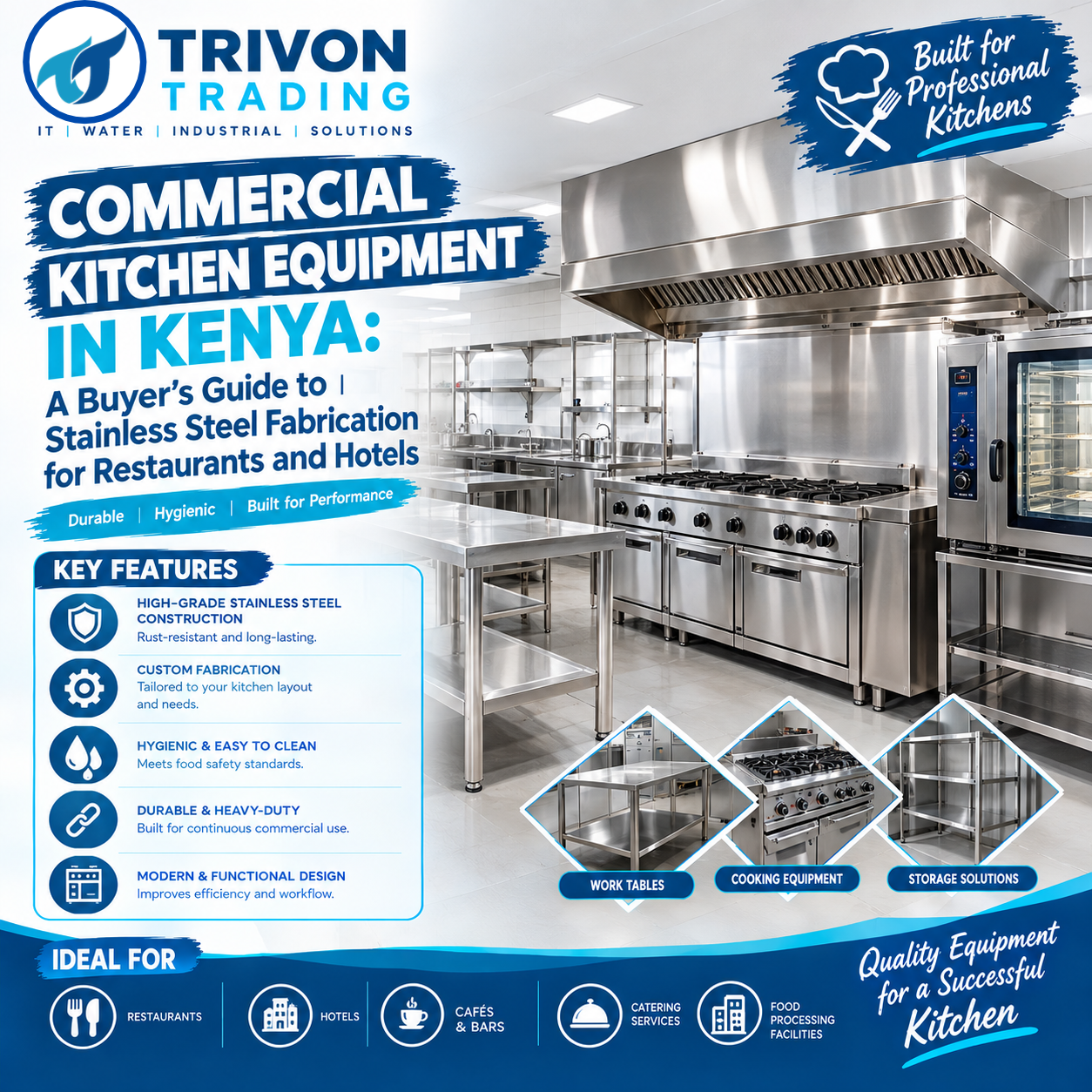
Whether you’re opening a new restaurant, upgrading a hotel kitchen, fitting out a school cafeteria, or setting up a bakery production line, one decision affects almost everything else about how your kitchen performs: what your equipment is made of.
Wooden tables crack and harbor bacteria. Plastic surfaces stain, scratch, and melt under heat. Both routinely fail health inspections and need replacing every year or two. Stainless steel, on the other hand, is the standard the commercial food industry has settled on worldwide — and for good reason.
This guide walks through what commercial kitchen buyers in Kenya actually need to know before investing in stainless steel fabrication: what to look for, what it costs relative to alternatives, and how to plan a setup that fits your specific operation, whether that’s a small café or a full hotel kitchen.
Why Stainless Steel Is the Standard for Commercial Kitchens
Health authorities, hotel chains, and experienced restaurateurs converge on stainless steel for a simple reason: it solves the core problems that other materials create.
- Non-porous surface – Bacteria and food residue can’t embed into the material the way they do in wood grain or scratched plastic
- Easy to sanitize – Wipes clean with standard kitchen cleaning agents, no special treatment needed
- Heat and chemical resistant – Withstands hot pots, cleaning chemicals, and daily wear without degrading
- Long lifespan – A well-fabricated stainless steel table or sink can last 20+ years with basic care
- Professional appearance – Signals quality and hygiene to both health inspectors and customers who see into open kitchens
For any business required to pass health inspections — which is every licensed food business in Kenya — stainless steel isn’t really optional at the core prep and washing stations. It’s the baseline.
Understanding Stainless Steel Grades: 304 vs 316
Not all stainless steel is the same, and this matters when you’re being quoted equipment.
- Grade 304 – The standard food-grade stainless steel used in the vast majority of commercial kitchen equipment: work tables, sinks, shelving, and general food contact surfaces. Excellent corrosion resistance and durability for typical kitchen use.
- Grade 316 – A higher-grade steel with added molybdenum, offering superior corrosion resistance. Typically reserved for more demanding environments (coastal locations, high-salt food processing, or specialized equipment) where 304 might not be sufficient long-term.
For most restaurant, hotel, and bakery kitchens, 304 stainless steel is the appropriate and cost-effective standard. If your kitchen is in a coastal or high-humidity environment, it’s worth discussing with your fabricator whether 316 makes sense for specific components.
Core Equipment Every Commercial Kitchen Needs
Work and Preparation Tables
The backbone of any kitchen. These come in several configurations:
- Single-tier tables – Simple work surface, maximum legroom underneath
- Double-tier tables – Work surface plus an under-shelf for additional storage
- Tables with overhead shelving – Maximizes vertical storage in tight kitchens
- Mobile tables – Fitted with lockable castors for flexible workspace arrangement
- Wall-mounted tables – Space-saving option for very small kitchens
Standard sizes typically range from 120cm to 200cm+ in length, though custom dimensions are common since kitchen layouts rarely match off-the-shelf sizing exactly.
Sinks
Sink configuration depends heavily on your health department requirements and kitchen volume:
- Single bowl sinks – Suited to smaller operations or specific single-purpose washing
- Double bowl sinks – The most common configuration, allowing separate washing and rinsing
- Triple bowl sinks – Required for higher-volume operations needing a full wash-rinse-sanitize sequence
- Hand wash basins – Often required separately from food/utensil washing sinks for compliance
Storage Shelving
Wall-mounted or free-standing shelving keeps ingredients and equipment organized and off the floor — itself often a health inspection requirement. Adjustable-height shelving in stainless steel resists rust in humid kitchen environments where painted or wooden shelving would deteriorate quickly.
Specialized Fabrication
Beyond the basics, commercial kitchens often need custom-fabricated items such as exhaust hood frameworks, equipment stands, splash guards, and cutouts for sinks or built-in equipment — all of which benefit from being fabricated to the exact dimensions of your kitchen rather than adapted from generic products.
Cost Considerations: Why Cheaper Isn’t Actually Cheaper
It’s tempting to compare upfront prices between wooden, plastic, and stainless steel equipment and choose the lowest number. But this comparison misses the full picture.
Over a 10-year period, wooden or plastic tables typically need replacing every 1–3 years due to cracking, staining, or failing inspection — meaning the cumulative cost over a decade often exceeds a single, well-fabricated stainless steel purchase that simply keeps performing.
When you factor in:
- Replacement costs over time
- Labor and downtime for replacing failed equipment
- Risk of failed inspections and associated penalties
- The professional image stainless steel projects to customers and inspectors
…stainless steel is very often the lower total-cost option, not the more expensive one — despite the higher initial price tag.
Planning Your Kitchen Layout Before You Order
A common mistake is ordering equipment piece by piece without first mapping the actual kitchen workflow. Before placing an order, it helps to think through:
- Workflow sequence – How does food move from delivery, to storage, to prep, to cooking, to service? Equipment should support that flow, not fight it.
- Available space – Exact measurements matter; custom fabrication only helps if your measurements are accurate.
- Growth plans – If you expect to expand seating or production volume, it’s worth discussing scalable or modular equipment options upfront.
- Health department requirements – Some jurisdictions and business types have specific sink count or configuration requirements — confirm these before finalizing your order.
A brief consultation with your fabricator before ordering can often catch layout issues that would be expensive to fix after installation.
Custom Fabrication vs. Off-the-Shelf Equipment
Many commercial kitchens in Kenya operate in spaces that weren’t originally designed as kitchens — converted rooms, repurposed retail spaces, or older buildings with non-standard dimensions. In these cases, custom fabrication offers real advantages over imported, off-the-shelf equipment:
- Exact fit for irregular spaces or specific equipment integration
- Faster turnaround than importing, in many cases
- Local support and spare parts without international shipping delays
- Ability to adjust designs during the process based on real site conditions
Who Needs This Equipment?
Stainless steel commercial kitchen fabrication serves a wide range of businesses:
- Restaurants – From small eateries to full-service dining rooms
- Hotels – Kitchen setups scaled to guest volume and multiple service points
- Schools and institutions – Large-volume prep and serving equipment for cafeterias
- Bakeries and pastry shops – Specialized prep surfaces suited to dough handling and packaging
- Catering companies – Both permanent kitchen setups and mobile/transportable equipment
- Butcheries and delis – Cutting and packaging surfaces meeting food safety standards
What to Look for in a Fabricator
Before committing to a supplier, it’s worth confirming:
- Material certification – Confirm actual food-grade 304 (or 316 where relevant) stainless steel is being used, not a lower-grade substitute
- Welding quality – Professional TIG welding produces stronger, cleaner joints than lower-quality welding methods
- Finish options – Polished vs. satin finish, and whether edges are properly rounded for safety and hygiene
- Installation service – Whether delivery includes professional installation and leveling, or just drop-off
- Turnaround time – Realistic timelines for both standard and custom orders
- After-sales support – Availability of repairs, adjustments, or additional pieces later as your kitchen evolves
Getting Your Kitchen Set Up Right
Whether you’re opening a small café or fitting out a full hotel kitchen, the right stainless steel equipment — properly planned, correctly sized, and professionally fabricated — is one of the most consequential decisions in setting up a commercial food operation. It affects your health compliance, staff efficiency, and how long you go before needing to replace anything.
At Trivon Trading, we design and fabricate stainless steel kitchen equipment for restaurants, hotels, schools, and bakeries across Kenya — from individual work tables and sinks to complete kitchen setups. We work with you on measurements, layout, and specifications to make sure what we build actually fits how your kitchen operates.
Trivon Trading Company Limited 📞 Call/WhatsApp: 0790145145 | 0713644544 📧 info@trivontrading.co.ke | trivontrading@gmail.com 🌐 www.trivontrading.co.ke
Trivon Trading Co. Ltd – Delivering Reliable Water & Dairy Solutions You Can Trust