

In an era where clean water is vital for health, agriculture, and business, choosing the right water purification process is critical. Two popular membrane-based technologies are Ultrafiltration (UF) and Reverse Osmosis (RO). Knowing their differences, advantages, and limitations helps you make an informed choice—whether you’re building a water vending station, supplying safe drinking water to your home, or running a full-scale purification plant.
1. What is Ultrafiltration (UF)?
Ultrafiltration is a membrane filtration technique used in water treatment that removes suspended solids, bacteria, viruses, and colloids from water. UF filters use semi-permeable membranes with pore sizes typically between 0.01 to 0.1 microns. This means particles larger than that size are retained; smaller molecules (including many dissolved salts, minerals) pass through.
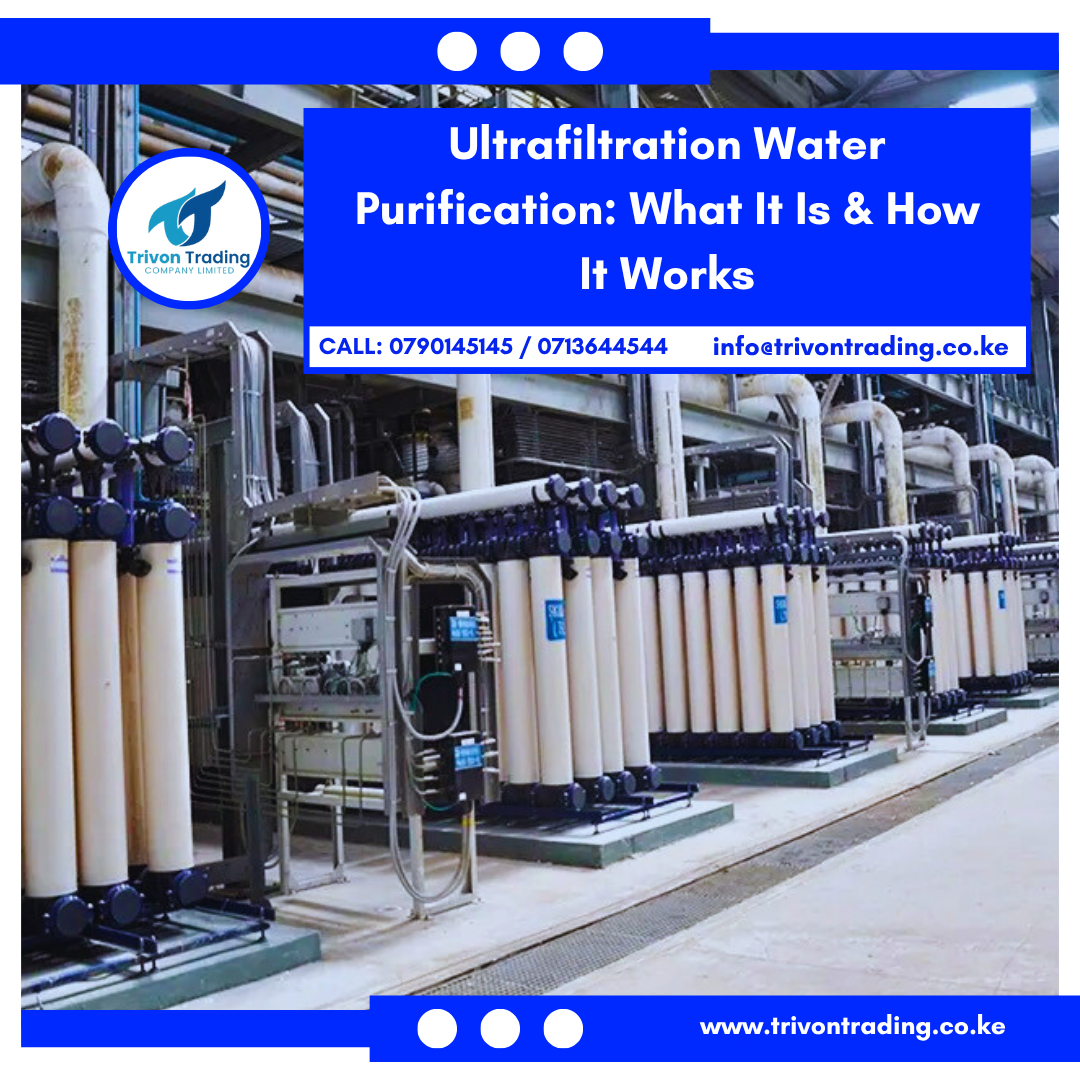
UF membranes are often hollow fiber, although other configurations (flat sheet, tubular) also exist. The process is pressure-driven but demands much lower pressure compared to RO—often only what a modest pump can supply.
2. How Ultrafiltration Works: The Stages
A typical UF system operates through several stages:
-
Pre-filtration / Sediment Filtering: Removes large particles (sand, clay, rust). Helps prolong membrane life.
-
UF Membrane Stage: Water is forced through the membrane. Contaminants like bacteria, suspended solids, some viruses are blocked. Clean water passes.
-
Optional Post-Treatment (UV / Carbon Polishing): To improve taste, remove odor, disinfect means that UV or activated carbon filters may be added.
-
Clean / Backwash Cycles: Over time, membranes accumulate “fouling” (debris, biofilm). Backwashing or periodic chemical cleaning restores performance.
Because UF removes pathogens and solids but retains minerals (e.g., calcium, magnesium), water retains a more natural taste—often preferred in many domestic or light commercial applications.
3. What Ultrafiltration Removes vs What It Doesn’t
Removes:
-
Suspended solids, turbidity (cloudiness).
-
Bacteria & many protozoa.
-
Some viruses (depending on size).
-
Colloids & larger organic matter.
Does not remove (or only partially remove):
-
Dissolved salts and heavy metals (e.g. sodium, chloride, lead).
-
Fluoride (in many cases)Very fine organic molecules or small compounds & ions.
Ultrafiltration vs Reverse Osmosis (RO): Key Differences

| Feature | Ultrafiltration (UF) | Reverse Osmosis (RO) |
|---|---|---|
| Membrane Pore Size | ~0.01-0.1 µm | ~0.0001 µm |
| What It Removes | Suspended solids, bacteria, some viruses; retains minerals | Removes almost all dissolved salts, heavy metals, nearly all pathogens; does not leave most minerals behind without remixing |
| Operating Pressure / Energy | Low pressure, low energy consumption | High pressure; higher energy & cost |
| Water Recovery (Waste) | High recovery; minimal or no wastewater | Lower recovery; produces brine or wastewater depending on system design |
| Mineral Retention | Yes; minerals are preserved in the purified water | Mostly removed; may require remineralization for taste & health |
| Cost / Maintenance | Lower upfront cost, simpler maintenance; faster membrane fouling possible if pre-filtering is poor | Higher cost; sensitive to water hardness & scaling; more complex pretreatment required |
| Typical Use Cases | Municipal tap water, spring water, water vending where TDS acceptable, prefiltration for RO plants | Brackish water, borehole high TDS, seawater, industries needing ultra-pure water |
Practical Applications & When to Use UF vs RO
Here are some use-case scenarios to help you decide which technology suits your situation:
-
Municipal / Council Water: If the local supply is mostly clean but has turbidity, bacteria, or sediment, UF is often sufficient.
-
Water Vending with Moderate Quality Source: Use UF if users are okay with natural mineral content; RO if safety standards require lower TDS or to remove chemical contaminants.
-
Borehole / Hard Water: When water from boreholes has high TDS, minerals, or salinity, RO may be necessary. UF may serve as pretreatment.
-
Seawater or Brackish Water: RO (special membranes) is typically the only option. UF won’t remove salts.
-
Budget & Running Cost Constraints: UF systems are cheaper to run, consume less power, have fewer consumables, and simpler maintenance.
Benefits of Ultrafiltration
-
Cleaner water from microbes & particles without stripping out minerals.
-
Lower energy usage — smaller pumps, less pressure.
-
Less wastewater compared to RO systems.
-
Simpler design, easier maintenance — membrane modules, backwashing, cleaning.
-
Better taste retention because minerals are preserved.
-
Quicker start-up and lower cost for smaller businesses.
How UF Systems Are Built – Components & Key Factors
To understand UF deeply, it’s necessary to look at system components and what influences performance:
-
Membrane Modules – hollow fiber, flat sheet, or tubular. Hollow fiber is commonly used in small commercial/domestic systems.
-
Pre-Filters – sediment and carbon filters to prevent fouling (particles, chlorine, organic matter).
-
Feed Pump – relatively low pressure, but must supply consistent flow.
-
Cleaning Mechanisms – backwash, chemical cleaning (with mild agents), sediment flush.
-
Housing & Material – stainless steel, FRP, or plastic depending on budget and hygiene requirements.
-
Optional Add-Ons – UV lamp (for disinfection of viruses or resistant organisms), Taste / Odor improvement, mineral balancing if needed.
Limitations of UF and When It’s Not Enough
While UF has many advantages, there are times when UF alone is not sufficient:
-
Does not remove dissolved salts or high TDS.
-
Doesn’t remove certain chemical contaminants (e.g., fluoride, arsenic at low concentration, some heavy metals).
-
Membrane fouling if pre-filtration is inadequate.
-
Less effective in very turbid or polluted water without good pretreatment.
-
UV / RO might be needed in combination for full disinfection and chemical removal.
Case Study Scenarios & Recommendation by Trivon Trading
Here’s how Trivon Trading Company Limited uses this knowledge in real settings:
-
Scenario A: A school near town with good municipal water but periodic turbidity — solution: UF system + carbon polishing. Fast setup, low cost, retains minerals.
-
Scenario B: A water vending shop using borehole water with elevated TDS and occasional hardness — solution: UF pretreatment + RO membrane to reduce TDS and hardness.
-
Scenario C: Coastal resort needing desalination — UF not usable for salt removal, so RO desalination required.
-
Scenario D: Estate owner wanting water for gardening & drinking — UF might suffice for drinking; cheaper to maintain.
Trivon helps clients do water testing first (measuring TDS, hardness, bacteria, chemicals) to recommend the right combo.
Choosing UF or RO: Questions to Ask Before Investing
To make the right choice, answer:
-
What is the incoming water quality? (TDS, hardness, bacteria, turbidity)
-
What is the target water quality? (for drinking, bottling, industrial use)
-
What budget do you have for initial setup and running cost?
-
How important is mineral retention for health and taste?
-
Is energy availability / cost an issue?
-
Is there need for wastewater / brine disposal concerns?
Answering these helps decide whether UF, RO, or a hybrid system is best.
Why Choose Trivon Trading for UF & RO Systems
At Trivon Trading Company Limited, we specialize in:
-
Full water quality testing before designing systems.
-
Supplying UF machines, RO systems, combined UF-RO units, and standing steel-skid systems.
-
Helping small businesses build vending shops.
-
Providing after-sales maintenance and filter / membrane replacement.
-
Customizing systems (capacity, features) to match budgets and space.
We believe the right technology, well maintained, gives best results — clean water, sustained uptime, and good cost efficiency.
Contact Us
If you’re considering Ultrafiltration Water Purification or want to compare UF vs RO for your water source:
📍 Trivon Trading Company Limited — along Thika Super Highway, Ruiru Kimbo (Opposite NIBS College)
📞 Call / WhatsApp: 0790 145 145 | 0713 644 544
📧 Emails: info@trivontrading.co.ke / trivontrading@gmail.com / trivonsales@gmail.com
🌐 Visit us: www.trivontrading.co.ke
Let us carry out a physical water test for your source, then recommend the ideal purification setup so you get clean water with good value and long-term sustainability.


