

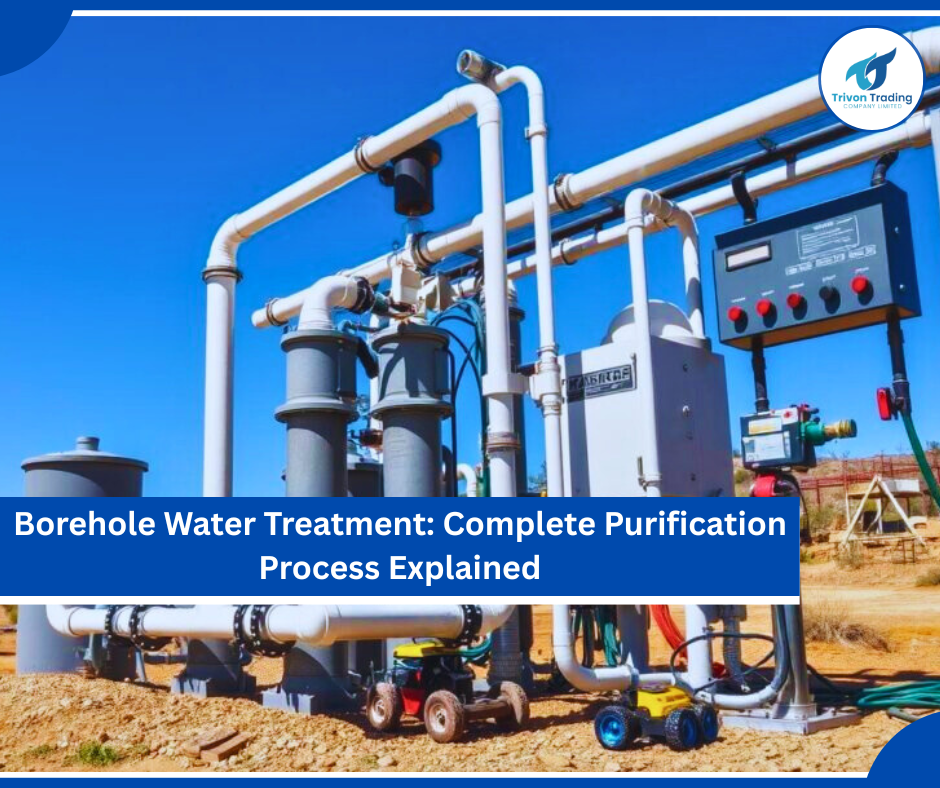
Access to clean and safe water is a growing concern for homes, businesses, farms, and institutions across Kenya and East Africa. While borehole water is often seen as a reliable alternative to municipal supply, raw borehole water is rarely safe for direct consumption without proper treatment.
This guide explains, step by step, the complete borehole water purification process, the equipment involved, common water quality challenges, and how to design a system that meets both health standards and business needs.
Whether you are setting up a water vending business, factory, hotel, school, or domestic supply, this article will help you understand exactly what happens between raw borehole water and clean, drinkable water.
Understanding Borehole Water Quality
Borehole water originates from underground aquifers, passing through layers of soil, rock, and minerals. While this natural filtration removes some contaminants, it also introduces others.
Common Borehole Water Problems
-
High Total Dissolved Solids (TDS)
Minerals such as calcium, magnesium, sodium, and chlorides dissolve into the water. -
Salinity / Brackish Water
Common in coastal and semi-arid regions. -
Iron and Manganese
Causes brown stains, metallic taste, and clogged pipes. -
Hardness
Leads to scale buildup in tanks, pipes, and machines. -
Bacteria and Microorganisms
Including E. coli, coliforms, and other pathogens. -
Turbidity & Suspended Solids
Sand, silt, and clay particles. -
Unpleasant Taste, Odor, or Color
Because each borehole is different, water treatment must always start with a water analysis.
Step 1: Water Analysis – The Foundation of Proper Treatment
Before selecting any machine or equipment, a laboratory water test is mandatory.
Key Parameters Tested
-
pH level
-
TDS (Total Dissolved Solids)
-
Electrical Conductivity (EC)
-
Iron & Manganese
-
Hardness (Calcium & Magnesium)
-
Turbidity
-
Chlorides
-
Fluoride
-
Nitrates
-
Microbiological contamination
A professional supplier uses this analysis to design a treatment system tailored to your water, not a generic setup.
Step 2: Raw Water Storage & Aeration
Raw Water Storage Tanks
Borehole water is first pumped into a raw water storage tank, usually made of:
-
Food-grade plastic (HDPE)
-
Mild steel (lined)
-
Stainless steel (industrial setups)
This tank ensures:
-
Constant supply
-
Stable pressure
-
Controlled flow into treatment units
Aeration (Optional but Important)
For boreholes with high iron or manganese, aeration helps oxidize dissolved metals, making them easier to filter out in later stages.
Step 3: Multimedia / Sand Filtration
Purpose
Removes:
-
Sand
-
Silt
-
Mud
-
Suspended particles
-
Turbidity
How It Works
Water passes through layers of:
-
Gravel
-
Quartz sand
-
Anthracite (in some systems)
This step protects downstream equipment like RO membranes, reducing maintenance costs and extending lifespan.
Step 4: Iron Removal Filter (If Required)
For borehole water with high iron or manganese, a dedicated iron removal filter is installed.
Benefits
-
Removes brown staining
-
Eliminates metallic taste
-
Prevents clogging of pipes and membranes
This stage is critical in many Kenyan boreholes.
Step 5: Activated Carbon Filtration
Purpose
-
Removes odors and bad taste
-
Reduces organic compounds
-
Removes chlorine (if pre-chlorination was done)
-
Improves overall water clarity
Activated carbon also protects RO membranes from chemical damage.
Step 6: Water Softening (Optional but Recommended)
Hard water causes:
-
Scaling in pipes and tanks
-
Reduced RO efficiency
-
Higher electricity consumption
Water Softener Role
-
Removes calcium and magnesium
-
Uses ion-exchange resin
-
Prevents long-term system damage
For industrial and commercial setups, softening is highly recommended.
Step 7: Cartridge / Micron Filtration
Before water reaches advanced purification stages, it passes through micron filters, typically:
-
20 micron
-
10 micron
-
5 micron
-
1 micron
These filters trap fine particles and ensure crystal-clear water enters the RO or UF system.
Step 8: Reverse Osmosis (RO) – The Core Purification Stage
What Is Reverse Osmosis?
Reverse Osmosis is a high-pressure filtration process that removes up to 99% of dissolved salts, chemicals, and contaminants.
What RO Removes
-
Salts & minerals (TDS reduction)
-
Fluoride
-
Nitrates
-
Heavy metals
-
Bacteria & viruses
-
Chemical contaminants
Key RO Components
-
High-pressure pump
-
RO membranes (standard or stainless steel fibre membranes)
-
Pressure vessels
-
Control panel
-
Flow meters & pressure gauges
Stainless Steel RO Systems
For food, dairy, and water vending applications, stainless steel RO machines offer:
-
Superior hygiene
-
Corrosion resistance
-
Long lifespan
-
Professional appearance
Step 9: Ultra Filtration (UF) – Alternative or Supplement
Ultra Filtration systems are often used:
-
As a standalone solution for low-TDS boreholes
-
As a pre-treatment for RO
-
In applications where mineral retention is required
UF removes:
-
Bacteria
-
Viruses
-
Suspended solids
But does not remove dissolved salts, unlike RO.
Step 10: UV Sterilization & Ozonation
UV Sterilizer
-
Destroys bacteria and viruses
-
No chemicals added
-
Instant disinfection
Ozone System (Optional)
-
Powerful oxidizer
-
Improves taste
-
Extends shelf life in bottled water
-
Used in water vending and bottling plants
Step 11: Treated Water Storage
After purification, water is stored in food-grade tanks, commonly:
-
Stainless steel storage tanks
-
UV-protected HDPE tanks
These tanks prevent re-contamination and maintain water quality.
Step 12: Filling, Packaging & Distribution
Depending on your business model:
-
Water vending filling stations (2–6 taps)
-
Automatic or semi-automatic bottling lines
-
Manual filling systems
-
Bottle rinsers and packing tables
This is where treated water becomes a revenue-generating product.
Borehole Water Treatment for Different Applications
1. Domestic Use
-
RO or UF system
-
Compact storage tanks
-
UV sterilization
2. Water Vending Business
-
High-capacity RO
-
Storage tanks (1,000L – 10,000L)
-
Filling stations
-
Bottle rinsers
3. Hotels & Restaurants
-
Stainless steel RO
-
Softeners
-
UV systems
4. Dairy & Food Processing
-
Stainless steel RO
-
Fibre membranes
-
Strict hygiene compliance
Importance of Professional System Design
Poorly designed systems lead to:
-
Frequent breakdowns
-
High operating costs
-
Poor water quality
-
Regulatory non-compliance
A professional supplier:
-
Reviews water analysis
-
Designs custom systems
-
Provides installation & support
-
Ensures scalability
Maintenance & Operating Costs
Routine Maintenance Includes:
-
Filter replacement
-
Membrane cleaning
-
Pump servicing
-
Water quality checks
Proper maintenance ensures:
-
Long equipment life
-
Consistent water quality
-
Reduced downtime
Regulatory Standards in Kenya
Treated water must meet:
-
KEBS drinking water standards
-
Public Health requirements
-
County licensing regulations
Professional systems help businesses remain compliant.
Final Thoughts
Borehole water treatment is not a one-size-fits-all process. Each borehole presents unique challenges that require a properly engineered purification system.
From raw water storage to advanced RO filtration and hygienic filling, understanding each stage helps you make informed decisions, protect your investment, and deliver safe water.
If you are planning a domestic setup, commercial water vending business, or industrial application, investing in the right treatment system is essential for long-term success.


